6XCU image
Deposition Date 2020-06-09
Release Date 2021-02-10
Last Version Date 2025-06-04
Entry Detail
PDB ID:
6XCU
Title:
NMR structure of Ost4V23D, a critical mutant of Ost4, in DPC micelles
Biological Source:
Host Organism:
Method Details:
Experimental Method:
Conformers Calculated:
100
Conformers Submitted:
20
Selection Criteria:
structures with the lowest energy
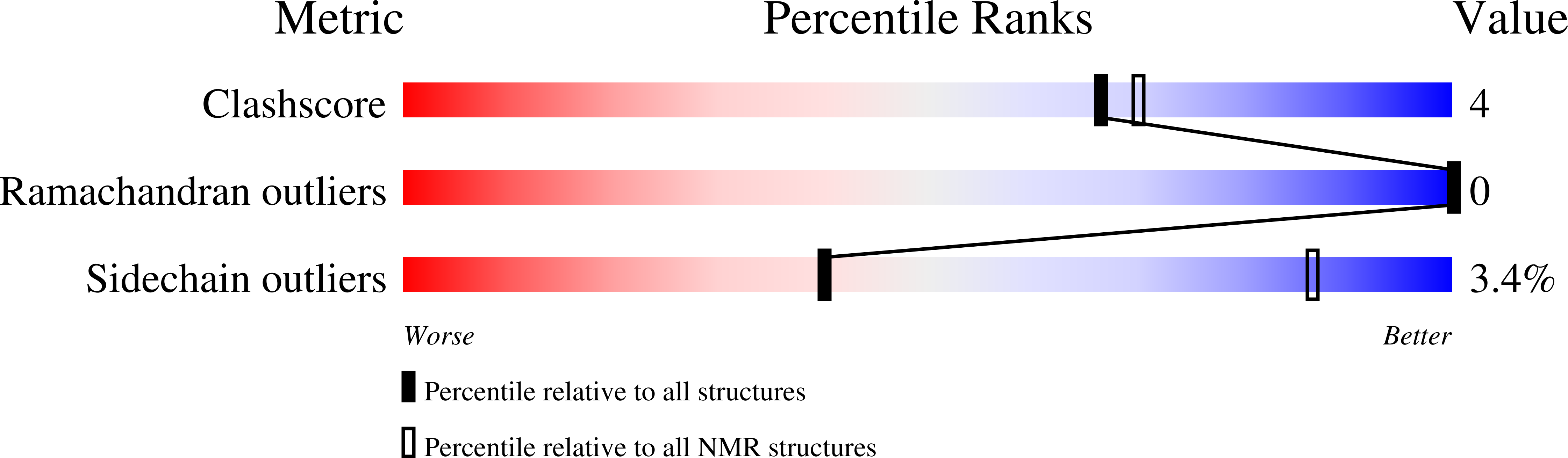
Macromolecular Entities
Structures with similar UniProt ID
Protein Blast
Polymer Type:polypeptide(L)
Molecule:Oligosaccharyltransferase
Mutagens:V23D
Chain IDs:A
Chain Length:45
Number of Molecules:1
Biological Source:Saccharomyces cerevisiae (strain YJM789)
Ligand Molecules
Primary Citation
NMR and MD simulations reveal the impact of the V23D mutation on the function of yeast oligosaccharyltransferase subunit Ost4.
Glycobiology 31 838 850 (2021)
PMID: 33442744 DOI: 10.1093/glycob/cwab002

Abstact

Asparagine-linked glycosylation, also known as N-linked glycosylation, is an essential and highly conserved co- and post-translational protein modification in eukaryotes and some prokaryotes. In the central step of this reaction, a carbohydrate moiety is transferred from a lipid-linked donor to the side-chain of a consensus asparagine in a nascent protein as it is synthesized at the ribosome. Complete loss of oligosaccharyltransferase (OST) function is lethal in eukaryotes. This reaction is carried out by a membrane-associated multisubunit enzyme, OST, localized in the endoplasmic reticulum. The smallest subunit, Ost4, contains a single membrane-spanning helix that is critical for maintaining the stability and activity of OST. Mutation of any residue from Met18 to Ile24 of Ost4 destabilizes the enzyme complex, affecting its activity. Here, we report solution nuclear magnetic resonance structures and molecular dynamics (MD) simulations of Ost4 and Ost4V23D in micelles. Our studies revealed that while the point mutation did not impact the structure of the protein, it affected its position and solvent exposure in the membrane mimetic environment. Furthermore, our MD simulations of the membrane-bound OST complex containing either WT or V23D mutant demonstrated disruption of most hydrophobic helix-helix interactions between Ost4V23D and transmembrane TM12 and TM13 of Stt3. This disengagement of Ost4V23D from the OST complex led to solvent exposure of the D23 residue in the hydrophobic pocket created by these interactions. Our study not only solves the structures of yeast Ost4 subunit and its mutant but also provides a basis for the destabilization of the OST complex and reduced OST activity.

Legend

Protein

Chemical

Disease

Primary Citation of related structures
Feedback Form
Name
Email
Institute
Feedback