6X8Z image
Deposition Date 2020-06-02
Release Date 2020-09-16
Last Version Date 2023-10-18
Entry Detail
PDB ID:
6X8Z
Keywords:
Title:
Crystal structure of N-truncated human B12 chaperone CblD(C262S)-thiolato-cob(III)alamin complex (108-296)
Biological Source:
Source Organism:
Homo sapiens (Taxon ID: 9606)
Host Organism:
Method Details:
Experimental Method:
Resolution:
2.50 Å
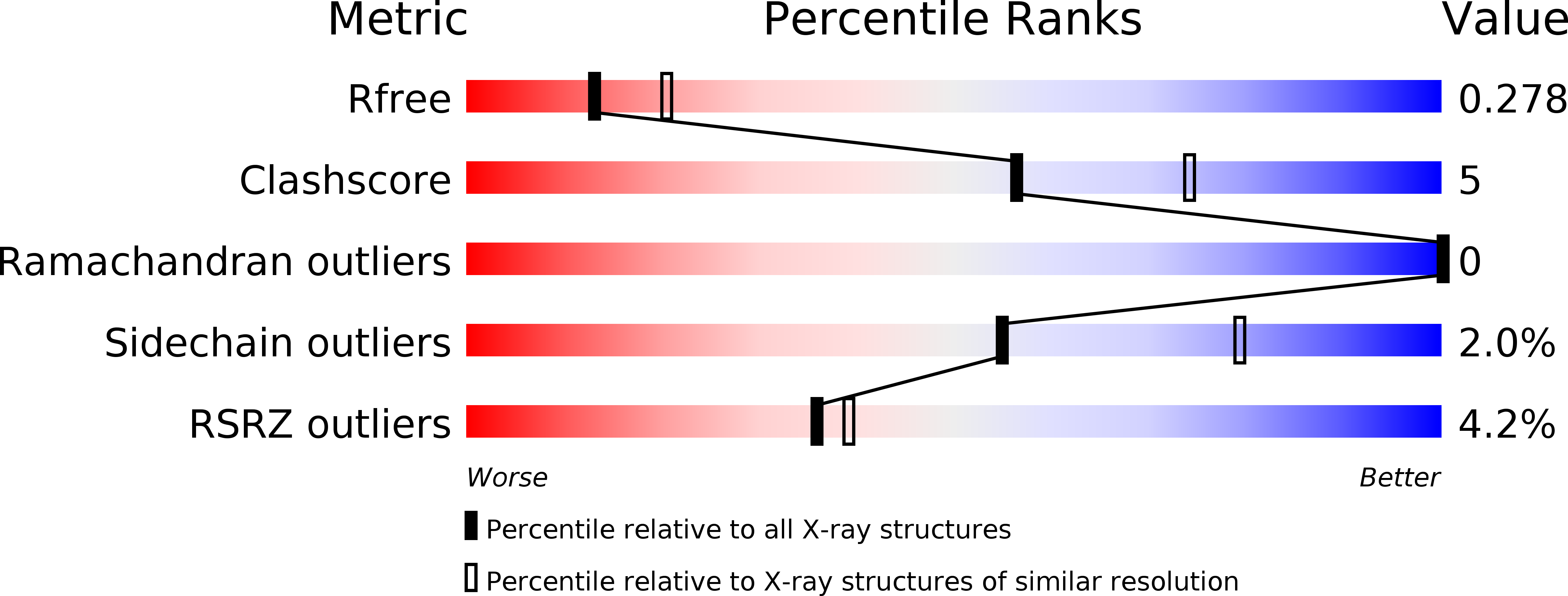
R-Value Free:
0.27
R-Value Work:
0.24
R-Value Observed:
0.25
Space Group:
C 1 2 1
Macromolecular Entities
Structures with similar UniProt ID
Protein Blast
Polymer Type:polypeptide(L)
Molecule:Methylmalonic aciduria and homocystinuria type D protein, mitochondrial
Gene (Uniprot):MMADHC
Mutagens:C262S
Chain IDs:A, B
Chain Length:192
Number of Molecules:2
Biological Source:Homo sapiens
Ligand Molecules
Primary Citation
An Interprotein Co-S Coordination Complex in the B 12 -Trafficking Pathway.
J.Am.Chem.Soc. 142 16334 16345 (2020)
PMID: 32871076 DOI: 10.1021/jacs.0c06590

Abstact

The CblC and CblD chaperones are involved in early steps in the cobalamin trafficking pathway. Cobalamin derivatives entering the cytoplasm are converted by CblC to a common cob(II)alamin intermediate via glutathione-dependent alkyltransferase or reductive elimination activities. Cob(II)alamin is subsequently converted to one of two biologically active alkylcobalamins by downstream chaperones. The function of CblD has been elusive although it is known to form a complex with CblC under certain conditions. Here, we report that CblD provides a sulfur ligand to cob(II)alamin bound to CblC, forming an interprotein coordination complex that rapidly oxidizes to thiolato-cob(III)alamin. Cysteine scanning mutagenesis and EPR spectroscopy identified Cys-261 on CblD as the sulfur donor. The unusual interprotein Co-S bond was characterized by X-ray absorption spectroscopy and visualized in the crystal structure of the human CblD thiolato-cob(III)alamin complex. Our study provides insights into how cobalamin coordination chemistry could be utilized for cofactor translocation in the trafficking pathway.

Legend

Protein

Chemical

Disease

Primary Citation of related structures
Feedback Form
Name
Email
Institute
Feedback