6X1I image
Deposition Date 2020-05-18
Release Date 2021-03-03
Last Version Date 2023-10-18
Entry Detail
PDB ID:
6X1I
Title:
Two-Component D3 Assembly Constructed by Fusing Symmetric Oligomers to Coiled Coils
Biological Source:
Method Details:
Experimental Method:
Resolution:
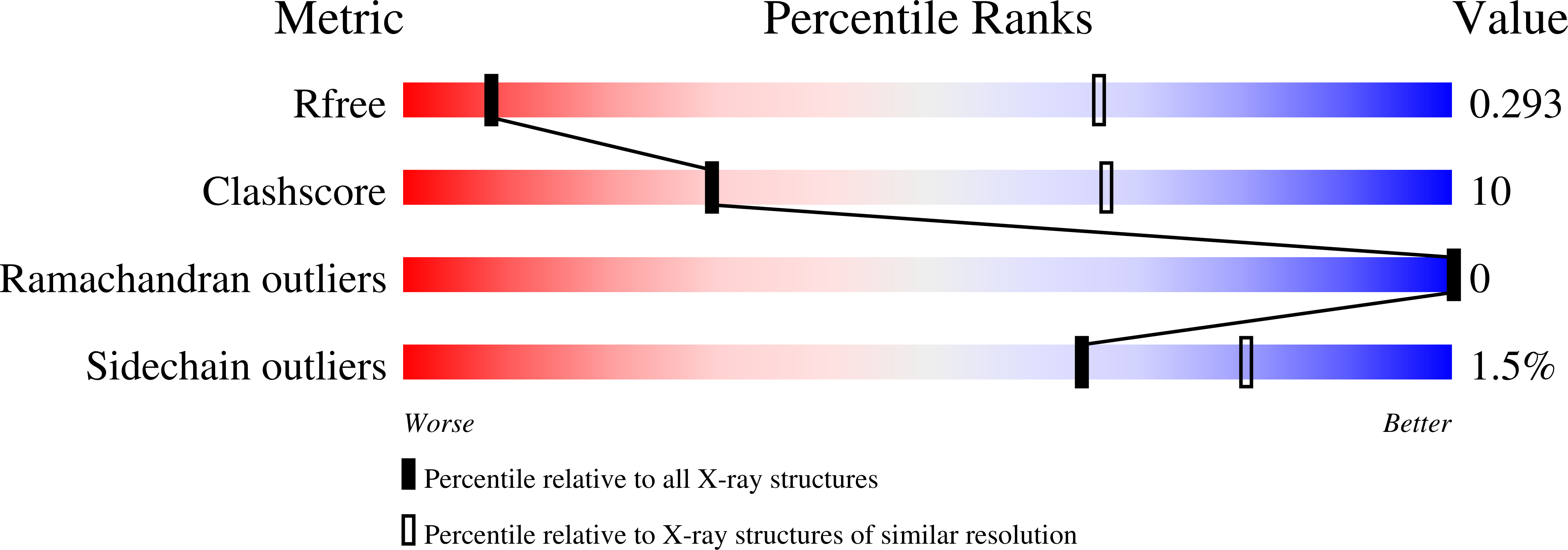
4.32 Å
R-Value Free:
0.29
R-Value Work:
0.27
R-Value Observed:
0.27
Space Group:
P 43 3 2
Macromolecular Entities
Structures with similar UniProt ID
Protein Blast
Polymer Type:polypeptide(L)
Molecule:Cob_adeno_trans domain-containing protein PH0671 fused to a coiled coil
Gene (Uniprot):PH0671
Chain IDs:A
Chain Length:172
Number of Molecules:1
Biological Source:Pyrococcus horikoshii (strain ATCC 700860 / DSM 12428 / JCM 9974 / NBRC 100139 / OT-3), Pyrococcus horikoshii OT3
Structures with similar UniProt ID
Protein Blast
Polymer Type:polypeptide(L)
Molecule:SnoaL-like Protein fused to a coiled coil
Gene (Uniprot):Atu0744
Chain IDs:B
Chain Length:157
Number of Molecules:1
Biological Source:Agrobacterium fabrum str. C58, Agrobacterium fabrum (strain C58 / ATCC 33970)
Ligand Molecules
Primary Citation
Geometric Lessons and Design Strategies for Nanoscale Protein Cages.
Acs Nano 15 4277 4286 (2021)
PMID: 33683103 DOI: 10.1021/acsnano.0c07167

Abstact

Protein molecules bring a rich functionality to the field of designed nanoscale architectures. High-symmetry protein cages are rapidly finding diverse applications in biomedicine, nanotechnology, and imaging, but methods for their reliable and predictable construction remain challenging. In this study we introduce an approach for designing protein assemblies that combines ideas and favorable elements adapted from recent work. Cubically symmetric cages can be created by combining two simpler symmetries, following recently established principles. Here, two different oligomeric protein components are brought together in a geometrically specific arrangement by their separate genetic fusion to individual components of a heterodimeric coiled-coil polypeptide motif of known structure. Fusions between components are made by continuous α-helices to limit flexibility. After a computational design, we tested 10 different protein cage constructions experimentally, two of which formed larger assemblies. One produced the intended octahedral cage, ∼26 nm in diameter, while the other appeared to produce the intended tetrahedral cage as a minor component, crystallizing instead in an alternate form representing a collapsed structure of lower stoichiometry and symmetry. Geometric distinctions between the two characterized designs help explain the different degrees of success, leading to clearer principles and improved prospects for the routine creation of nanoscale protein architectures using diverse methods.

Legend

Protein

Chemical

Disease

Primary Citation of related structures
Feedback Form
Name
Email
Institute
Feedback