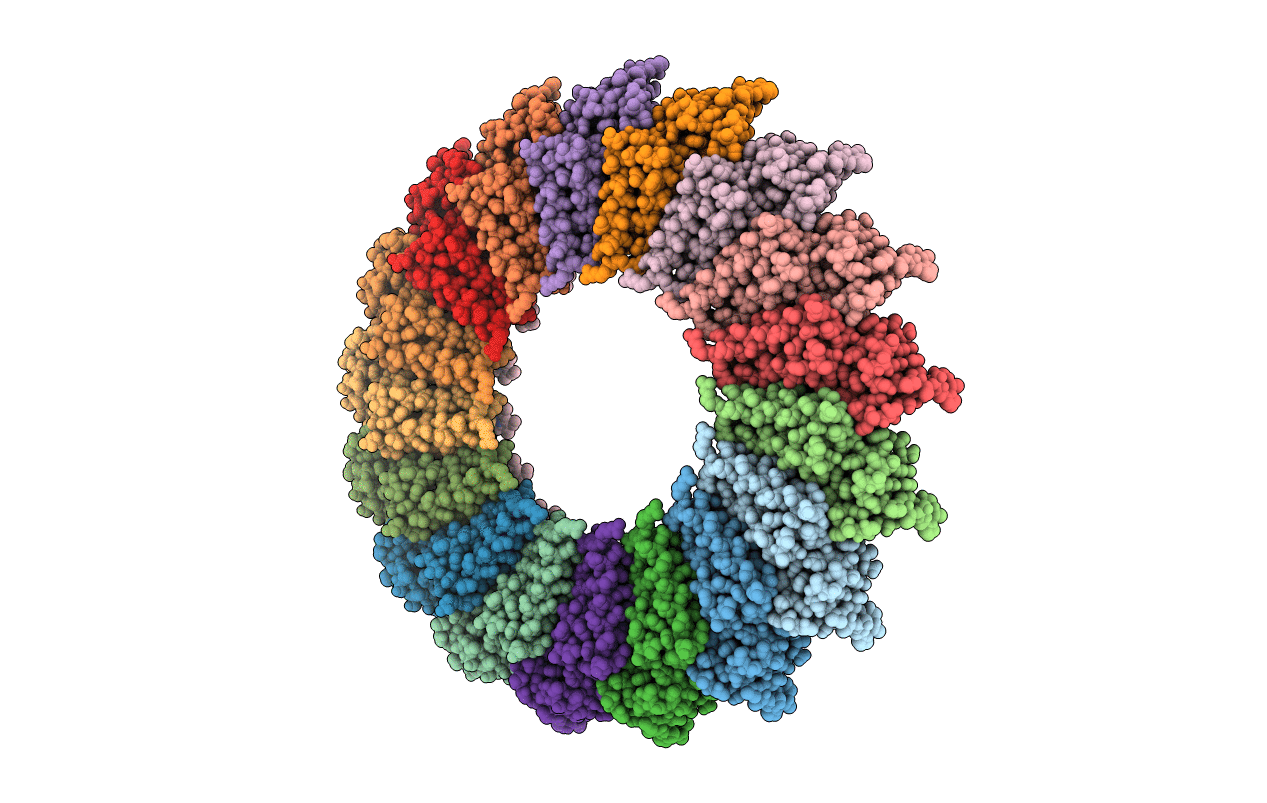
6X0Q image
Deposition Date 2020-05-17
Release Date 2020-12-09
Last Version Date 2023-10-18
Entry Detail
PDB ID:
6X0Q
Keywords:
Title:
A Circular Permutant of the Tobacco Mosaic Virus (TMV) mutant Q101H coordinated with heme
Biological Source:
Source Organism:
Host Organism:
Method Details:
Experimental Method:
Resolution:
3.00 Å
R-Value Free:
0.26
R-Value Work:
0.25
R-Value Observed:
0.25
Space Group:
C 1 2 1
Macromolecular Entities
Structures with similar UniProt ID
Protein Blast
Polymer Type:polypeptide(L)
Molecule:Capsid protein Circular Permutant
Gene (Uniprot):CP
Mutagens:Q101H
Chain IDs:A, B, C, D, E, F, G, H, I, J, K, L, M, N, O, P, Q
Chain Length:161
Number of Molecules:17
Biological Source:Tobacco mosaic virus (strain vulgare)
Ligand Molecules
Primary Citation
Protein-Embedded Metalloporphyrin Arrays Templated by Circularly Permuted Tobacco Mosaic Virus Coat Proteins.
Acs Nano 15 8110 8119 (2021)
PMID: 33285072 DOI: 10.1021/acsnano.0c07165

Abstact

Bioenergetic processes in nature have relied on networks of cofactors for harvesting, storing, and transforming the energy from sunlight into chemical bonds. Models mimicking the structural arrangement and functional crosstalk of the cofactor arrays are important tools to understand the basic science of natural systems and to provide guidance for non-natural functional biomaterials. Here, we report an artificial multiheme system based on a circular permutant of the tobacco mosaic virus coat protein (cpTMV). The double disk assembly of cpTMV presents a gap region sandwiched by the two C2-symmetrically related disks. Non-native bis-his coordination sites formed by the mutation of the residues in this gap region were computationally screened and experimentally tested. A cpTMV mutant Q101H was identified to create a circular assembly of 17 protein-embedded hemes. Biophysical characterization using X-ray crystallography, cyclic voltammetry, and electron paramagnetic resonance (EPR) suggested both structural and functional similarity to natural multiheme cytochrome c proteins. This protein framework offers many further engineering opportunities for tuning the redox properties of the cofactors and incorporating non-native components bearing varied porphyrin structures and metal centers. Emulating the electron transfer pathways in nature using a tunable artificial system can contribute to the development of photocatalytic materials and bioelectronics.

Legend

Protein

Chemical

Disease

Primary Citation of related structures
Feedback Form
Name
Email
Institute
Feedback