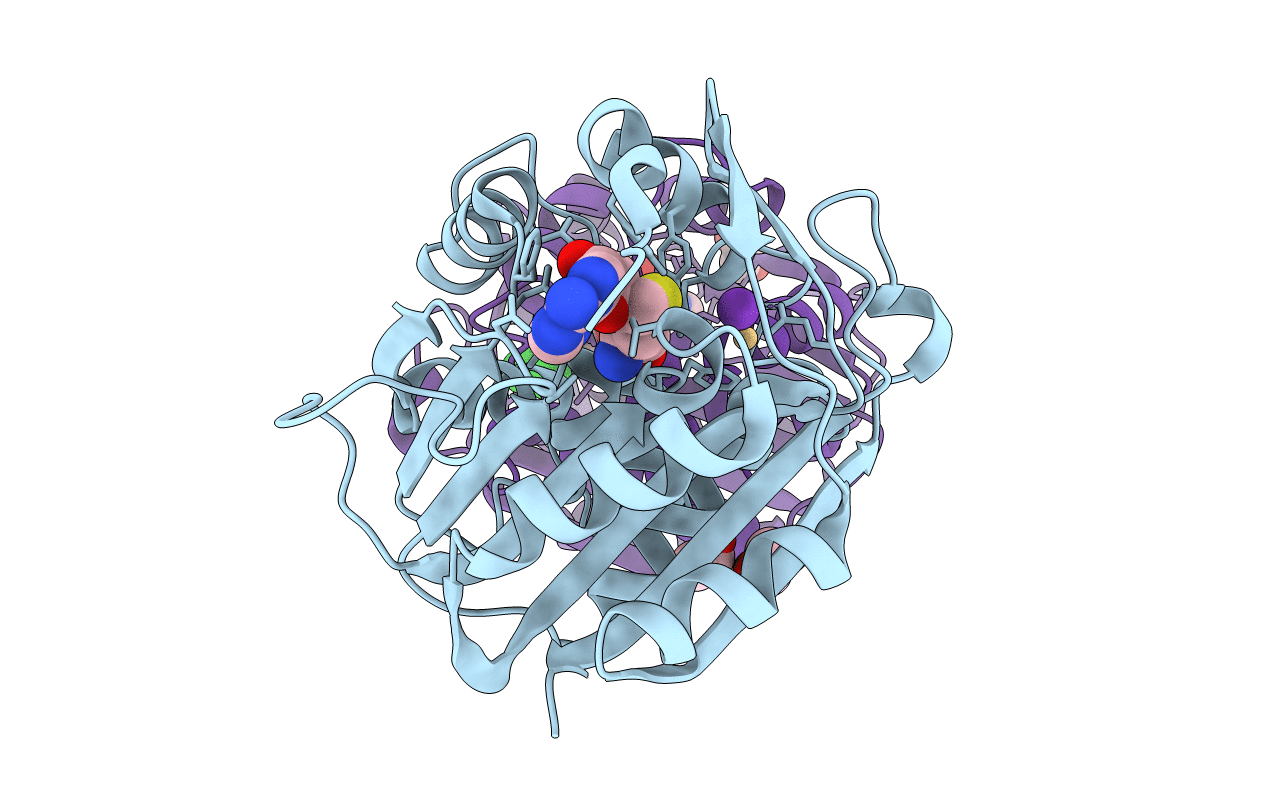
6WS1 image
Deposition Date 2020-04-30
Release Date 2020-08-05
Last Version Date 2024-10-23
Entry Detail
PDB ID:
6WS1
Keywords:
Title:
Crystal structure of human phenylethanolamine N-methyltransferase (PNMT) in complex with (2S)-2-amino-4-((((2R,5R)-5-(6-amino-9H-purin-9-yl)-3,4-dihydroxytetrahydrofuran-2-yl)methyl)(3-(7,8-dichloro-1,2,3,4-tetrahydroisoquinolin-4-yl)propyl)amino)butanoic acid and AdoHcy (SAH)
Biological Source:
Source Organism(s):
Homo sapiens (Taxon ID: 9606)
Expression System(s):
Method Details:
Experimental Method:
Resolution:
2.76 Å
R-Value Free:
0.27
R-Value Work:
0.22
R-Value Observed:
0.22
Space Group:
P 43 21 2

Macromolecular Entities
Structures with similar UniProt ID
Protein Blast
Polymer Type:polypeptide(L)
Molecule:Phenylethanolamine N-methyltransferase
Gene (Uniprot):PNMT
Chain IDs:A, B
Chain Length:294
Number of Molecules:2
Biological Source:Homo sapiens
Primary Citation
Transition-State Analogues of PhenylethanolamineN-Methyltransferase.
J.Am.Chem.Soc. 142 14222 14233 (2020)
PMID: 32702980 DOI: 10.1021/jacs.0c05446

Abstact

Phenylethanolamine N-methyltransferase (PNMT) is a critical enzyme in catecholamine synthesis. It transfers the methyl group of S-adenosylmethionine (SAM) to catalyze the synthesis of epinephrine from norepinephrine. Epinephrine has been associated with diverse human processes, including the regulation of blood pressure and respiration, as well as neurodegeneration found in Alzheimer's disease. Human PNMT (hPNMT) proceeds through an SN2 transition state (TS) in which the transfer of the methyl group is rate limiting. TS analogue enzyme inhibitors are specific for their target and bind orders of magnitude more tightly than their substrates. Molecules resembling the TS of hPNMT were designed, synthesized, and kinetically characterized. This new inhibitory scaffold was designed to mimic the geometry and electronic properties of the hPNMT TS. Synthetic efforts resulted in a tight-binding inhibitor with a Ki value of 12.0 nM. This is among the first of the TS analogue inhibitors of methyltransferase enzymes to show an affinity in the nanomolar range. Isothermal titration calorimetry (ITC) measurements indicated negative cooperative binding of inhibitor to the dimeric protein, driven by favorable entropic contributions. Structural analysis revealed that inhibitor 3 binds to hPNMT by filling the catalytic binding pockets for the cofactor (SAM) and the substrate (norepinephrine) binding sites.

Legend

Protein

Chemical

Disease

Primary Citation of related structures
Feedback Form
Name
Email
Institute
Feedback