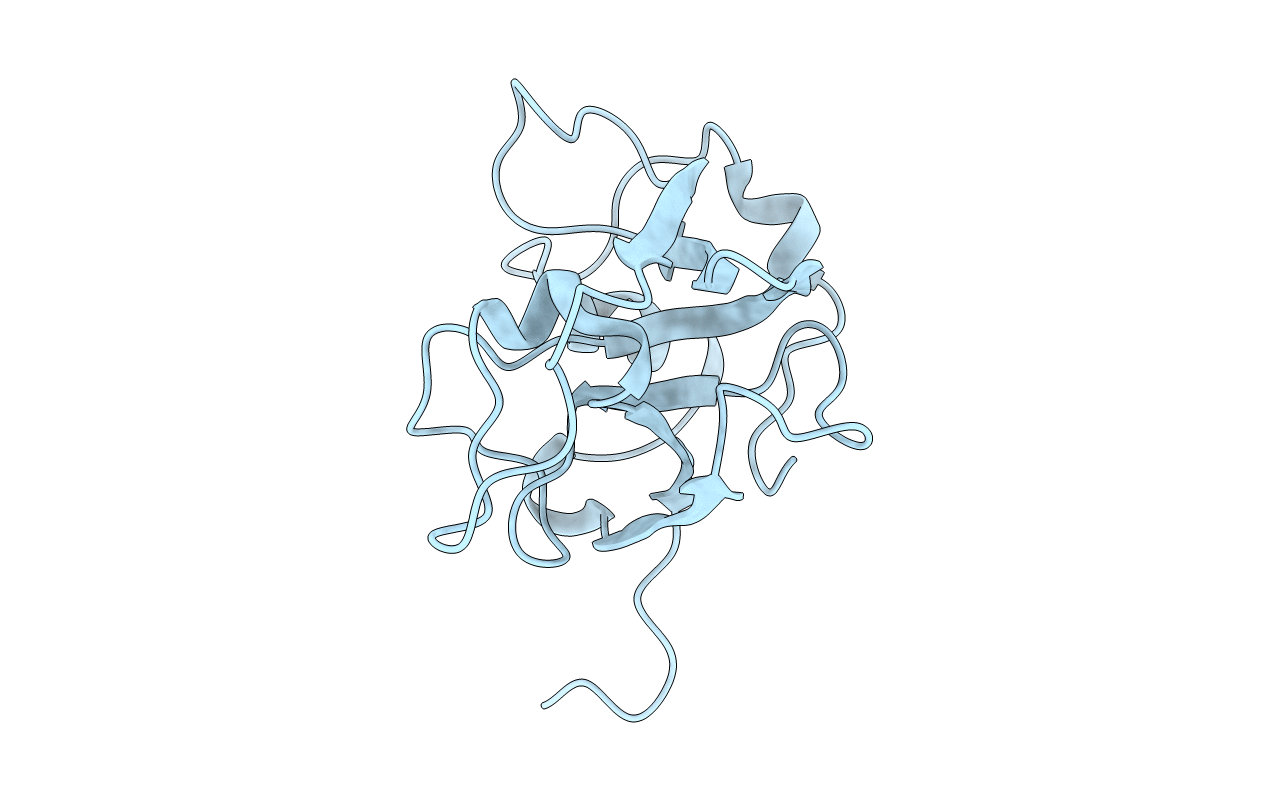
6WIN image
Deposition Date 2020-04-10
Release Date 2020-04-22
Last Version Date 2024-10-23
Entry Detail
PDB ID:
6WIN
Title:
Type 6 secretion amidase effector 2 (Tae2)
Biological Source:
Source Organism:
Method Details:
Experimental Method:
Resolution:
2.05 Å
R-Value Free:
0.22
R-Value Work:
0.17
R-Value Observed:
0.17
Space Group:
P 1 21 1

Macromolecular Entities
Structures with similar UniProt ID
Protein Blast
Polymer Type:polypeptide(L)
Molecule:Type 6 secretion amidase effector 2
Gene (Uniprot):CAJ76_09015, CAJ80_18365, CAJ85_10805, CAL67_16600, CB224_09340, CC884_06395, CC907_10665, CC972_10770, D4Z37_10355, D6Q30_18620, DKA88_11235, DNM71_09770, DNV09_07170, DS261_10025, DUQ91_10185, DUV11_09900, DVG36_08355, EBC38_08670, EID90_06215, ELQ62_05210, EU445_09805, EVI00_09960, F9R11_11830, F9Y21_10505, FI137_05510, G2227_21740, G2244_11710, G3982_003799, G3V49_003978, G4I71_004420, G4L28_003754, G4P30_004091, G4Y41_004527, G4Y55_002609, G9264_004218, G9C68_002405, G9X37_004139, GDI29_09980, GND71_002457, K3U68_13035, ZZ17_05140
Chain IDs:A
Chain Length:140
Number of Molecules:1
Biological Source:Salmonella typhi
Modified Residue
Compound ID Chain ID Parent Comp ID Details 2D Image
MSE A MET modified residue
Primary Citation
Ticks Resist Skin Commensals with Immune Factor of Bacterial Origin.
Cell 183 1562 1571.e12 (2020)
PMID: 33306955 DOI: 10.1016/j.cell.2020.10.042

Abstact

Ticks transmit a diverse array of microbes to vertebrate hosts, including human pathogens, which has led to a human-centric focus in this vector system. Far less is known about pathogens of ticks themselves. Here, we discover that a toxin in blacklegged ticks (Ixodes scapularis) horizontally acquired from bacteria-called domesticated amidase effector 2 (dae2)-has evolved to kill mammalian skin microbes with remarkable efficiency. Secreted into the saliva and gut of ticks, Dae2 limits skin-associated staphylococci in ticks while feeding. In contrast, Dae2 has no intrinsic ability to kill Borrelia burgdorferi, the tick-borne Lyme disease bacterial pathogen. These findings suggest ticks resist their own pathogens while tolerating symbionts. Thus, just as tick symbionts can be pathogenic to humans, mammalian commensals can be harmful to ticks. Our study underscores how virulence is context-dependent and bolsters the idea that "pathogen" is a status and not an identity.

Legend

Protein

Chemical

Disease

Primary Citation of related structures
Feedback Form
Name
Email
Institute
Feedback