6WH8 image
Deposition Date 2020-04-07
Release Date 2020-08-26
Last Version Date 2024-10-23
Entry Detail
PDB ID:
6WH8
Keywords:
Title:
The structure of NTMT1 in complex with compound BM-30
Biological Source:
Source Organism:
Method Details:
Experimental Method:
Resolution:
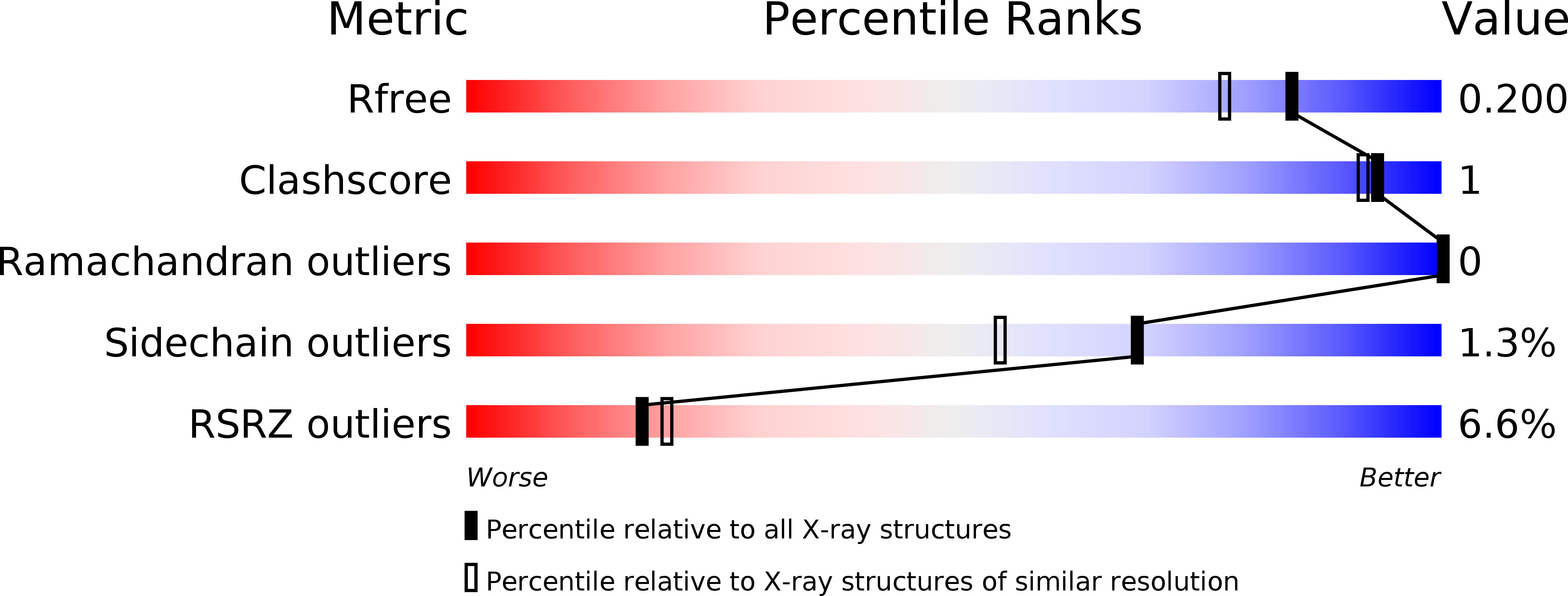
1.73 Å
R-Value Free:
0.19
R-Value Work:
0.17
R-Value Observed:
0.18
Space Group:
P 65 2 2
Macromolecular Entities
Structures with similar UniProt ID
Protein Blast
Polymer Type:polypeptide(L)
Molecule:N-terminal Xaa-Pro-Lys N-methyltransferase 1
Gene (Uniprot):NTMT1
Chain IDs:A (auth: B), B (auth: A)
Chain Length:241
Number of Molecules:2
Biological Source:Homo sapiens
Polymer Type:polypeptide(L)
Molecule:4HP-PRO-LYS-ARG-NH2, BM-30
Chain IDs:C, D
Chain Length:5
Number of Molecules:2
Biological Source:synthetic construct
Ligand Molecules
Peptide-like Molecules
PRD_002315
Primary Citation
Selective Peptidomimetic Inhibitors of NTMT1/2: Rational Design, Synthesis, Characterization, and Crystallographic Studies.
J.Med.Chem. 63 9512 9522 (2020)
PMID: 32689795 DOI: 10.1021/acs.jmedchem.0c00689

Abstact

Protein N-terminal methyltransferases (NTMTs) methylate the α-N-terminal amines of proteins starting with the canonical X-P-K/R motif. Genetic studies imply that NTMT1 regulates cell mitosis and DNA damage repair. Herein, we report the rational design and development of the first potent peptidomimetic inhibitor for NTMT1/2. Biochemical and cocrystallization studies manifest that BM30 (with a half-maximal inhibitory concentration of 0.89 ± 0.10 μM) is a competitive inhibitor to the peptide substrate and noncompetitive to the cofactor S-adenosylmethionine. BM30 exhibits over 100-fold selectivity to NTMT1/2 among a panel of 41 MTs, indicating its potential to achieve high selectivity when targeting the peptide substrate binding site of NTMT1/2. Its cell-permeable analogue DC432 (IC50 of 54 ± 4 nM) decreases the N-terminal methylation level of the regulator of chromosome condensation 1 and SET proteins in HCT116 cells. This proof-of principle study provides valuable probes for NTMT1/2 and highlights the opportunity to develop more cell-potent inhibitors to elucidate the function of NTMTs in the future.

Legend

Protein

Chemical

Disease

Primary Citation of related structures
Feedback Form
Name
Email
Institute
Feedback