6WBJ image
Deposition Date 2020-03-26
Release Date 2020-06-17
Last Version Date 2024-10-23
Entry Detail
PDB ID:
6WBJ
Title:
High resolution crystal structure of mRECK(CC4) in fusion with engineered MBP
Biological Source:
Source Organism:
Escherichia coli (Taxon ID: 562)
Mus musculus (Taxon ID: 10090)
Host Organism:
Method Details:
Experimental Method:
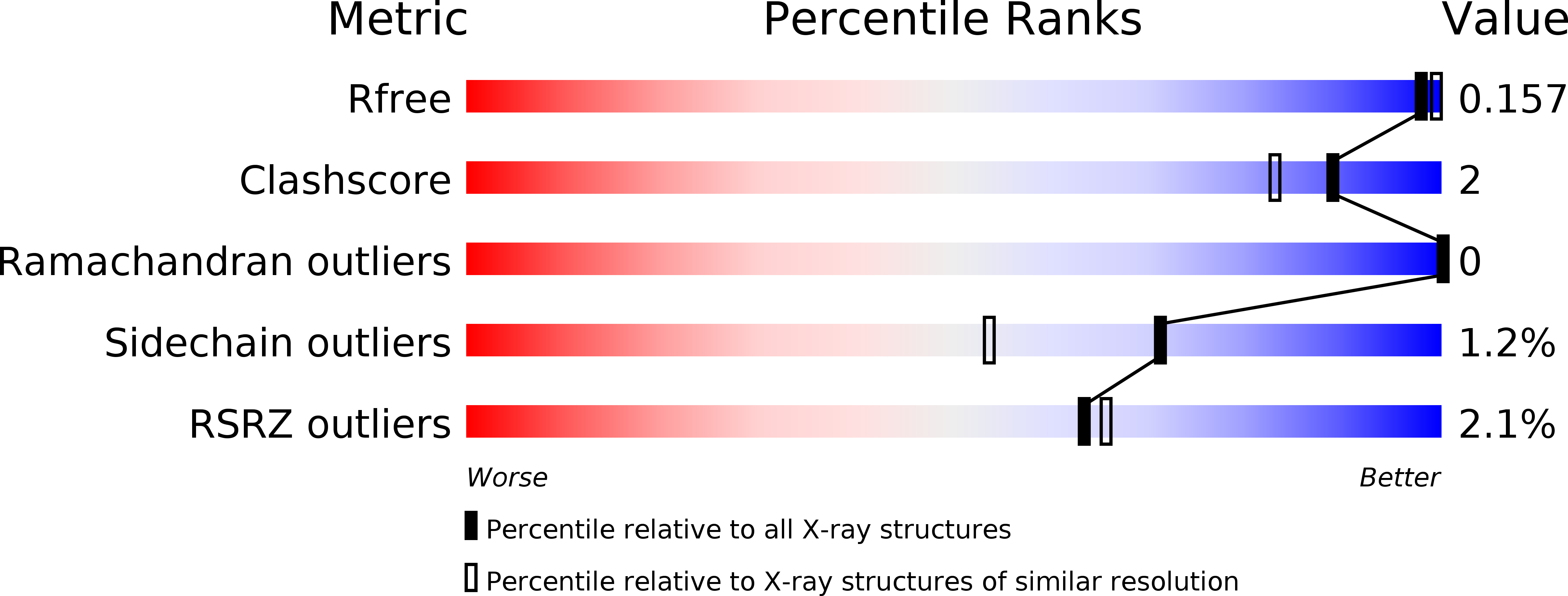
Resolution:
1.65 Å
R-Value Free:
0.17
R-Value Work:
0.15
R-Value Observed:
0.15
Space Group:
P 21 21 2
Macromolecular Entities
Protein Blast
Polymer Type:polypeptide(L)
Molecule:Maltodextrin-binding protein,Reversion-inducing cysteine-rich protein with Kazal motifs fusion
Gene (Uniprot):Reck
Mutagens:D84A,K85A,E174A,N175A,A217H,K221H,K241A,A314V,I319V,E361A,K364A,D365A
Chain IDs:A
Chain Length:447
Number of Molecules:1
Biological Source:Escherichia coli, Mus musculus
Peptide-like Molecules
PRD_900001
Primary Citation
Structure of the RECK CC domain, an evolutionary anomaly.
Proc.Natl.Acad.Sci.USA 117 15104 15111 (2020)
PMID: 32541044 DOI: 10.1073/pnas.2006332117

Abstact

Five small protein domains, the CC-domains, at the N terminus of the RECK protein, play essential roles in signaling by WNT7A and WNT7B in the context of central nervous system angiogenesis and blood-brain barrier formation and maintenance. We have determined the structure of CC domain 4 (CC4) at 1.65-Å resolution and find that it folds into a compact four-helix bundle with three disulfide bonds. The CC4 structure, together with homology modeling of CC1, reveals the surface locations of critical residues that were shown in previous mutagenesis studies to mediate GPR124 binding and WNT7A/WNT7B recognition and signaling. Surprisingly, sequence and structural homology searches reveal no other cell-surface or secreted domains in vertebrates that resemble the CC domain, a pattern that is in striking contrast to other ancient and similarly sized domains, such as Epidermal Growth Factor, Fibronectin Type 3, Immunoglobulin, and Thrombospondin type 1 domains, which are collectively present in hundreds of proteins.

Legend

Protein

Chemical

Disease

Primary Citation of related structures
Feedback Form
Name
Email
Institute
Feedback