6W4Z image
Deposition Date 2020-03-12
Release Date 2020-09-02
Last Version Date 2023-10-18
Entry Detail
PDB ID:
6W4Z
Title:
Galectin-8N terminal domain in complex with Methyl 3-O-[3-O-benzyloxy]-malonyl-beta-D-galactopyranoside
Biological Source:
Source Organism:
Homo sapiens (Taxon ID: 9606)
Host Organism:
Method Details:
Experimental Method:
Resolution:
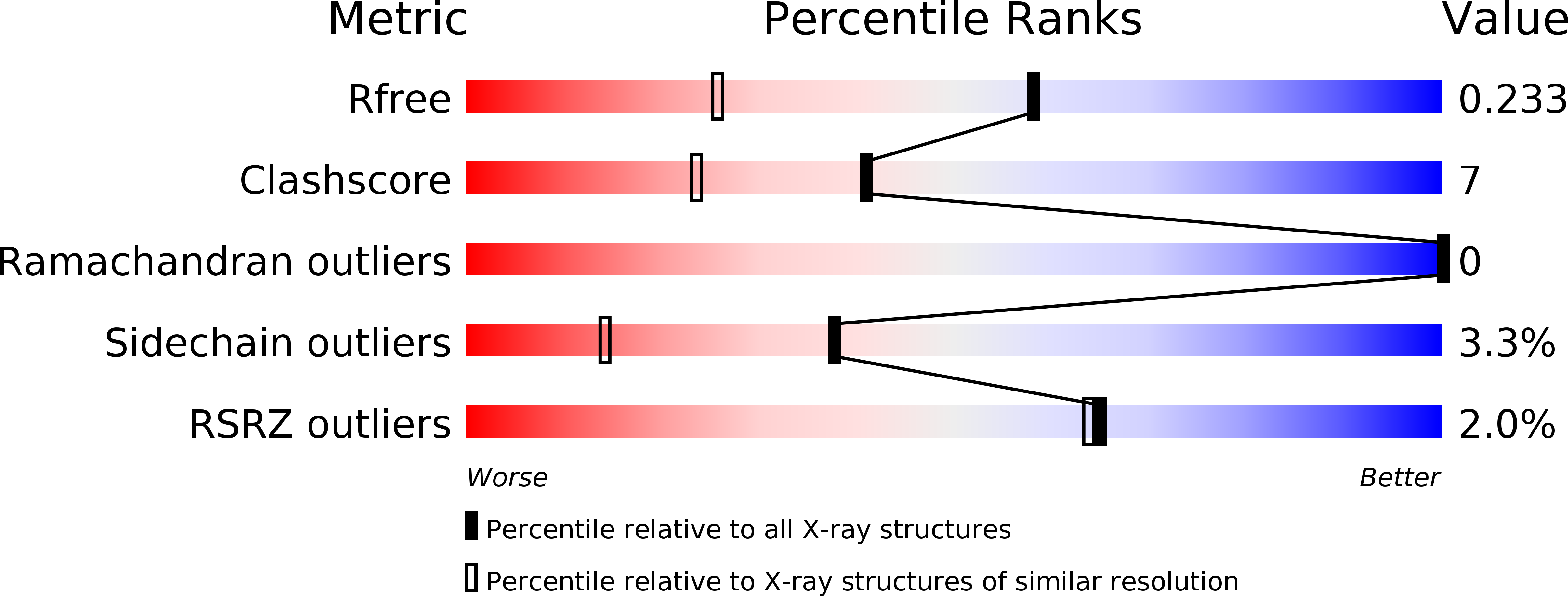
1.59 Å
R-Value Free:
0.22
R-Value Work:
0.19
Space Group:
C 1 2 1
Macromolecular Entities
Structures with similar UniProt ID
Protein Blast
Polymer Type:polypeptide(L)
Molecule:Galectin-8
Gene (Uniprot):LGALS8
Mutagens:M54V
Chain IDs:A, B
Chain Length:153
Number of Molecules:2
Biological Source:Homo sapiens
Primary Citation
Rational Design and Synthesis of Methyl-beta-d-galactomalonyl Phenyl Esters as Potent Galectin-8 N Antagonists.
J.Med.Chem. 63 11573 11584 (2020)
PMID: 32809817 DOI: 10.1021/acs.jmedchem.0c00602

Abstact

Galectin-8 is a β-galactoside-recognizing protein having an important role in the regulation of bone remodeling and cancer progression and metastasis. Methyl β-d-galactopyranoside malonyl aromatic esters have been designed to target and engage with particular amino acid residues of the galectin-8N extended carbohydrate-binding site. The chemically synthesized compounds had in vitro binding affinity toward galectin-8N in the range of 5-33 μM, as evaluated by isothermal titration calorimetry. This affinity directly correlated with the compounds' ability to inhibit galectin-8-induced expression of chemokines and proinflammatory cytokines in the SUM159 breast cancer cell line. X-ray crystallographic structure determination revealed that these monosaccharide-based compounds bind galectin-8N by engaging its unique arginine (Arg59) and simultaneously cross-linking to another arginine (Arg45) located across the carbohydrate-binding site. This structure-based drug design approach has led to the discovery of novel monosaccharide galactose-based antagonists, with the strongest-binding compound (Kd 5.72 μM) holding 7-fold tighter than the disaccharide lactose.

Legend

Protein

Chemical

Disease

Primary Citation of related structures
Feedback Form
Name
Email
Institute
Feedback