6W1X image
Deposition Date 2020-03-04
Release Date 2020-05-13
Last Version Date 2024-03-06
Entry Detail
PDB ID:
6W1X
Title:
Cryo-EM structure of anti-CRISPR AcrIF9, bound to the type I-F crRNA-guided CRISPR surveillance complex
Biological Source:
Source Organism:
Host Organism:
Method Details:
Experimental Method:
Resolution:
3.90 Å
Aggregation State:
PARTICLE
Reconstruction Method:
SINGLE PARTICLE
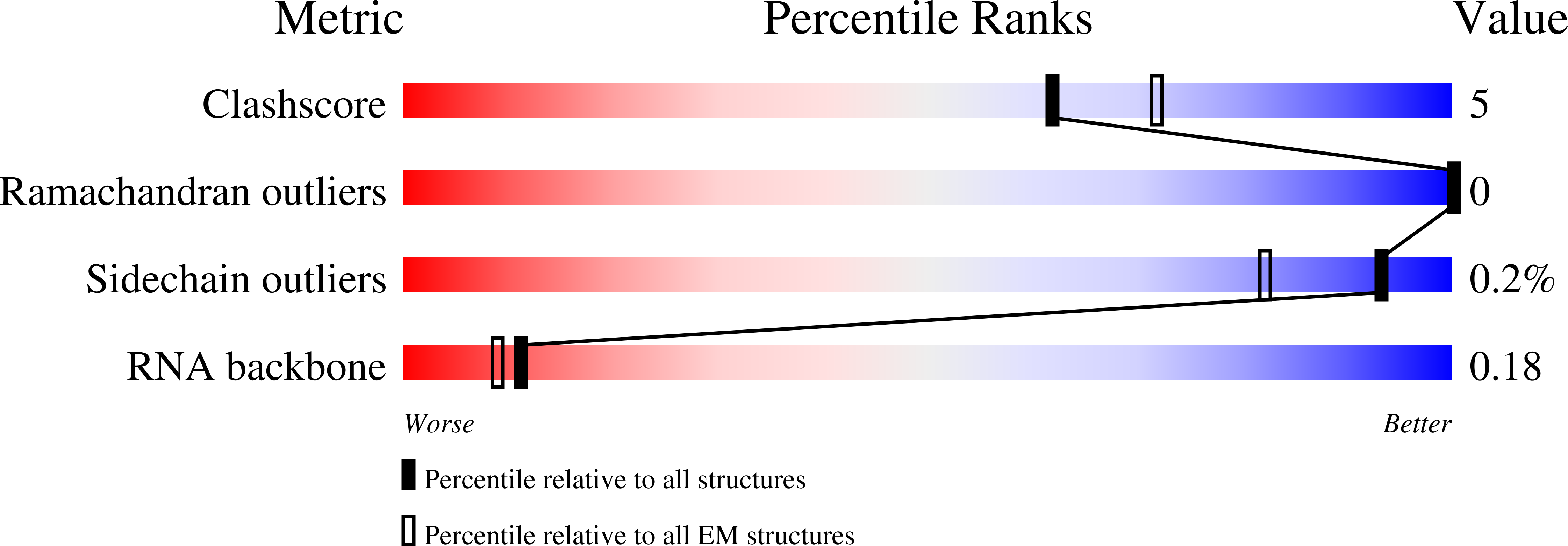
Macromolecular Entities
Structures with similar UniProt ID
Protein Blast
Polymer Type:polypeptide(L)
Molecule:CRISPR-associated protein Csy1
Gene (Uniprot):csy1
Chain IDs:A
Chain Length:434
Number of Molecules:1
Biological Source:Pseudomonas aeruginosa
Structures with similar UniProt ID
Protein Blast
Polymer Type:polypeptide(L)
Molecule:Type I-F CRISPR-associated protein Csy2
Chain IDs:B
Chain Length:327
Number of Molecules:1
Biological Source:Pseudomonas aeruginosa
Structures with similar UniProt ID
Protein Blast
Polymer Type:polypeptide(L)
Molecule:CRISPR-associated protein Csy3
Chain IDs:C, D, E, F, G, H
Chain Length:360
Number of Molecules:6
Biological Source:Pseudomonas aeruginosa
Polymer Type:polypeptide(L)
Molecule:anti-CRISPR AcrIF9
Chain IDs:K (auth: I), L (auth: J)
Chain Length:68
Number of Molecules:2
Biological Source:Proteus penneri
Structures with similar UniProt ID
Protein Blast
Polymer Type:polypeptide(L)
Molecule:CRISPR-associated endonuclease Cas6/Csy4
Gene (Uniprot):cas6f
Chain IDs:J (auth: L)
Chain Length:187
Number of Molecules:1
Biological Source:Pseudomonas aeruginosa
Polymer Type:polyribonucleotide
Molecule:RNA (60-MER)
Chain IDs:I (auth: M)
Chain Length:60
Number of Molecules:1
Biological Source:Pseudomonas aeruginosa
Ligand Molecules
Primary Citation
AcrIF9 tethers non-sequence specific dsDNA to the CRISPR RNA-guided surveillance complex.
Nat Commun 11 2730 2730 (2020)
PMID: 32483187 DOI: 10.1038/s41467-020-16512-1

Abstact

Bacteria have evolved sophisticated adaptive immune systems, called CRISPR-Cas, that provide sequence-specific protection against phage infection. In turn, phages have evolved a broad spectrum of anti-CRISPRs that suppress these immune systems. Here we report structures of anti-CRISPR protein IF9 (AcrIF9) in complex with the type I-F CRISPR RNA-guided surveillance complex (Csy). In addition to sterically blocking the hybridization of complementary dsDNA to the CRISPR RNA, our results show that AcrIF9 binding also promotes non-sequence-specific engagement with dsDNA, potentially sequestering the complex from target DNA. These findings highlight the versatility of anti-CRISPR mechanisms utilized by phages to suppress CRISPR-mediated immune systems.

Legend

Protein

Chemical

Disease

Primary Citation of related structures
Feedback Form
Name
Email
Institute
Feedback