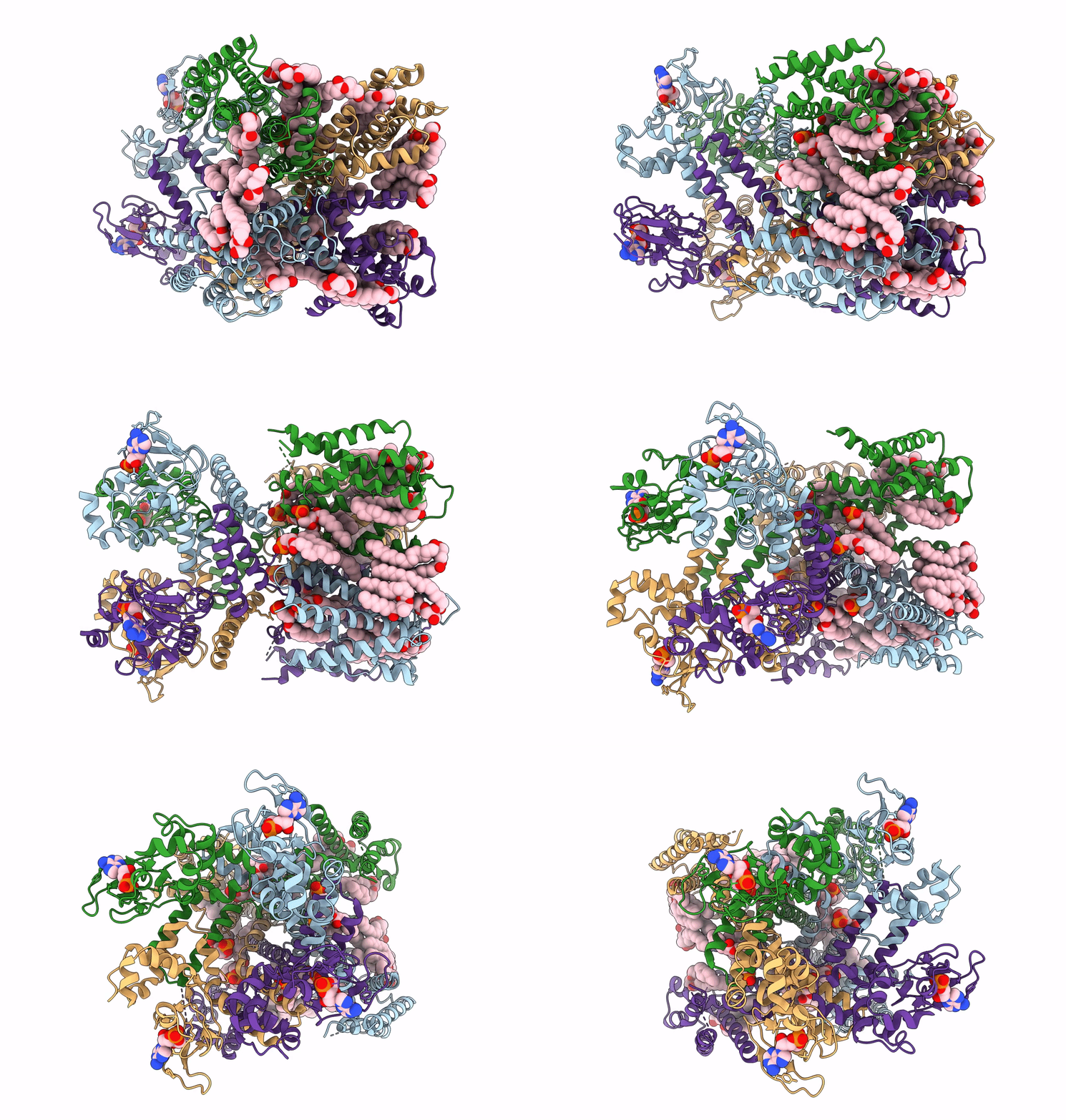
6VXZ image
Deposition Date 2020-02-25
Release Date 2020-11-11
Last Version Date 2024-03-06
Entry Detail
PDB ID:
6VXZ
Title:
SthK P300A cyclic nucleotide-gated potassium channel in the closed state, in complex with cAMP
Biological Source:
Method Details:
Experimental Method:
Resolution:
3.42 Å
Aggregation State:
PARTICLE
Reconstruction Method:
SINGLE PARTICLE
Macromolecular Entities
Structures with similar UniProt ID
Protein Blast
Polymer Type:polypeptide(L)
Molecule:SthK
Gene (Uniprot):Spith_0644
Mutagens:P300A
Chain IDs:A, B, C, D
Chain Length:456
Number of Molecules:4
Biological Source:Spirochaeta thermophila (strain ATCC 700085 / DSM 6578 / Z-1203)
Primary Citation
Prolyl isomerization controls activation kinetics of a cyclic nucleotide-gated ion channel.
Nat Commun 11 6401 6401 (2020)
PMID: 33328472 DOI: 10.1038/s41467-020-20104-4

Abstact

SthK, a cyclic nucleotide-modulated ion channel from Spirochaeta thermophila, activates slowly upon cAMP increase. This is reminiscent of the slow, cAMP-induced activation reported for the hyperpolarization-activated and cyclic nucleotide-gated channel HCN2 in the family of so-called pacemaker channels. Here, we investigate slow cAMP-induced activation in purified SthK channels using stopped-flow assays, mutagenesis, enzymatic catalysis and inhibition assays revealing that the cis/trans conformation of a conserved proline in the cyclic nucleotide-binding domain determines the activation kinetics of SthK. We propose that SthK exists in two forms: trans Pro300 SthK with high ligand binding affinity and fast activation, and cis Pro300 SthK with low affinity and slow activation. Following channel activation, the cis/trans equilibrium, catalyzed by prolyl isomerases, is shifted towards trans, while steady-state channel activity is unaffected. Our results reveal prolyl isomerization as a regulatory mechanism for SthK, and potentially eukaryotic HCN channels. This mechanism could contribute to electrical rhythmicity in cells.

Legend

Protein

Chemical

Disease

Primary Citation of related structures
Feedback Form
Name
Email
Institute
Feedback