6VVV image
Deposition Date 2020-02-18
Release Date 2020-10-21
Last Version Date 2023-10-11
Entry Detail
PDB ID:
6VVV
Title:
Crystal structure of a Mycobacterium smegmatis transcription initiation complex with Rifampicin-resistant RNA polymerase
Biological Source:
Method Details:
Experimental Method:
Resolution:
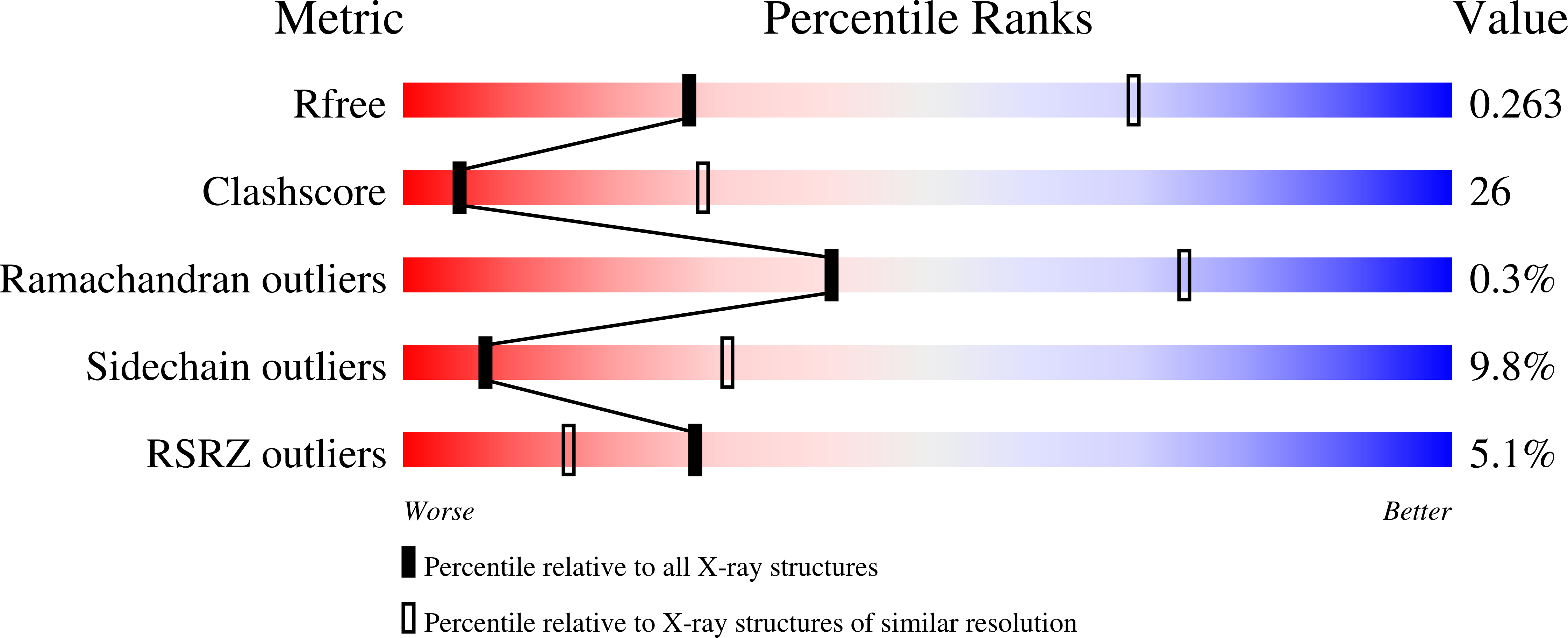
3.20 Å
R-Value Free:
0.26
R-Value Work:
0.23
R-Value Observed:
0.23
Space Group:
P 1 21 1
Macromolecular Entities
Structures with similar UniProt ID
Protein Blast
Polymer Type:polypeptide(L)
Molecule:DNA-directed RNA polymerase subunit alpha
Gene (Uniprot):rpoA
Chain IDs:B (auth: A), C (auth: B), I (auth: T)
Chain Length:350
Number of Molecules:3
Biological Source:Mycolicibacterium smegmatis (strain ATCC 700084 / mc(2)155)
Structures with similar UniProt ID
Protein Blast
Polymer Type:polypeptide(L)
Molecule:DNA-directed RNA polymerase subunit beta
Gene (Uniprot):rpoB
Chain IDs:D (auth: C)
Chain Length:1169
Number of Molecules:1
Biological Source:Mycolicibacterium smegmatis (strain ATCC 700084 / mc(2)155)
Structures with similar UniProt ID
Protein Blast
Polymer Type:polypeptide(L)
Molecule:DNA-directed RNA polymerase subunit beta'
Gene (Uniprot):rpoC
Chain IDs:E (auth: D)
Chain Length:1317
Number of Molecules:1
Biological Source:Mycolicibacterium smegmatis (strain ATCC 700084 / mc(2)155)
Structures with similar UniProt ID
Protein Blast
Polymer Type:polypeptide(L)
Molecule:DNA-directed RNA polymerase subunit omega
Gene (Uniprot):rpoZ
Chain IDs:F (auth: E)
Chain Length:107
Number of Molecules:1
Biological Source:Mycolicibacterium smegmatis (strain ATCC 700084 / mc(2)155)
Structures with similar UniProt ID
Protein Blast
Polymer Type:polypeptide(L)
Molecule:RNA polymerase sigma factor SigA
Gene (Uniprot):sigA
Chain IDs:G (auth: F)
Chain Length:466
Number of Molecules:1
Biological Source:Mycolicibacterium smegmatis (strain ATCC 700084 / mc(2)155)
Structures with similar UniProt ID
Protein Blast
Polymer Type:polypeptide(L)
Molecule:RNA polymerase-binding protein RbpA
Gene (Uniprot):rbpA
Chain IDs:A (auth: J)
Chain Length:114
Number of Molecules:1
Biological Source:Mycolicibacterium smegmatis (strain ATCC 700084 / mc(2)155)
Polymer Type:polydeoxyribonucleotide
Molecule:DNA (31-MER)
Chain IDs:H (auth: O)
Chain Length:31
Number of Molecules:1
Biological Source:synthetic construct
Polymer Type:polydeoxyribonucleotide
Molecule:DNA (26-MER)
Chain IDs:J (auth: P)
Chain Length:26
Number of Molecules:1
Biological Source:synthetic construct
Primary Citation
The antibiotic sorangicin A inhibits promoter DNA unwinding in a Mycobacterium tuberculosis rifampicin-resistant RNA polymerase.
Proc.Natl.Acad.Sci.USA 117 30423 30432 (2020)
PMID: 33199626 DOI: 10.1073/pnas.2013706117

Abstact

Rifampicin (Rif) is a first-line therapeutic used to treat the infectious disease tuberculosis (TB), which is caused by the pathogen Mycobacterium tuberculosis (Mtb). The emergence of Rif-resistant (RifR) Mtb presents a need for new antibiotics. Rif targets the enzyme RNA polymerase (RNAP). Sorangicin A (Sor) is an unrelated inhibitor that binds in the Rif-binding pocket of RNAP. Sor inhibits a subset of RifR RNAPs, including the most prevalent clinical RifR RNAP substitution found in Mtb infected patients (S456>L of the β subunit). Here, we present structural and biochemical data demonstrating that Sor inhibits the wild-type Mtb RNAP by a similar mechanism as Rif: by preventing the translocation of very short RNAs. By contrast, Sor inhibits the RifR S456L enzyme at an earlier step, preventing the transition of a partially unwound promoter DNA intermediate to the fully opened DNA and blocking the template-strand DNA from reaching the active site in the RNAP catalytic center. By defining template-strand blocking as a mechanism for inhibition, we provide a mechanistic drug target in RNAP. Our finding that Sor inhibits the wild-type and mutant RNAPs through different mechanisms prompts future considerations for designing antibiotics against resistant targets. Also, we show that Sor has a better pharmacokinetic profile than Rif, making it a suitable starting molecule to design drugs to be used for the treatment of TB patients with comorbidities who require multiple medications.

Legend

Protein

Chemical

Disease

Primary Citation of related structures
Feedback Form
Name
Email
Institute
Feedback