6V3V image
Deposition Date 2019-11-26
Release Date 2020-10-21
Last Version Date 2023-11-15
Entry Detail
PDB ID:
6V3V
Keywords:
Title:
Assembly of VIQKI I456(beta-L-homoisoleucine)with human parainfluenza virus type 3 (HPIV3) fusion glycoprotein N-terminal heptad repeat domain
Biological Source:
Method Details:
Experimental Method:
Resolution:
2.17 Å
R-Value Free:
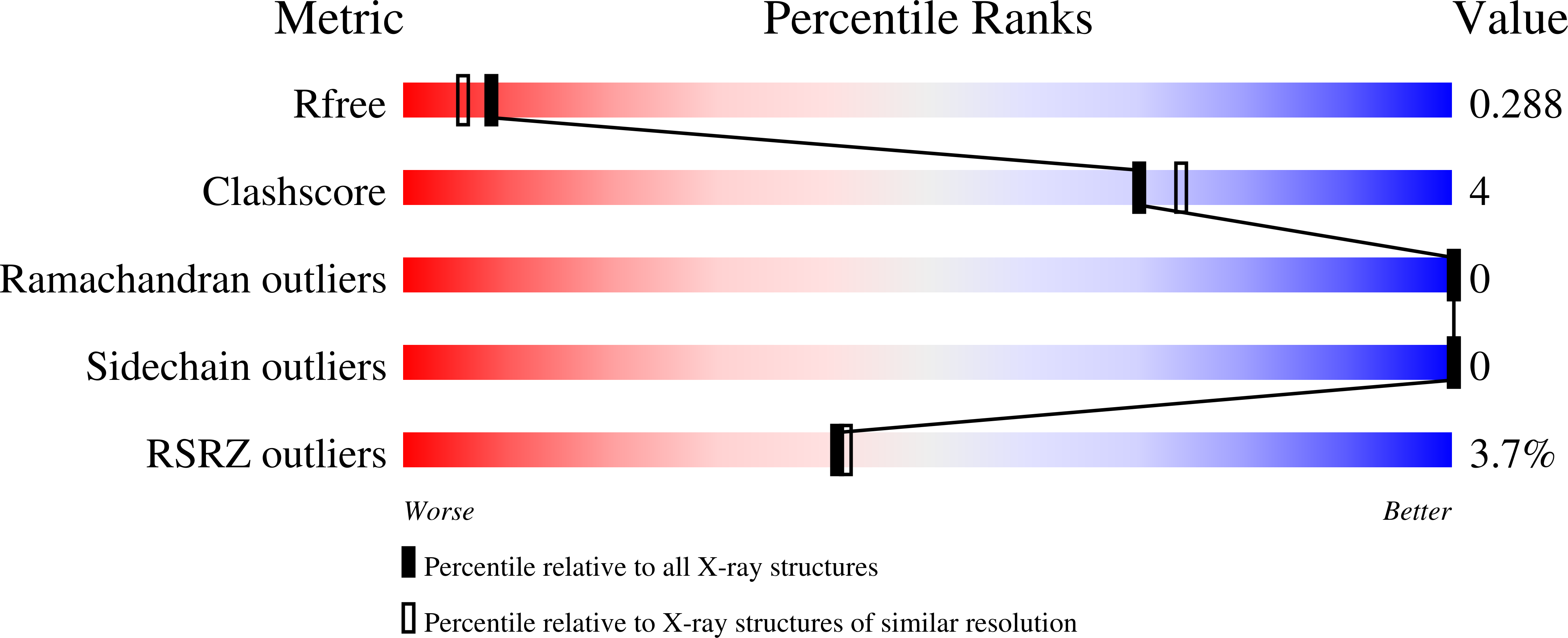
0.28
R-Value Work:
0.24
R-Value Observed:
0.24
Space Group:
P 1 21 1
Macromolecular Entities
Structures with similar UniProt ID
Protein Blast
Polymer Type:polypeptide(L)
Molecule:Fusion glycoprotein F1
Gene (Uniprot):F
Chain IDs:A, C, E
Chain Length:53
Number of Molecules:3
Biological Source:Human parainfluenza 3 virus (strain Wash/47885/57)
Structures with similar UniProt ID
Protein Blast
Polymer Type:polypeptide(L)
Molecule:Fusion glycoprotein F1
Gene (Uniprot):F
Mutagens:I456(beta-L-homoisoleucine), E459V, A463I, D466Q, Q479K, K480I
Chain IDs:B, D, F
Chain Length:38
Number of Molecules:3
Biological Source:Human parainfluenza 3 virus (strain Wash/47885/57)
Primary Citation
Effects of Single alpha-to-beta Residue Replacements on Recognition of an Extended Segment in a Viral Fusion Protein.
Acs Infect Dis. 6 2017 2022 (2020)
PMID: 32692914 DOI: 10.1021/acsinfecdis.0c00385

Abstact

Partial replacement of α-amino acid residues with β-amino acid residues has been established as a strategy for preserving target-engagement by helix-forming polypeptides while altering other properties. The impact of β-residue incorporation within polypeptides that adopt less regular conformations, however, has received less attention. The C-terminal heptad repeat (HRC) domains of fusion glycoproteins from pathogenic paramyxoviruses contain a segment that must adopt an extended conformation in order to coassemble with the N-terminal heptad repeat (HRN) domain in the postfusion state and drive a merger of the viral envelope with a target cell membrane. Here, we examine the impact of single α-to-β substitutions within this extended N-terminal segment of an engineered HRC peptide designated VIQKI. Stabilities of hexameric coassemblies formed with the native human parainfluenza virus 3 (HPIV3) HRN have been evaluated, the structures of five coassemblies have been determined, and antiviral efficacies have been measured. Many sites within the extended segment show functional tolerance of α-to-β substitution. These results offer a basis for future development of paramyxovirus infection inhibitors with novel biological activity profiles, possibly including resistance to proteolysis.

Legend

Protein

Chemical

Disease

Primary Citation of related structures
Feedback Form
Name
Email
Institute
Feedback