6USA image
Deposition Date 2019-10-25
Release Date 2020-09-30
Last Version Date 2023-10-25
Entry Detail
PDB ID:
6USA
Title:
Crystal structure of tryptophan synthase from M. tuberculosis - aminoacrylate- and GSK1-bound form
Biological Source:
Method Details:
Experimental Method:
Resolution:
2.41 Å
R-Value Free:
0.19
R-Value Work:
0.15
R-Value Observed:
0.15
Space Group:
P 21 21 21
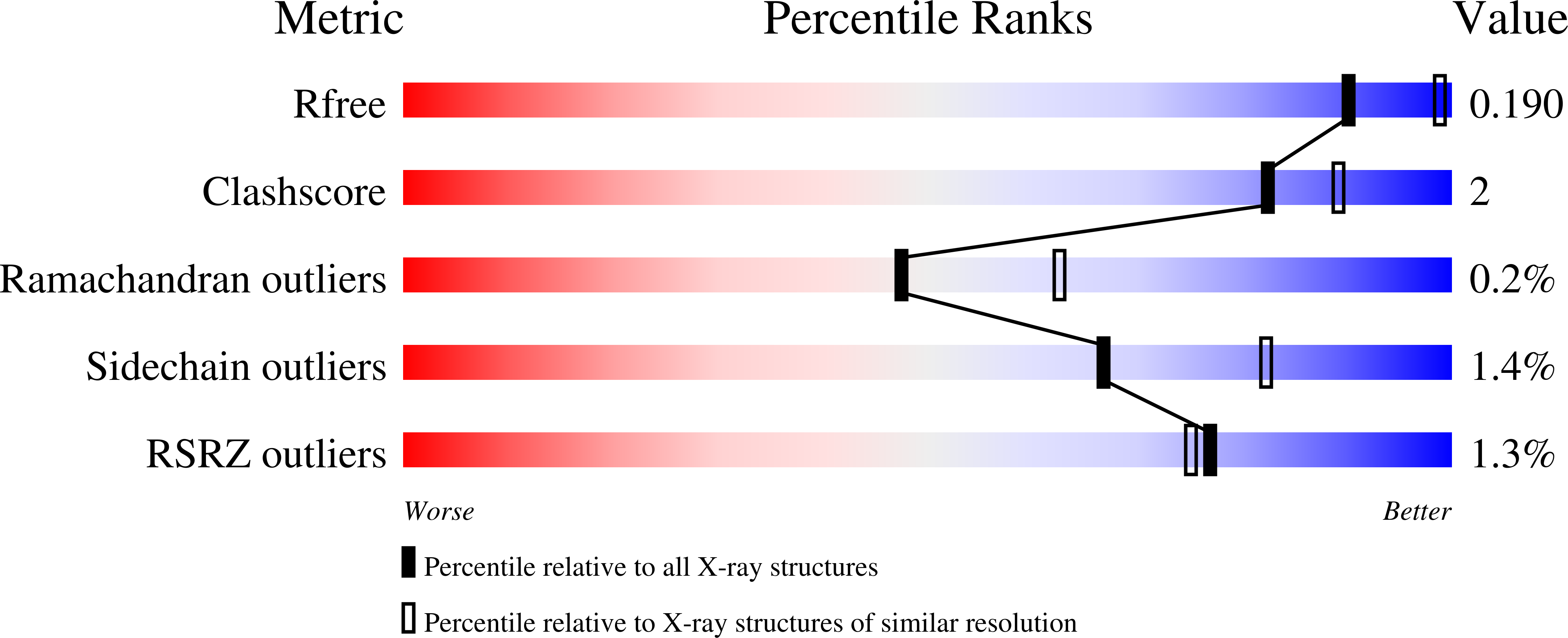
Macromolecular Entities
Structures with similar UniProt ID
Protein Blast
Polymer Type:polypeptide(L)
Molecule:Tryptophan synthase alpha chain
Gene (Uniprot):trpA
Chain IDs:A, C, E, G
Chain Length:276
Number of Molecules:4
Biological Source:Mycobacterium tuberculosis (strain ATCC 25618 / H37Rv)
Structures with similar UniProt ID
Protein Blast
Polymer Type:polypeptide(L)
Molecule:Tryptophan synthase beta chain
Gene (Uniprot):trpB
Chain IDs:B, D, F, H
Chain Length:410
Number of Molecules:4
Biological Source:Mycobacterium tuberculosis (strain ATCC 25618 / H37Rv)
Primary Citation
Allosteric inhibitors of Mycobacterium tuberculosis tryptophan synthase.
Protein Sci. 29 779 788 (2020)
PMID: 31930594 DOI: 10.1002/pro.3825

Abstact

Global dispersion of multidrug resistant bacteria is very common and evolution of antibiotic-resistance is occurring at an alarming rate, presenting a formidable challenge for humanity. The development of new therapeuthics with novel molecular targets is urgently needed. Current drugs primarily affect protein, nucleic acid, and cell wall synthesis. Metabolic pathways, including those involved in amino acid biosynthesis, have recently sparked interest in the drug discovery community as potential reservoirs of such novel targets. Tryptophan biosynthesis, utilized by bacteria but absent in humans, represents one of the currently studied processes with a therapeutic focus. It has been shown that tryptophan synthase (TrpAB) is required for survival of Mycobacterium tuberculosis in macrophages and for evading host defense, and therefore is a promising drug target. Here we present crystal structures of TrpAB with two allosteric inhibitors of M. tuberculosis tryptophan synthase that belong to sulfolane and indole-5-sulfonamide chemical scaffolds. We compare our results with previously reported structural and biochemical studies of another, azetidine-containing M. tuberculosis tryptophan synthase inhibitor. This work shows how structurally distinct ligands can occupy the same allosteric site and make specific interactions. It also highlights the potential benefit of targeting more variable allosteric sites of important metabolic enzymes.

Legend

Protein

Chemical

Disease

Primary Citation of related structures
Feedback Form
Name
Email
Institute
Feedback