6UFF image
Deposition Date 2019-09-24
Release Date 2020-03-25
Last Version Date 2023-10-11
Entry Detail
PDB ID:
6UFF
Keywords:
Title:
Structure of Ene-reductase 1 NostocER1 from cyanobacteria
Biological Source:
Method Details:
Experimental Method:
Resolution:
2.01 Å
R-Value Free:
0.22
R-Value Work:
0.17
R-Value Observed:
0.17
Space Group:
P 1
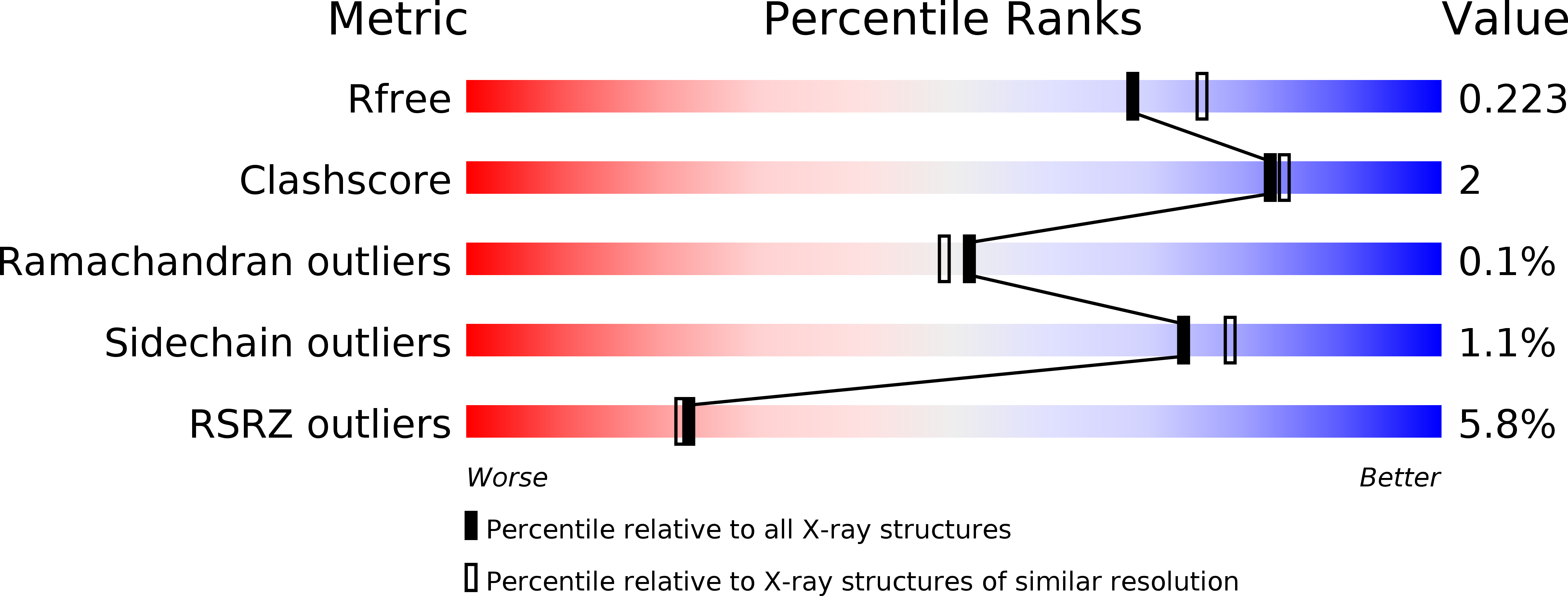
Macromolecular Entities
Structures with similar UniProt ID
Protein Blast
Polymer Type:polypeptide(L)
Molecule:Ene-reductase 1
Gene (Uniprot):all1865
Chain IDs:A, B, C, D, E, F, G, H
Chain Length:410
Number of Molecules:8
Biological Source:Nostoc sp. (strain PCC 7120 / SAG 25.82 / UTEX 2576)
Primary Citation
Photoenzymatic Hydrogenation of Heteroaromatic Olefins Using 'Ene'-Reductases with Photoredox Catalysts.
Angew.Chem.Int.Ed.Engl. 59 10484 10488 (2020)
PMID: 32181943 DOI: 10.1002/anie.202003125

Abstact

Flavin-dependent 'ene'-reductases (EREDs) are highly selective catalysts for the asymmetric reduction of activated alkenes. This function is, however, limited to enones, enoates, and nitroalkenes using the native hydride transfer mechanism. Here we demonstrate that EREDs can reduce vinyl pyridines when irradiated with visible light in the presence of a photoredox catalyst. Experimental evidence suggests the reaction proceeds via a radical mechanism where the vinyl pyridine is reduced to the corresponding neutral benzylic radical in solution. DFT calculations reveal this radical to be "dynamically stable", suggesting it is sufficiently long-lived to diffuse into the enzyme active site for stereoselective hydrogen atom transfer. This reduction mechanism is distinct from the native one, highlighting the opportunity to expand the synthetic capabilities of existing enzyme platforms by exploiting new mechanistic models.

Legend

Protein

Chemical

Disease

Primary Citation of related structures
Feedback Form
Name
Email
Institute
Feedback