6TZB image
Deposition Date 2019-08-12
Release Date 2019-10-30
Last Version Date 2024-11-13
Entry Detail
PDB ID:
6TZB
Keywords:
Title:
Crystal structure of the A/Hong Kong/1/1968 (H3N2) influenza virus hemagglutinin in complex with 6'-SLNLN
Biological Source:
Host Organism:
Method Details:
Experimental Method:
Resolution:
2.24 Å
R-Value Free:
0.20
R-Value Work:
0.15
R-Value Observed:
0.15
Space Group:
C 1 2 1
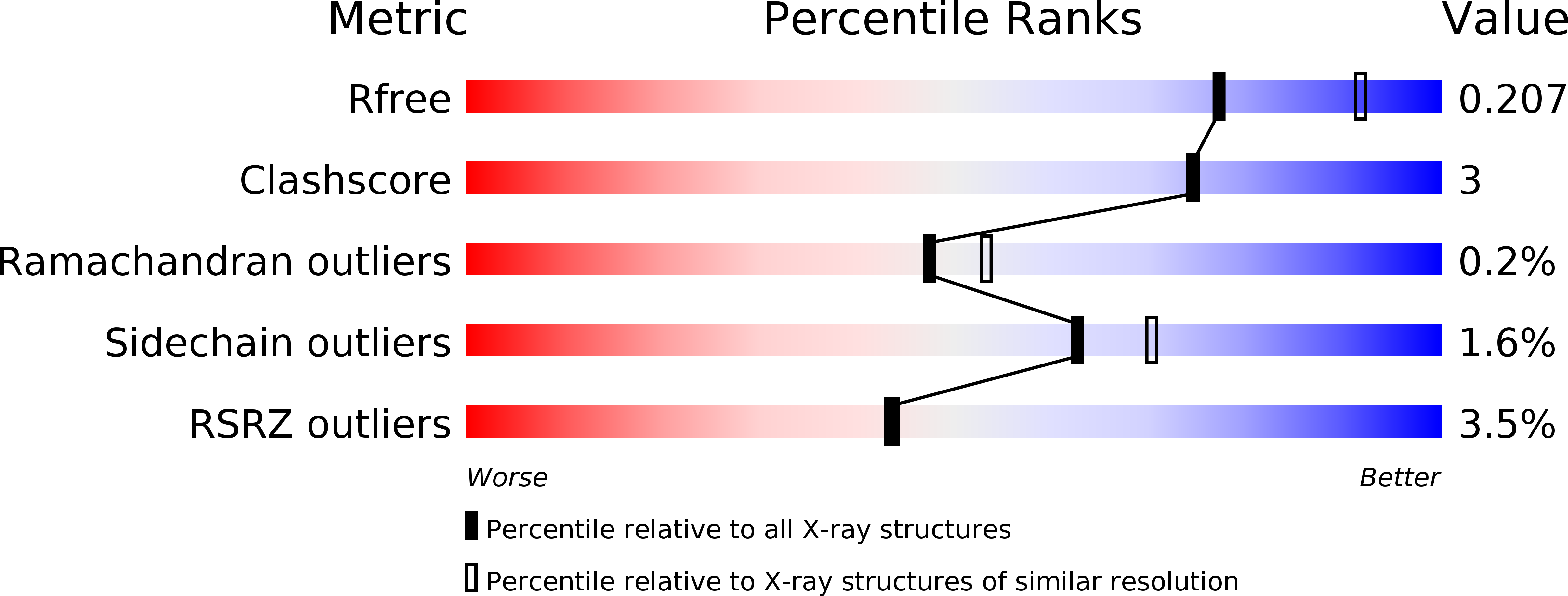
Macromolecular Entities
Structures with similar UniProt ID
Protein Blast
Polymer Type:polypeptide(L)
Molecule:Hemagglutinin HA1 chain
Gene (Uniprot):HA
Chain IDs:A, C, E
Chain Length:321
Number of Molecules:3
Biological Source:Influenza A virus (strain A/Hong Kong/1/1968 H3N2)
Structures with similar UniProt ID
Protein Blast
Polymer Type:polypeptide(L)
Molecule:Hemagglutinin HA2 chain
Gene (Uniprot):HA
Chain IDs:B, D, F
Chain Length:176
Number of Molecules:3
Biological Source:Influenza A virus (strain A/Hong Kong/1/1968 H3N2)
Ligand Molecules
Peptide-like Molecules
PRD_900046
Primary Citation
Major antigenic site B of human influenza H3N2 viruses has an evolving local fitness landscape.
Nat Commun 11 1233 1233 (2020)
PMID: 32144244 DOI: 10.1038/s41467-020-15102-5

Abstact

Antigenic drift of influenza virus hemagglutinin (HA) is enabled by facile evolvability. However, HA antigenic site B, which has become immunodominant in recent human H3N2 influenza viruses, is also evolutionarily constrained by its involvement in receptor binding. Here, we employ deep mutational scanning to probe the local fitness landscape of HA antigenic site B in six different human H3N2 strains spanning from 1968 to 2016. We observe that the fitness landscape of HA antigenic site B can be very different between strains. Sequence variants that exhibit high fitness in one strain can be deleterious in another, indicating that the evolutionary constraints of antigenic site B have changed over time. Structural analysis suggests that the local fitness landscape of antigenic site B can be reshaped by natural mutations via modulation of the receptor-binding mode. Overall, these findings elucidate how influenza virus continues to explore new antigenic space despite strong functional constraints.

Legend

Protein

Chemical

Disease

Primary Citation of related structures
Feedback Form
Name
Email
Institute
Feedback