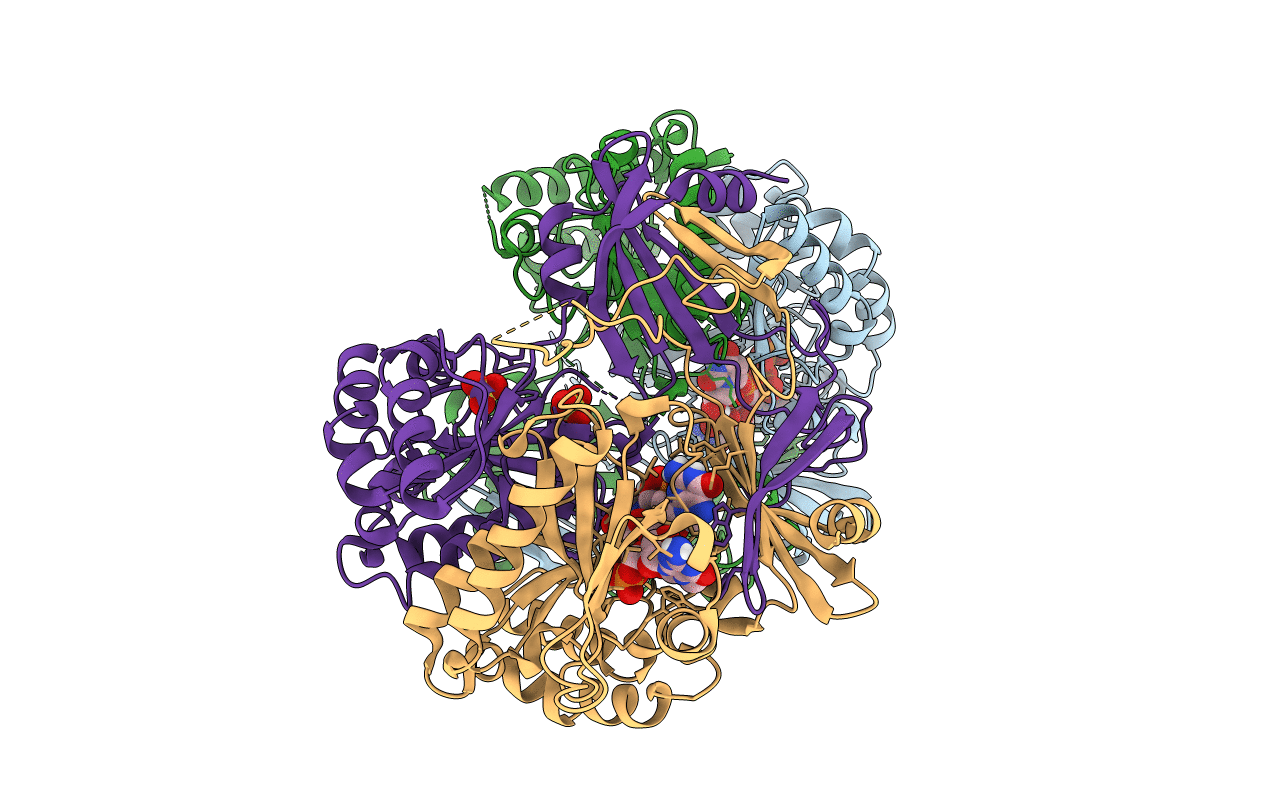
6TRQ image
Deposition Date 2019-12-19
Release Date 2020-07-22
Last Version Date 2025-12-17
Entry Detail
PDB ID:
6TRQ
Keywords:
Title:
S.c. Scavenger Decapping Enzyme DcpS in complex with the capped RNA dinucleotide m7G-GU
Biological Source:
Source Organism:
Host Organism:
Method Details:
Experimental Method:
Resolution:
2.94 Å
R-Value Free:
0.26
R-Value Work:
0.20
R-Value Observed:
0.20
Space Group:
P 21 21 21

Macromolecular Entities
Structures with similar UniProt ID
Protein Blast
Polymer Type:polypeptide(L)
Molecule:m7GpppX diphosphatase
Gene (Uniprot):DCS1
Mutagens:H268N
Chain IDs:A, B, C, D
Chain Length:345
Number of Molecules:4
Biological Source:Saccharomyces cerevisiae S288C
Polymer Type:polyribonucleotide
Molecule:Capped RNA dinucleotide
Chain IDs:E, F
Chain Length:2
Number of Molecules:2
Biological Source:synthetic construct
Primary Citation
Molecular basis of the selective processing of short mRNA substrates by the DcpS mRNA decapping enzyme.
Proc.Natl.Acad.Sci.USA 117 19237 19244 (2020)
PMID: 32723815 DOI: 10.1073/pnas.2009362117

Abstact

The 5' messenger RNA (mRNA) cap structure enhances translation and protects the transcript against exonucleolytic degradation. During mRNA turnover, this cap is removed from the mRNA. This decapping step is catalyzed by the Scavenger Decapping Enzyme (DcpS), in case the mRNA has been exonucleolyticly shortened from the 3' end by the exosome complex. Here, we show that DcpS only processes mRNA fragments that are shorter than three nucleotides in length. Based on a combination of methyl transverse relaxation optimized (TROSY) NMR spectroscopy and X-ray crystallography, we established that the DcpS substrate length-sensing mechanism is based on steric clashes between the enzyme and the third nucleotide of a capped mRNA. For longer mRNA substrates, these clashes prevent conformational changes in DcpS that are required for the formation of a catalytically competent active site. Point mutations that enlarge the space for the third nucleotide in the mRNA body enhance the activity of DcpS on longer mRNA species. We find that this mechanism to ensure that the enzyme is not active on translating long mRNAs is conserved from yeast to humans. Finally, we show that the products that the exosome releases after 3' to 5' degradation of the mRNA body are indeed short enough to be decapped by DcpS. Our data thus directly confirms the notion that mRNA products of the exosome are direct substrates for DcpS. In summary, we demonstrate a direct relationship between conformational changes and enzyme activity that is exploited to achieve substrate selectivity.

Legend

Protein

Chemical

Disease

Primary Citation of related structures
Feedback Form
Name
Email
Institute
Feedback