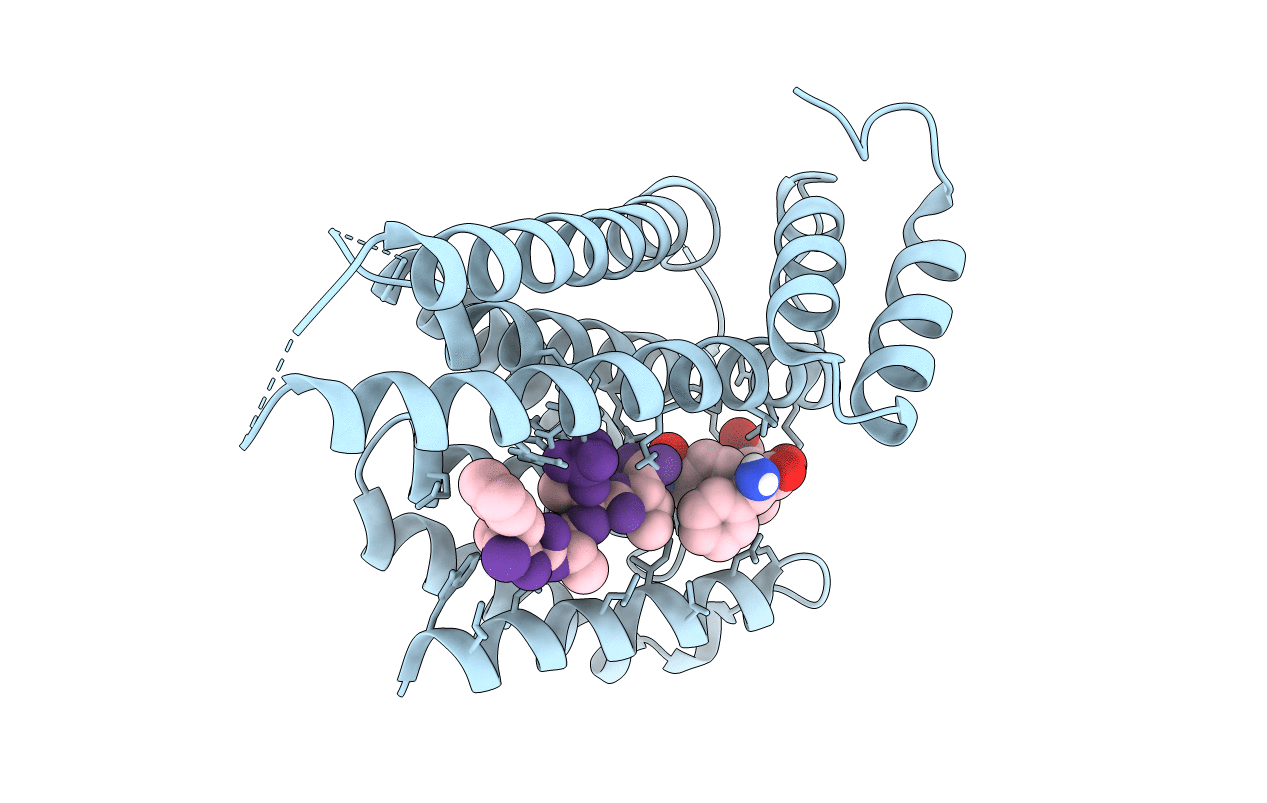
6TL3 image
Deposition Date 2019-11-30
Release Date 2020-04-29
Last Version Date 2024-10-16
Entry Detail
PDB ID:
6TL3
Title:
Crystal structure of an Estrogen Receptor alpha 8-mer phosphopeptide in complex with 14-3-3sigma stabilized by a Pyrrolidone1 derivative
Biological Source:
Source Organism:
Homo sapiens (Taxon ID: 9606)
Host Organism:
Method Details:
Experimental Method:
Resolution:
2.46 Å
R-Value Free:
0.25
R-Value Work:
0.20
R-Value Observed:
0.21
Space Group:
C 2 2 2

Macromolecular Entities
Structures with similar UniProt ID
Protein Blast
Polymer Type:polypeptide(L)
Molecule:14-3-3 protein sigma
Gene (Uniprot):SFN
Chain IDs:A
Chain Length:236
Number of Molecules:1
Biological Source:Homo sapiens
Structures with similar UniProt ID
Protein Blast
Polymer Type:polypeptide(L)
Molecule:Estrogen receptor
Gene (Uniprot):ESR1
Chain IDs:B
Chain Length:9
Number of Molecules:1
Biological Source:Homo sapiens
Modified Residue
Compound ID Chain ID Parent Comp ID Details 2D Image
CSO A CYS modified residue
TPO B THR modified residue
Ligand Molecules
Primary Citation
Design of Drug-Like Protein-Protein Interaction Stabilizers Guided By Chelation-Controlled Bioactive Conformation Stabilization.
Chemistry 26 7131 7139 (2020)
PMID: 32255539 DOI: 10.1002/chem.202001608

Abstact

Protein-protein interactions (PPIs) of 14-3-3 proteins are a model system for studying PPI stabilization. The complex natural product Fusicoccin A stabilizes many 14-3-3 PPIs but is not amenable for use in SAR studies, motivating the search for more drug-like chemical matter. However, drug-like 14-3-3 PPI stabilizers enabling such studies have remained elusive. An X-ray crystal structure of a PPI in complex with an extremely low potency stabilizer uncovered an unexpected non-protein interacting, ligand-chelated Mg2+ leading to the discovery of metal-ion-dependent 14-3-3 PPI stabilization potency. This originates from a novel chelation-controlled bioactive conformation stabilization effect. Metal chelation has been associated with pan-assay interference compounds (PAINS) and frequent hitter behavior, but chelation can evidently also lead to true potency gains and find use as a medicinal chemistry strategy to guide compound optimization. To demonstrate this, we exploited the effect to design the first potent, selective, and drug-like 14-3-3 PPI stabilizers.

Legend

Protein

Chemical

Disease

Primary Citation of related structures
Feedback Form
Name
Email
Institute
Feedback