6THO image
Deposition Date 2019-11-20
Release Date 2020-12-02
Last Version Date 2025-10-01
Entry Detail
PDB ID:
6THO
Keywords:
Title:
Acylintermediate of glutathione and the mature primitive phytochelatin synthase Alr0975 from Nostoc PCC 7120 at atomic resolution.
Biological Source:
Source Organism:
Method Details:
Experimental Method:
Resolution:
1.09 Å
R-Value Free:
0.14
R-Value Work:
0.11
R-Value Observed:
0.11
Space Group:
P 21 21 21
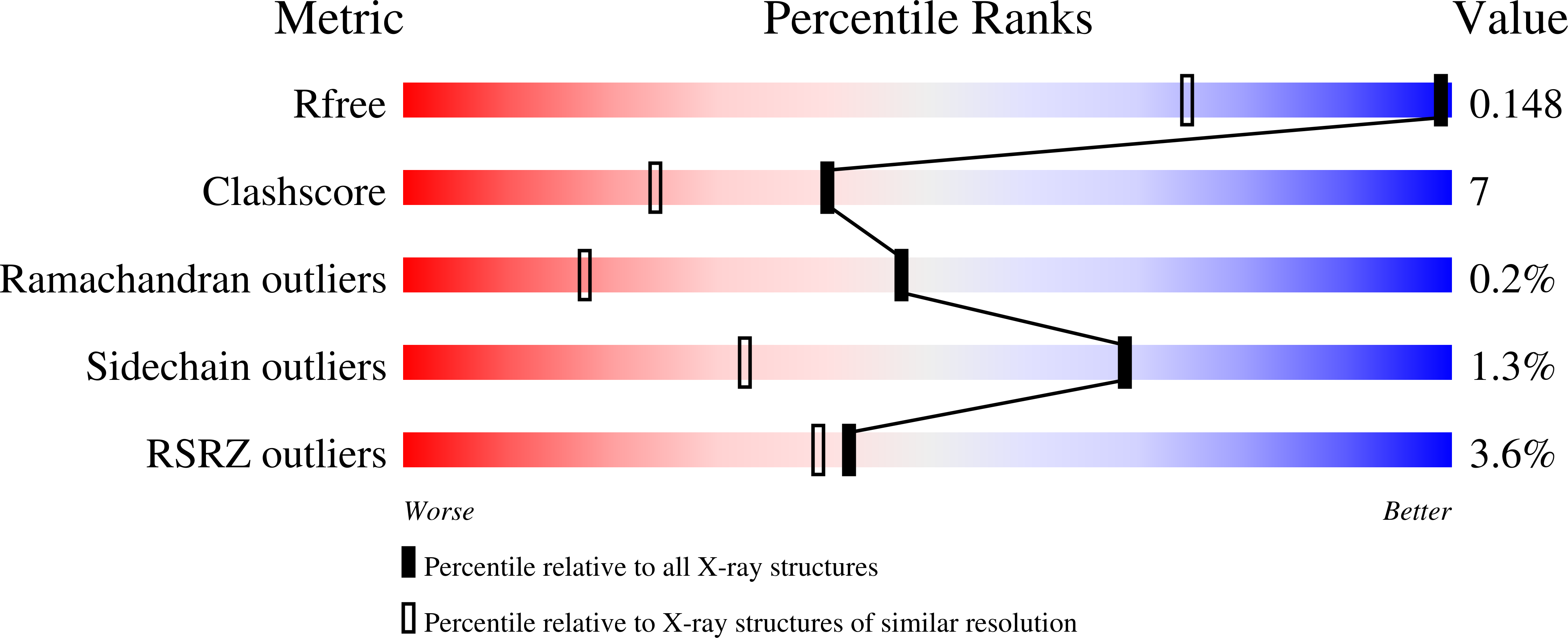
Macromolecular Entities
Structures with similar UniProt ID
Protein Blast
Polymer Type:polypeptide(L)
Molecule:Alr0975 protein
Gene (Uniprot):alr0975
Chain IDs:A, B
Chain Length:222
Number of Molecules:2
Biological Source:Nostoc sp. PCC 7120
Primary Citation
Structural and Biophysical Analysis of the Phytochelatin-Synthase-Like Enzyme from Nostoc sp. Shows That Its Protease Activity is Sensitive to the Redox State of the Substrate.
Acs Chem.Biol. 17 883 897 (2022)
PMID: 35377603 DOI: 10.1021/acschembio.1c00941

Abstact

Phytochelatins (PCs) are nonribosomal thiol-rich oligopeptides synthetized from glutathione (GSH) in a γ-glutamylcysteinyl transpeptidation reaction catalyzed by PC synthases (PCSs). Ubiquitous in plant and present in some invertebrates, PCSs are involved in metal detoxification and homeostasis. The PCS-like enzyme from the cyanobacterium Nostoc sp. (NsPCS) is considered to be an evolutionary precursor enzyme of genuine PCSs because it shows sufficient sequence similarity for homology to the catalytic domain of the eukaryotic PCSs and shares the peptidase activity consisting in the deglycination of GSH. In this work, we investigate the catalytic mechanism of NsPCS by combining structural, spectroscopic, thermodynamic, and theoretical techniques. We report several crystal structures of NsPCS capturing different states of the catalyzed chemical reaction: (i) the structure of the wild-type enzyme (wt-NsPCS); (ii) the high-resolution structure of the γ-glutamyl-cysteine acyl-enzyme intermediate (acyl-NsPCS); and (iii) the structure of an inactive variant of NsPCS, with the catalytic cysteine mutated into serine (C70S-NsPCS). We characterize NsPCS as a relatively slow enzyme whose activity is sensitive to the redox state of the substrate. Namely, NsPCS is active with reduced glutathione (GSH), but is inhibited by oxidized glutathione (GSSG) because the cleavage product is not released from the enzyme. Our biophysical analysis led us to suggest that the biological function of NsPCS is being a part of a redox sensing system. In addition, we propose a mechanism how PCS-like enzymes may have evolved toward genuine PCS enzymes.

Legend

Protein

Chemical

Disease

Primary Citation of related structures
Feedback Form
Name
Email
Institute
Feedback