6TDW image
Deposition Date 2019-11-10
Release Date 2019-11-27
Last Version Date 2024-05-22
Entry Detail
PDB ID:
6TDW
Title:
Cryo-EM structure of Euglena gracilis mitochondrial ATP synthase, peripheral stalk, rotational state 1
Biological Source:
Source Organism:
Method Details:
Experimental Method:
Resolution:
3.80 Å
Aggregation State:
PARTICLE
Reconstruction Method:
SINGLE PARTICLE
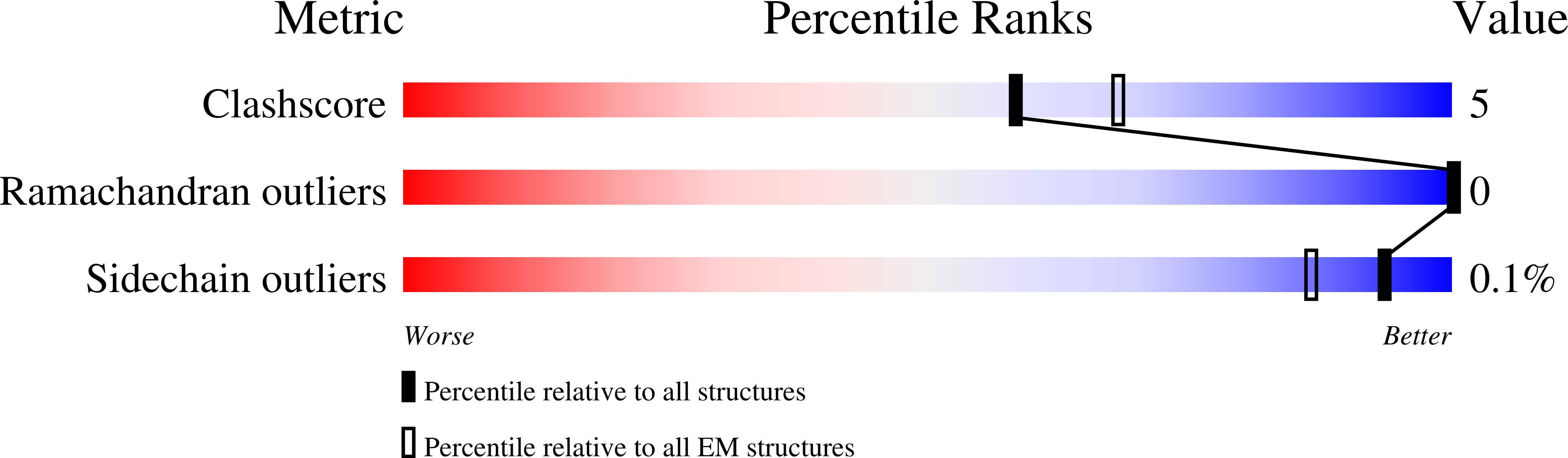
Macromolecular Entities
Polymer Type:polypeptide(L)
Molecule:ATPTB1
Chain IDs:A
Chain Length:487
Number of Molecules:1
Biological Source:Euglena gracilis
Polymer Type:polypeptide(L)
Molecule:ATPTB3
Chain IDs:C (auth: B)
Chain Length:338
Number of Molecules:1
Biological Source:Euglena gracilis
Polymer Type:polypeptide(L)
Molecule:ATPTB4
Chain IDs:D (auth: C)
Chain Length:169
Number of Molecules:1
Biological Source:Euglena gracilis
Polymer Type:polypeptide(L)
Molecule:subunit d
Chain IDs:B (auth: H)
Chain Length:476
Number of Molecules:1
Biological Source:Euglena gracilis
Polymer Type:polypeptide(L)
Molecule:oligomycin sensitivity conferrring protein (OSCP)
Chain IDs:E (auth: M)
Chain Length:267
Number of Molecules:1
Biological Source:Euglena gracilis
Polymer Type:polypeptide(L)
Molecule:subunit b
Chain IDs:F (auth: N)
Chain Length:112
Number of Molecules:1
Biological Source:Euglena gracilis
Polymer Type:polypeptide(L)
Molecule:subunit 8
Chain IDs:G (auth: T)
Chain Length:58
Number of Molecules:1
Biological Source:Euglena gracilis
Ligand Molecules
Primary Citation
Structure of a mitochondrial ATP synthase with bound native cardiolipin.
Elife 8 ? ? (2019)
PMID: 31738165 DOI: 10.7554/eLife.51179

Abstact

The mitochondrial ATP synthase fuels eukaryotic cells with chemical energy. Here we report the cryo-EM structure of a divergent ATP synthase dimer from mitochondria of Euglena gracilis, a member of the phylum Euglenozoa that also includes human parasites. It features 29 different subunits, 8 of which are newly identified. The membrane region was determined to 2.8 Å resolution, enabling the identification of 37 associated lipids, including 25 cardiolipins, which provides insight into protein-lipid interactions and their functional roles. The rotor-stator interface comprises four membrane-embedded horizontal helices, including a distinct subunit a. The dimer interface is formed entirely by phylum-specific components, and a peripherally associated subcomplex contributes to the membrane curvature. The central and peripheral stalks directly interact with each other. Last, the ATPase inhibitory factor 1 (IF1) binds in a mode that is different from human, but conserved in Trypanosomatids.

Legend

Protein

Chemical

Disease

Primary Citation of related structures
Feedback Form
Name
Email
Institute
Feedback