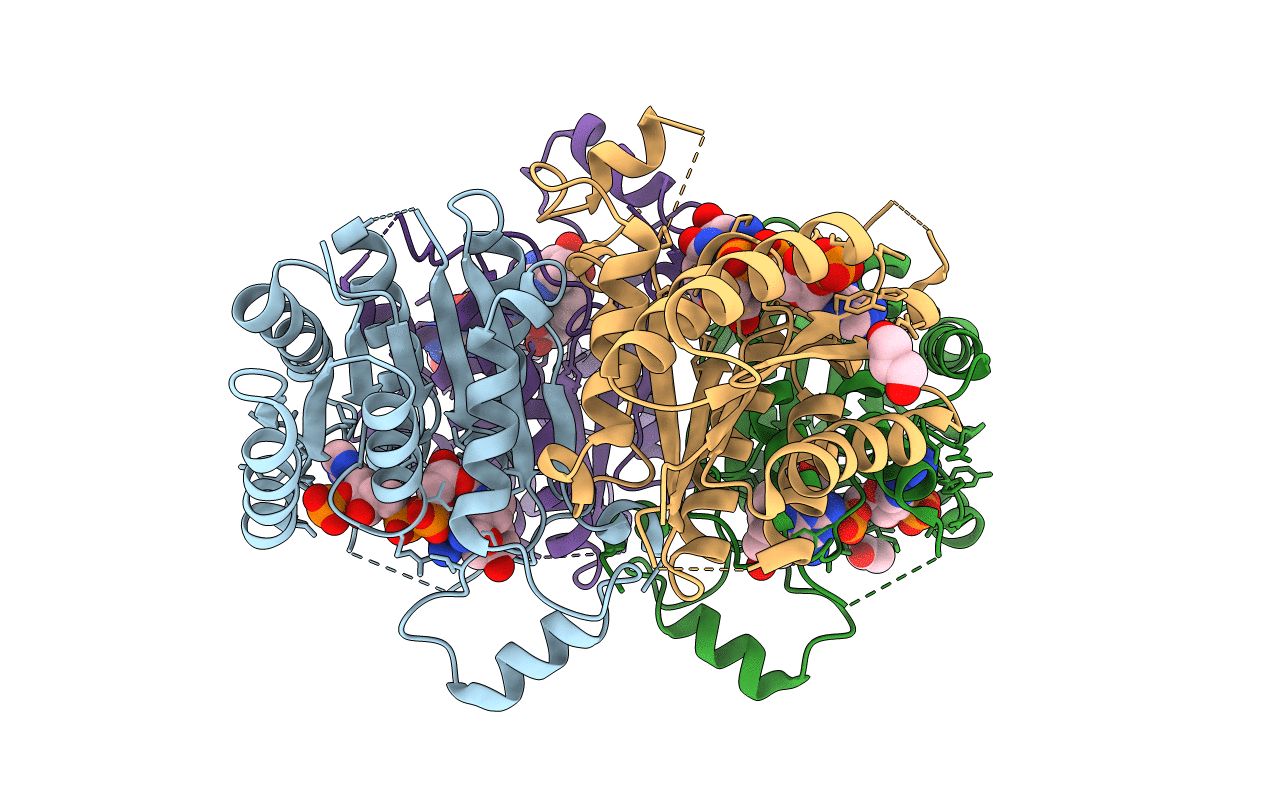
6TBX image
Deposition Date 2019-11-04
Release Date 2020-06-03
Last Version Date 2024-01-24
Entry Detail
PDB ID:
6TBX
Keywords:
Title:
Trypanosoma brucei PTR1 (TbPTR1) in complex with a tricyclic-based inhibitor
Biological Source:
Source Organism:
Method Details:
Experimental Method:
Resolution:
1.30 Å
R-Value Free:
0.15
R-Value Work:
0.12
R-Value Observed:
0.12
Space Group:
P 1 21 1

Macromolecular Entities
Structures with similar UniProt ID
Protein Blast
Polymer Type:polypeptide(L)
Molecule:Pteridine reductase
Gene (Uniprot):PTR1
Chain IDs:A, B, D
Chain Length:288
Number of Molecules:3
Biological Source:Trypanosoma brucei brucei
Structures with similar UniProt ID
Protein Blast
Polymer Type:polypeptide(L)
Molecule:Pteridine reductase
Gene (Uniprot):PTR1
Chain IDs:C
Chain Length:288
Number of Molecules:1
Biological Source:Trypanosoma brucei brucei
Modified Residue
Compound ID Chain ID Parent Comp ID Details 2D Image
CSX C CYS modified residue
Primary Citation
High-resolution crystal structure of Trypanosoma brucei pteridine reductase 1 in complex with an innovative tricyclic-based inhibitor.
Acta Crystallogr D Struct Biol 76 558 564 (2020)
PMID: 32496217 DOI: 10.1107/S2059798320004891

Abstact

The protozoan parasite Trypanosoma brucei is the etiological agent of human African trypanosomiasis (HAT). HAT, together with other neglected tropical diseases, causes serious health and economic issues, especially in tropical and subtropical areas. The classical antifolates targeting dihydrofolate reductase (DHFR) are ineffective towards trypanosomatid parasites owing to a metabolic bypass by the expression of pteridine reductase 1 (PTR1). The combined inhibition of PTR1 and DHFR activities in Trypanosoma parasites represents a promising strategy for the development of new effective treatments for HAT. To date, only monocyclic and bicyclic aromatic systems have been proposed as inhibitors of T. brucei PTR1 (TbPTR1); nevertheless, the size of the catalytic cavity allows the accommodation of expanded molecular cores. Here, an innovative tricyclic-based compound has been explored as a TbPTR1-targeting molecule and its potential application for the development of a new class of PTR1 inhibitors has been evaluated. 2,4-Diaminopyrimido[4,5-b]indol-6-ol (1) was designed and synthesized, and was found to be effective in blocking TbPTR1 activity, with a Ki in the low-micromolar range. The binding mode of 1 was clarified through the structural characterization of its ternary complex with TbPTR1 and the cofactor NADP(H), which was determined to 1.30 Å resolution. The compound adopts a substrate-like orientation inside the cavity that maximizes the binding contributions of hydrophobic and hydrogen-bond interactions. The binding mode of 1 was compared with those of previously reported bicyclic inhibitors, providing new insights for the design of innovative tricyclic-based molecules targeting TbPTR1.

Legend

Protein

Chemical

Disease

Primary Citation of related structures
Feedback Form
Name
Email
Institute
Feedback