6SYG image
Deposition Date 2019-09-27
Release Date 2020-03-04
Last Version Date 2024-01-24
Entry Detail
PDB ID:
6SYG
Title:
Crystal structure of the Cyclic Nucleotide-Binding Homology Domain of the human KCNH2 channel
Biological Source:
Source Organism(s):
Homo sapiens (Taxon ID: 9606)
Expression System(s):
Method Details:
Experimental Method:
Resolution:
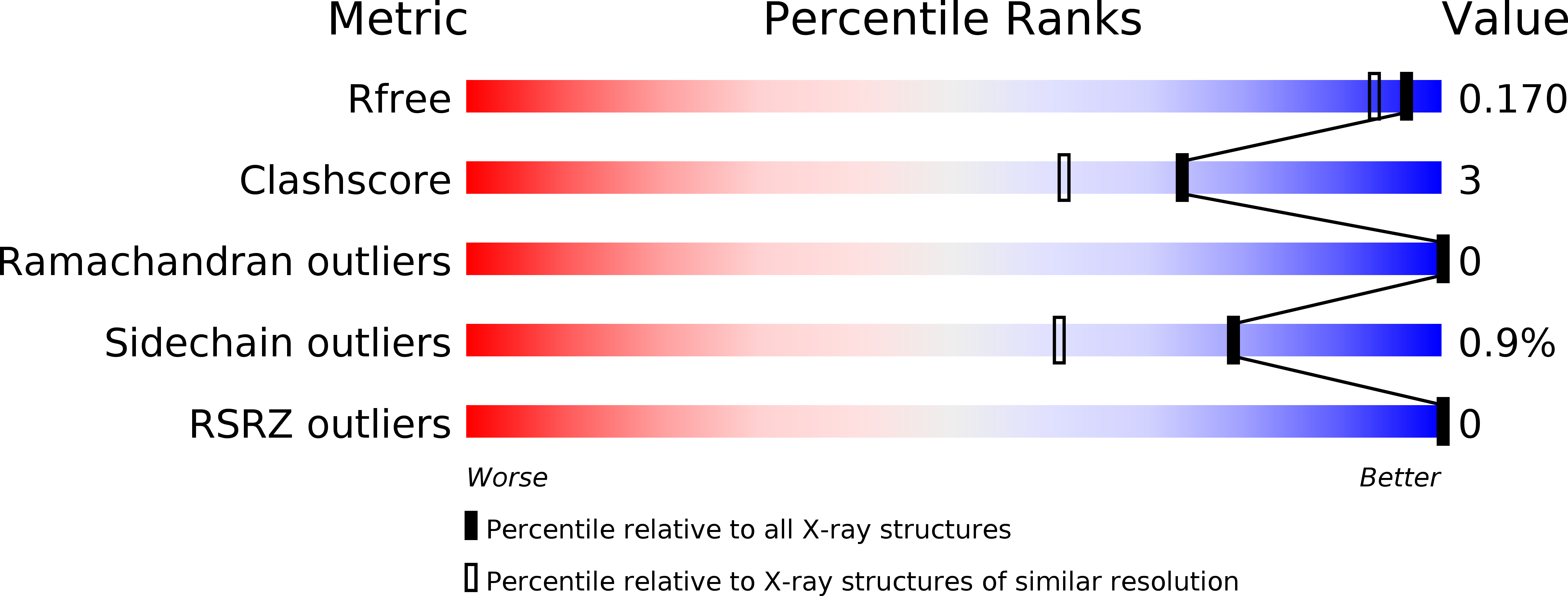
1.50 Å
R-Value Free:
0.18
R-Value Work:
0.17
R-Value Observed:
0.17
Space Group:
C 2 2 21
Macromolecular Entities
Structures with similar UniProt ID
Protein Blast
Polymer Type:polypeptide(L)
Molecule:Potassium voltage-gated channel subfamily H member 2
Chain IDs:A
Chain Length:135
Number of Molecules:1
Biological Source:Homo sapiens
Primary Citation
Structure of KCNH2 cyclic nucleotide-binding homology domain reveals a functionally vital salt-bridge.
J.Gen.Physiol. 152 ? ? (2020)
PMID: 32191791 DOI: 10.1085/jgp.201912505

Abstact

Human KCNH2 channels (hKCNH2, ether-à-go-go [EAG]-related gene, hERG) are best known for their contribution to cardiac action potential repolarization and have key roles in various pathologies. Like other KCNH family members, hKCNH2 channels contain a unique intracellular complex, consisting of an N-terminal eag domain and a C-terminal cyclic nucleotide-binding homology domain (CNBHD), which is crucial for channel function. Previous studies demonstrated that the CNBHD is occupied by an intrinsic ligand motif, in a self-liganded conformation, providing a structural mechanism for the lack of KCNH channel regulation by cyclic nucleotides. While there have been significant advancements in the structural and functional characterization of the CNBHD of KCNH channels, a high-resolution structure of the hKCNH2 intracellular complex has been missing. Here, we report the 1.5 Å resolution structure of the hKCNH2 channel CNBHD. The structure reveals the canonical fold shared by other KCNH family members, where the spatial organization of the intrinsic ligand is preserved within the β-roll region. Moreover, measurements of small-angle x-ray scattering profile in solution, as well as comparison with a recent NMR analysis of hKCNH2, revealed high agreement with the crystallographic structure, indicating an overall low flexibility in solution. Importantly, we identified a novel salt-bridge (E807-R863) which was not previously resolved in the NMR and cryo-EM structures. Electrophysiological analysis of charge-reversal mutations revealed the bridge's crucial role in hKCNH2 function. Moreover, comparison with other KCNH members revealed the structural conservation of this salt-bridge, consistent with its functional significance. Together with the available structure of the mouse KCNH1 intracellular complex and previous electrophysiological and spectroscopic studies of KCNH family members, we propose that this salt-bridge serves as a strategically positioned linchpin to support both the spatial organization of the intrinsic ligand and the maintenance of the intracellular complex interface.

Legend

Protein

Chemical

Disease

Primary Citation of related structures
Feedback Form
Name
Email
Institute
Feedback