6SQG image
Deposition Date 2019-09-03
Release Date 2019-11-06
Last Version Date 2024-10-23
Entry Detail
PDB ID:
6SQG
Title:
Crystal structure of viral rhodopsin OLPVRII
Biological Source:
Source Organism:
Host Organism:
Method Details:
Experimental Method:
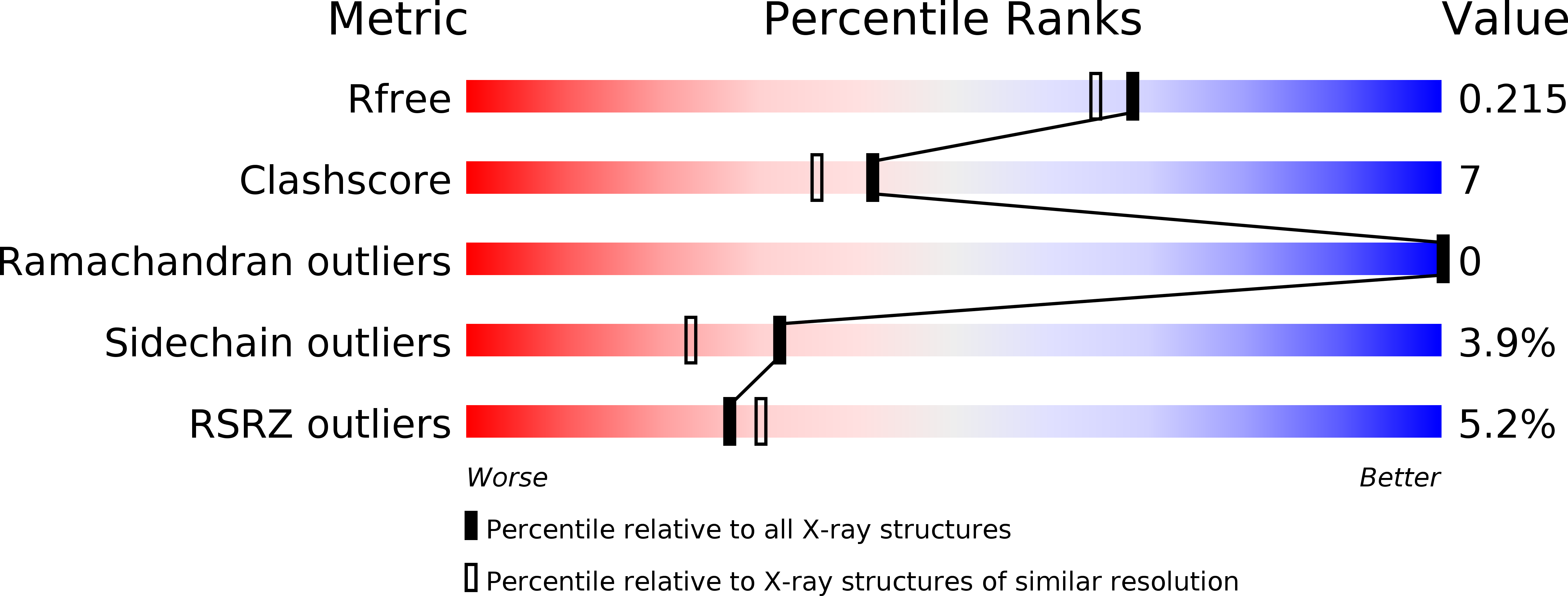
Resolution:
1.90 Å
R-Value Free:
0.20
R-Value Work:
0.17
R-Value Observed:
0.17
Space Group:
P 1 21 1
Macromolecular Entities
Structures with similar UniProt ID
Protein Blast
Polymer Type:polypeptide(L)
Molecule:viral rhodopsin OLPVRII
Gene (Uniprot):162286292
Chain IDs:A, B, C, D
Chain Length:211
Number of Molecules:4
Biological Source:Organic Lake phycodnavirus
Structures with similar UniProt ID
Protein Blast
Polymer Type:polypeptide(L)
Molecule:viral rhodopsin OLPVRII
Gene (Uniprot):162286292
Chain IDs:E
Chain Length:219
Number of Molecules:1
Biological Source:Organic Lake phycodnavirus
Primary Citation

Abstact

Recently, two groups of rhodopsin genes were identified in large double-stranded DNA viruses. The structure and function of viral rhodopsins are unknown. We present functional characterization and high-resolution structure of an Organic Lake Phycodnavirus rhodopsin II (OLPVRII) of group 2. It forms a pentamer, with a symmetrical, bottle-like central channel with the narrow vestibule in the cytoplasmic part covered by a ring of 5 arginines, whereas 5 phenylalanines form a hydrophobic barrier in its exit. The proton donor E42 is placed in the helix B. The structure is unique among the known rhodopsins. Structural and functional data and molecular dynamics suggest that OLPVRII might be a light-gated pentameric ion channel analogous to pentameric ligand-gated ion channels, however, future patch clamp experiments should prove this directly. The data shed light on a fundamentally distinct branch of rhodopsins and may contribute to the understanding of virus-host interactions in ecologically important marine protists.

Legend

Protein

Chemical

Disease

Primary Citation of related structures
Feedback Form
Name
Email
Institute
Feedback