6S6Y image
Deposition Date 2019-07-04
Release Date 2019-12-04
Last Version Date 2024-01-24
Entry Detail
PDB ID:
6S6Y
Keywords:
Title:
X-ray crystal structure of the formyltransferase/hydrolase complex (FhcABCD) from Methylorubrum extorquens in complex with methylofuran
Biological Source:
Source Organism(s):
Method Details:
Experimental Method:
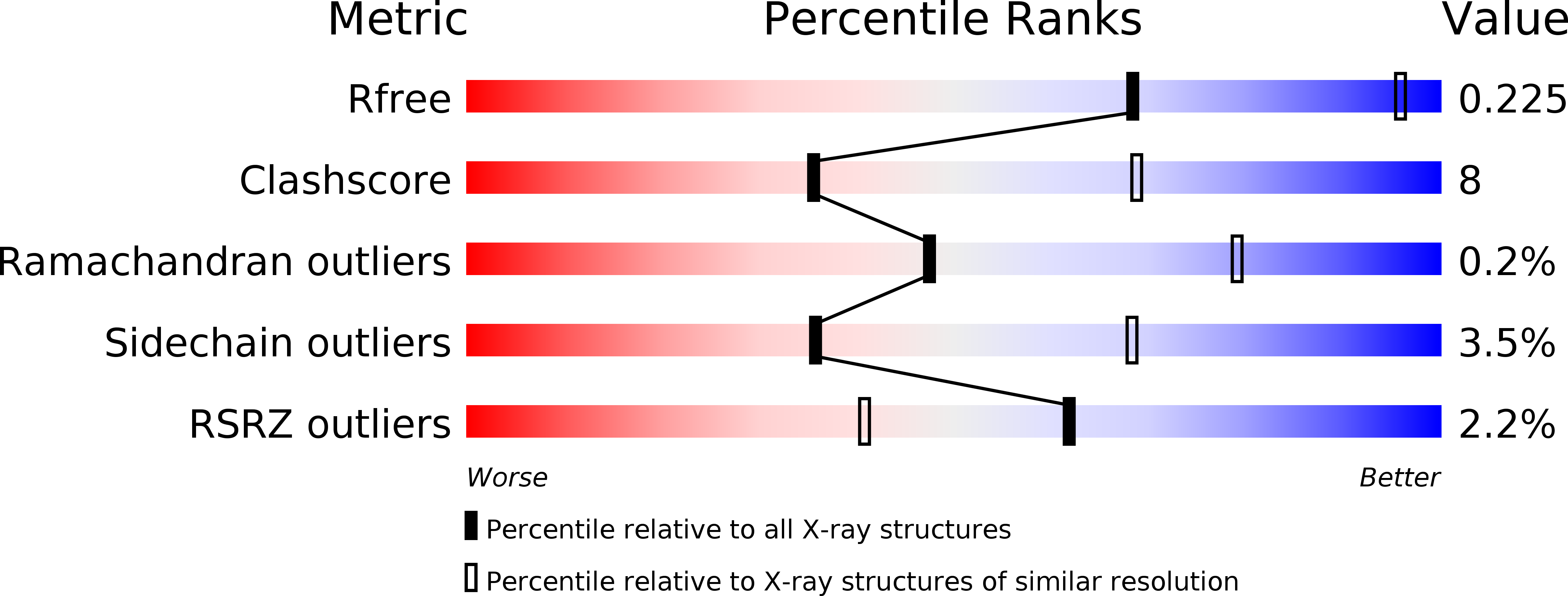
Resolution:
3.10 Å
R-Value Free:
0.25
R-Value Work:
0.22
R-Value Observed:
0.22
Space Group:
P 1
Macromolecular Entities
Polymer Type:polypeptide(L)
Molecule:Formylmethanofuran dehydrogenase subunit A
Mutagens:wild type
Chain IDs:A, E, I, M
Chain Length:548
Number of Molecules:4
Biological Source:Methylobacterium extorquens (strain PA1)
Polymer Type:polypeptide(L)
Molecule:Tungsten-containing formylmethanofuran dehydrogenase, subunit B
Chain IDs:B, F, J, N
Chain Length:361
Number of Molecules:4
Biological Source:Methylobacterium extorquens (strain PA1)
Polymer Type:polypeptide(L)
Molecule:Formylmethanofuran dehydrogenase subunit C
Chain IDs:C, G, K, O
Chain Length:276
Number of Molecules:4
Biological Source:Methylobacterium extorquens (strain PA1)
Polymer Type:polypeptide(L)
Molecule:Formylmethanofuran--tetrahydromethanopterin formyltransferase
Chain IDs:D, H, L, P
Chain Length:310
Number of Molecules:4
Biological Source:Methylobacterium extorquens (strain PA1)
Modified Residue
Compound ID Chain ID Parent Comp ID Details 2D Image
KCX A LYS modified residue
Primary Citation
Methylofuran is a prosthetic group of the formyltransferase/hydrolase complex and shuttles one-carbon units between two active sites.
Proc.Natl.Acad.Sci.USA 116 25583 25590 (2019)
PMID: 31776258 DOI: 10.1073/pnas.1911595116

Abstact

Methylotrophy, the ability of microorganisms to grow on reduced one-carbon substrates such as methane or methanol, is a feature of various bacterial species. The prevailing oxidation pathway depends on tetrahydromethanopterin (H4MPT) and methylofuran (MYFR), an analog of methanofuran from methanogenic archaea. Formyltransferase/hydrolase complex (Fhc) generates formate from formyl-H4MPT in two consecutive reactions where MYFR acts as a carrier of one-carbon units. Recently, we chemically characterized MYFR from the model methylotroph Methylorubrum extorquens and identified an unusually long polyglutamate side chain of up to 24 glutamates. Here, we report on the crystal structure of Fhc to investigate the function of the polyglutamate side chain in MYFR and the relatedness of the enzyme complex with the orthologous enzymes in archaea. We identified MYFR as a prosthetic group that is tightly, but noncovalently, bound to Fhc. Surprisingly, the structure of Fhc together with MYFR revealed that the polyglutamate side chain of MYFR is branched and contains glutamates with amide bonds at both their α- and γ-carboxyl groups. This negatively charged and branched polyglutamate side chain interacts with a cluster of conserved positively charged residues of Fhc, allowing for strong interactions. The MYFR binding site is located equidistantly from the active site of the formyltransferase (FhcD) and metallo-hydrolase (FhcA). The polyglutamate serves therefore an additional function as a swinging linker to shuttle the one-carbon carrying amine between the two active sites, thereby likely increasing overall catalysis while decreasing the need for high intracellular MYFR concentrations.

Legend

Protein

Chemical

Disease

Primary Citation of related structures
Feedback Form
Name
Email
Institute
Feedback