6S5P image
Deposition Date 2019-07-02
Release Date 2019-08-21
Last Version Date 2024-11-20
Entry Detail
PDB ID:
6S5P
Title:
Cfucosylated peptide SBL2 bound to Fucose binding Lectin LecB (PA-IIL) from Pseudomonas aeruginosa at 1.46 Angstrom resolution
Biological Source:
Source Organism:
Method Details:
Experimental Method:
Resolution:
1.46 Å
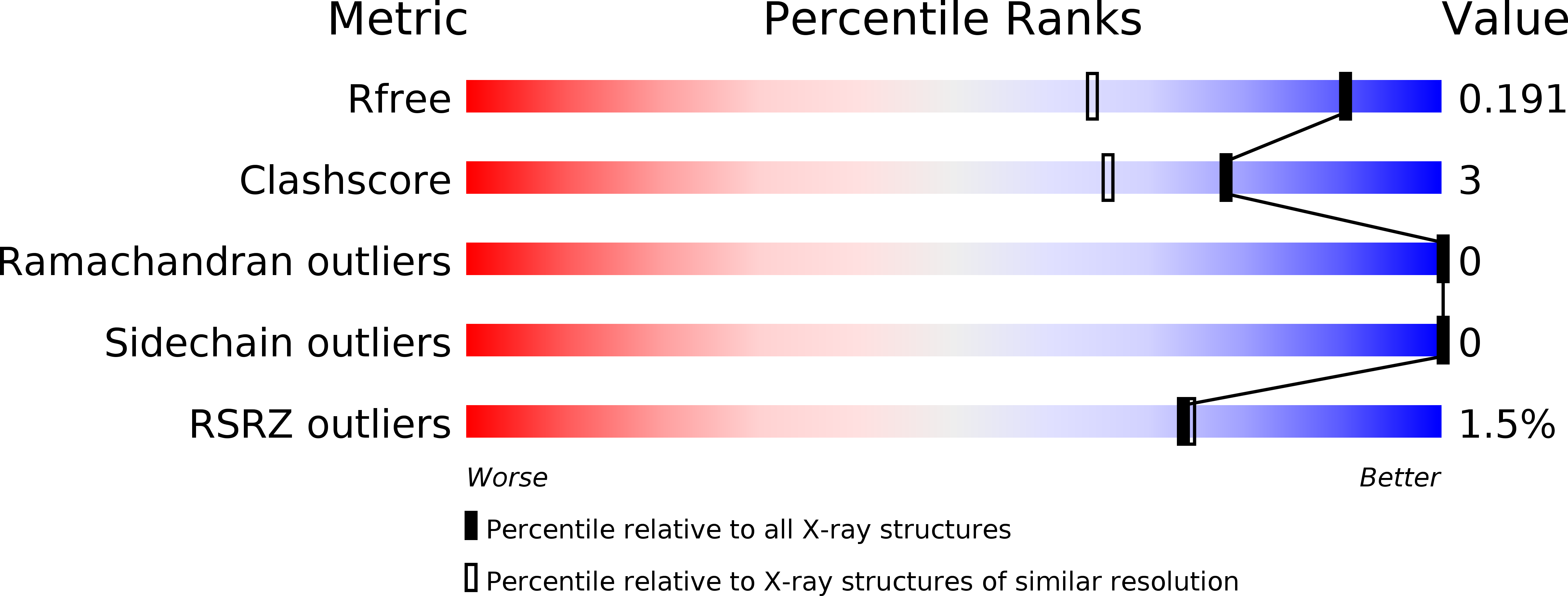
R-Value Free:
0.19
R-Value Work:
0.17
R-Value Observed:
0.17
Space Group:
P 21 21 2
Macromolecular Entities
Structures with similar UniProt ID
Protein Blast
Polymer Type:polypeptide(L)
Molecule:Fucose-binding lectin
Chain IDs:A, B, C, D
Chain Length:115
Number of Molecules:4
Biological Source:Pseudomonas aeruginosa
Polymer Type:polypeptide(L)
Molecule:SBL2
Chain IDs:E (auth: H), F (auth: E), G (auth: F)
Chain Length:7
Number of Molecules:3
Biological Source:synthetic construct
Primary Citation
X-ray Crystal Structures of Short Antimicrobial Peptides as Pseudomonas aeruginosa Lectin B Complexes.
Acs Chem.Biol. 14 758 766 (2019)
PMID: 30830745 DOI: 10.1021/acschembio.9b00047

Abstact

Herein, we report X-ray crystal structures of 11-13 residue antimicrobial peptides (AMPs) active against Pseudomonas aeruginosa as complexes of fucosylated d-enantiomeric sequences with the P. aeruginosa lectin LecB. These represent the first crystal structures of short AMPs. In 24 individual structures of eight different peptides, we found mostly α-helices assembled as two-helix or four-helix bundles with a hydrophobic core and cationic residues pointing outside. Two of the analogs formed an extended structure engaging in multiple contacts with the lectin. Molecular dynamics (MD) simulations showed that α-helices are stabilized by bundle formation and suggested that the N-terminal acyl group present in the linker to the fucosyl group can extend the helix by one additional H-bond and increase α-helix amphiphilicity. Investigating N-terminal acylation led to AMPs with equivalent and partly stronger antibacterial effects compared to the free peptide.

Legend

Protein

Chemical

Disease

Primary Citation of related structures
Feedback Form
Name
Email
Institute
Feedback