6S07 image
Deposition Date 2019-06-14
Release Date 2019-06-26
Last Version Date 2024-01-24
Entry Detail
PDB ID:
6S07
Keywords:
Title:
Structure of formylglycine-generating enzyme at 1.04 A in complex with copper and substrate reveals an acidic pocket for binding and acti-vation of molecular oxygen.
Biological Source:
Method Details:
Experimental Method:
Resolution:
1.04 Å
R-Value Free:
0.18
R-Value Work:
0.17
R-Value Observed:
0.17
Space Group:
P 21 21 21
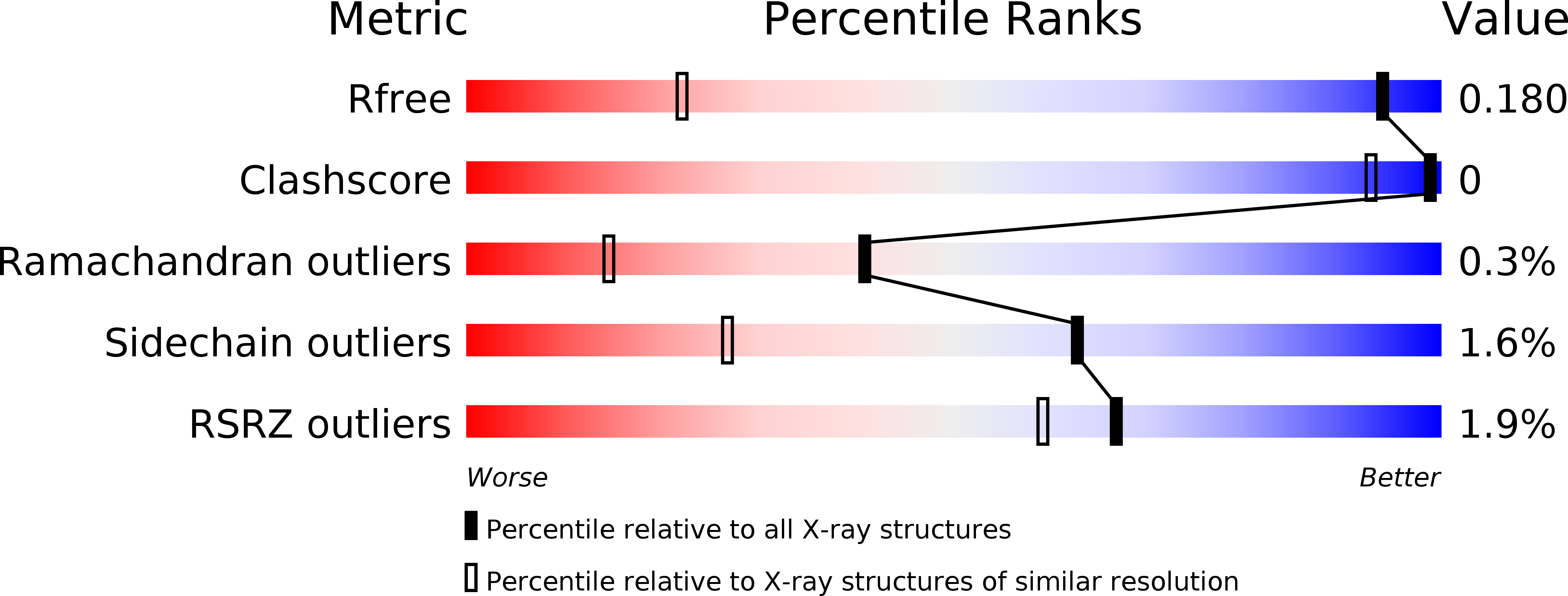
Macromolecular Entities
Structures with similar UniProt ID
Protein Blast
Polymer Type:polypeptide(L)
Molecule:Formylglycine-generating enzyme
Gene (Uniprot):Tcur_4811
Chain IDs:A
Chain Length:303
Number of Molecules:1
Biological Source:Thermomonospora curvata (strain ATCC 19995 / DSM 43183 / JCM 3096 / NBRC 15933 / NCIMB 10081 / Henssen B9)
Structures with similar UniProt ID
Protein Blast
Polymer Type:polypeptide(L)
Molecule:Abz-ALA-THR-THR-PRO-LEU-CYS-GLY-PRO-SER-ARG-ALA-SER-ILE-LEU-SER-GLY-ARG
Chain IDs:B (auth: C)
Chain Length:17
Number of Molecules:1
Biological Source:Thermomonospora curvata DSM 43183
Primary Citation
Structure of formylglycine-generating enzyme in complex with copper and a substrate reveals an acidic pocket for binding and activation of molecular oxygen.
Chem Sci 10 7049 7058 (2019)
PMID: 31588272 DOI: 10.1039/c9sc01723b

Abstact

The formylglycine generating enzyme (FGE) catalyzes oxidative conversion of specific peptidyl-cysteine residues to formylglycine. FGE mediates O2-activation and hydrogen-atom abstraction in an active site that contains Cu(i) coordinated to two cysteine residues. Similar coordination geometries are common among copper-sensing transcription factors and copper-chaperone but are unprecedented among copper-dependent oxidases. To examine the mechanism of this unusual catalyst we determined the 1.04 Å structure of FGE from Thermomonospora curvata in complex with copper and a cysteine-containing peptide substrate. This structure unveils a network of four crystallographic waters and two active site residues that form a highly acidic O2-binding pocket juxtaposed to the trigonal planar tris-cysteine coordinated Cu(i) center. Comparison with structures of FGE in complex with Ag(i) and Cd(ii) combined with evidence from NMR spectroscopy and kinetic observations highlight several structural changes that are induced by substrate binding and prime the enzyme for O2-binding and subsequent activation.

Legend

Protein

Chemical

Disease

Primary Citation of related structures
Feedback Form
Name
Email
Institute
Feedback