6RJB image
Deposition Date 2019-04-26
Release Date 2019-09-11
Last Version Date 2024-05-15
Entry Detail
PDB ID:
6RJB
Keywords:
Title:
Human transketolase variant T382E
Biological Source:
Source Organism:
Homo sapiens (Taxon ID: 9606)
Method Details:
Experimental Method:
Resolution:
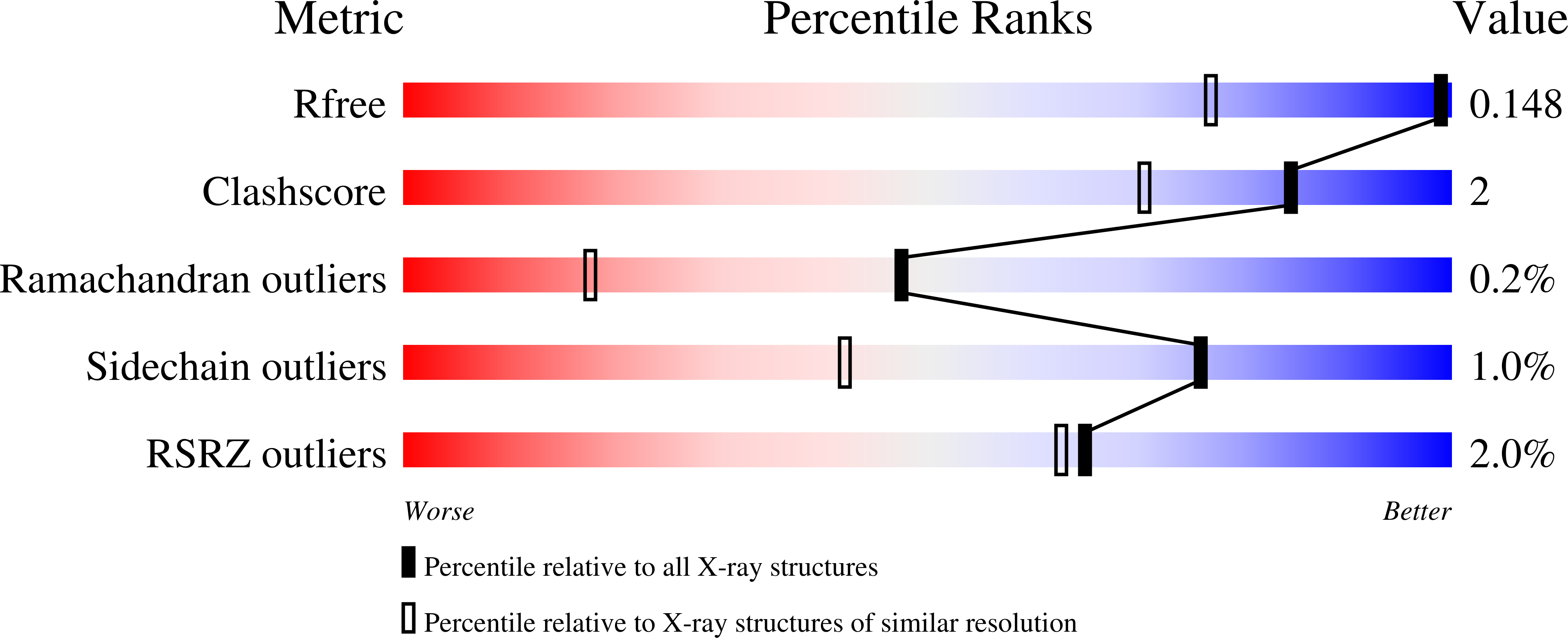
1.15 Å
R-Value Free:
0.14
R-Value Work:
0.12
R-Value Observed:
0.12
Space Group:
P 1 21 1
Macromolecular Entities
Structures with similar UniProt ID
Protein Blast
Polymer Type:polypeptide(L)
Molecule:Transketolase
Gene (Uniprot):TKT
Chain IDs:A, B
Chain Length:637
Number of Molecules:2
Biological Source:Homo sapiens
Primary Citation
Low-barrier hydrogen bonds in enzyme cooperativity.
Nature 573 609 613 (2019)
PMID: 31534226 DOI: 10.1038/s41586-019-1581-9

Abstact

The underlying molecular mechanisms of cooperativity and allosteric regulation are well understood for many proteins, with haemoglobin and aspartate transcarbamoylase serving as prototypical examples1,2. The binding of effectors typically causes a structural transition of the protein that is propagated through signalling pathways to remote sites and involves marked changes on the tertiary and sometimes even the quaternary level1-5. However, the origin of these signals and the molecular mechanism of long-range signalling at an atomic level remain unclear5-8. The different spatial scales and timescales in signalling pathways render experimental observation challenging; in particular, the positions and movement of mobile protons cannot be visualized by current methods of structural analysis. Here we report the experimental observation of fluctuating low-barrier hydrogen bonds as switching elements in cooperativity pathways of multimeric enzymes. We have observed these low-barrier hydrogen bonds in ultra-high-resolution X-ray crystallographic structures of two multimeric enzymes, and have validated their assignment using computational calculations. Catalytic events at the active sites switch between low-barrier hydrogen bonds and ordinary hydrogen bonds in a circuit that consists of acidic side chains and water molecules, transmitting a signal through the collective repositioning of protons by behaving as an atomistic Newton's cradle. The resulting communication synchronizes catalysis in the oligomer. Our studies provide several lines of evidence and a working model for not only the existence of low-barrier hydrogen bonds in proteins, but also a connection to enzyme cooperativity. This finding suggests new principles of drug and enzyme design, in which sequences of residues can be purposefully included to enable long-range communication and thus the regulation of engineered biomolecules.

Legend

Protein

Chemical

Disease

Primary Citation of related structures
Feedback Form
Name
Email
Institute
Feedback