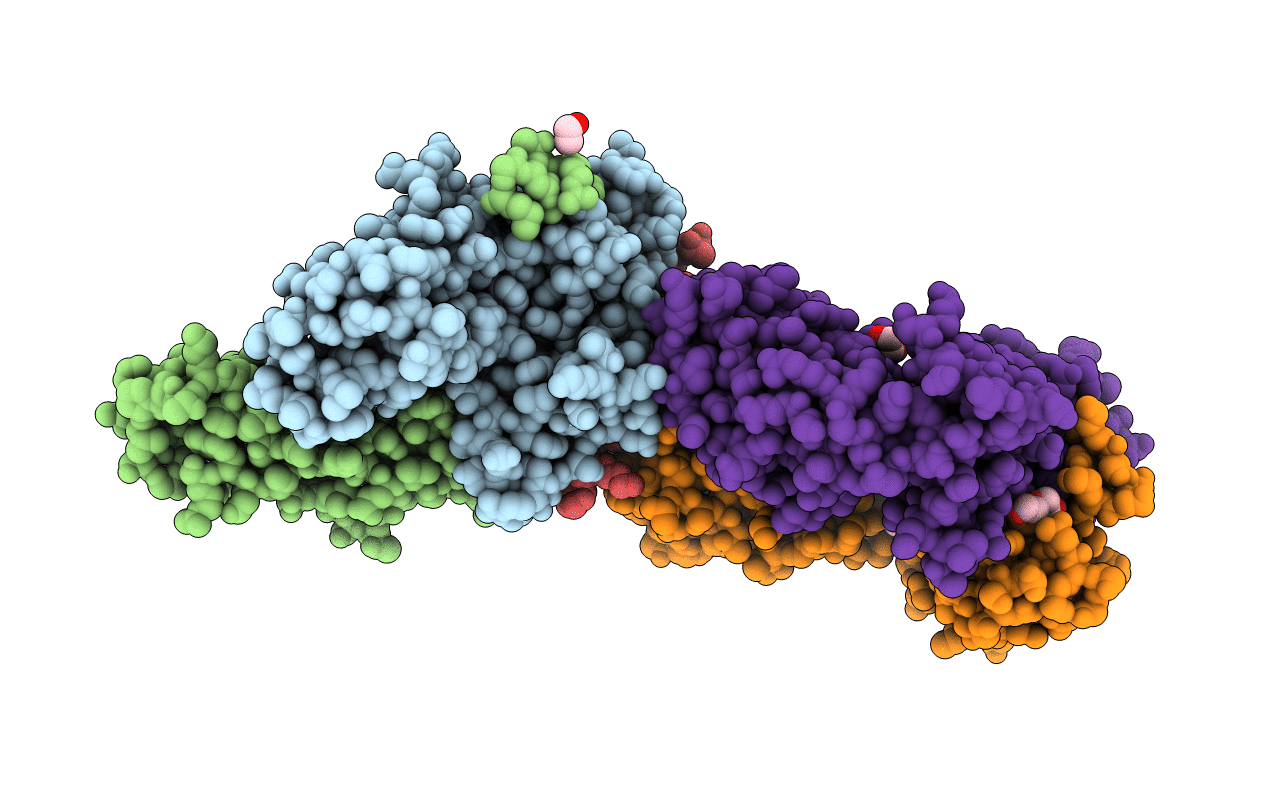
6R0E image
Deposition Date 2019-03-12
Release Date 2020-07-15
Last Version Date 2024-11-20
Entry Detail
PDB ID:
6R0E
Keywords:
Title:
Structure of F11TCR in complex with DR1 MHC Class II presenting PKYVKQNTLKLAT
Biological Source:
Source Organism:
Homo sapiens (Taxon ID: 9606)
Influenza A virus (Taxon ID: 11320)
Host Organism:
Method Details:
Experimental Method:
Resolution:
1.91 Å
R-Value Free:
0.23
R-Value Work:
0.20
Space Group:
P 21 21 2

Macromolecular Entities
Structures with similar UniProt ID
Protein Blast
Polymer Type:polypeptide(L)
Molecule:HLA class II histocompatibility antigen, DR alpha chain
Gene (Uniprot):HLA-DRA
Chain IDs:A (auth: AAA)
Chain Length:183
Number of Molecules:1
Biological Source:Homo sapiens
Structures with similar UniProt ID
Protein Blast
Polymer Type:polypeptide(L)
Molecule:HLA class II histocompatibility antigen, DRB1-1 beta chain
Chain IDs:B (auth: BBB)
Chain Length:191
Number of Molecules:1
Biological Source:Homo sapiens
Structures with similar UniProt ID
Protein Blast
Polymer Type:polypeptide(L)
Molecule:Hemagglutinin
Gene (Uniprot):HA
Chain IDs:C (auth: CCC)
Chain Length:13
Number of Molecules:1
Biological Source:Influenza A virus
Polymer Type:polypeptide(L)
Molecule:F11-TCR Alpha Chain
Chain IDs:D (auth: DDD)
Chain Length:202
Number of Molecules:1
Biological Source:Homo sapiens
Polymer Type:polypeptide(L)
Molecule:F11-TCR Beta Chain
Chain IDs:E (auth: EEE)
Chain Length:240
Number of Molecules:1
Biological Source:Homo sapiens
Primary Citation
CD4+T Cells Recognize Conserved Influenza A Epitopes through Shared Patterns of V-Gene Usage and Complementary Biochemical Features.
Cell Rep 32 107885 107885 (2020)
PMID: 32668259 DOI: 10.1016/j.celrep.2020.107885

Abstact

T cell recognition of peptides presented by human leukocyte antigens (HLAs) is mediated by the highly variable T cell receptor (TCR). Despite this built-in TCR variability, individuals can mount immune responses against viral epitopes by using identical or highly related TCRs expressed on CD8+ T cells. Characterization of these TCRs has extended our understanding of the molecular mechanisms that govern the recognition of peptide-HLA. However, few examples exist for CD4+ T cells. Here, we investigate CD4+ T cell responses to the internal proteins of the influenza A virus that correlate with protective immunity. We identify five internal epitopes that are commonly recognized by CD4+ T cells in five HLA-DR1+ subjects and show conservation across viral strains and zoonotic reservoirs. TCR repertoire analysis demonstrates several shared gene usage biases underpinned by complementary biochemical features evident in a structural comparison. These epitopes are attractive targets for vaccination and other T cell therapies.

Legend

Protein

Chemical

Disease

Primary Citation of related structures
Feedback Form
Name
Email
Institute
Feedback