6QJ3 image
Deposition Date 2019-01-22
Release Date 2019-07-03
Last Version Date 2024-10-16
Entry Detail
PDB ID:
6QJ3
Keywords:
Title:
Crystal structure of the C. thermophilum condensin Ycs4-Brn1 subcomplex
Biological Source:
Method Details:
Experimental Method:
Resolution:
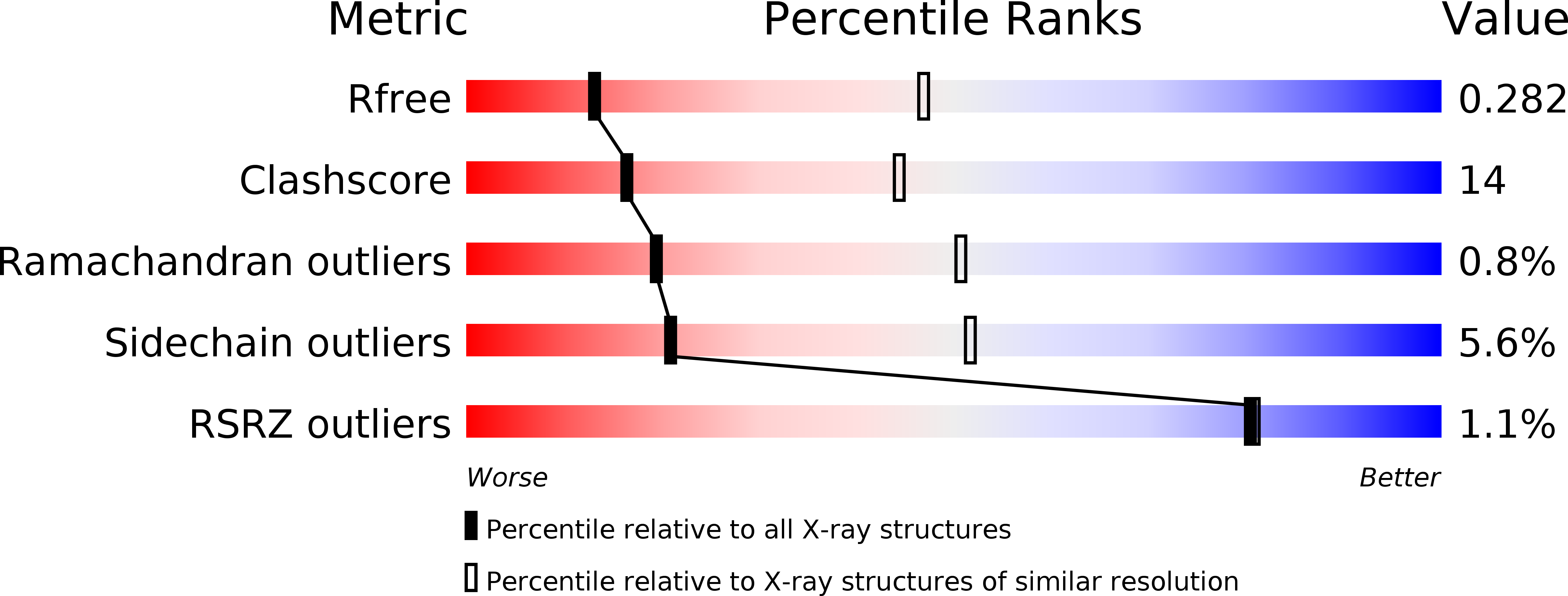
3.30 Å
R-Value Free:
0.28
R-Value Work:
0.23
R-Value Observed:
0.23
Space Group:
P 1 21 1
Macromolecular Entities
Structures with similar UniProt ID
Protein Blast
Polymer Type:polypeptide(L)
Molecule:Condensin complex subunit 1,Condensin complex subunit 1,Ycs4
Gene (Uniprot):CTHT_0049230
Chain IDs:A
Chain Length:1155
Number of Molecules:1
Biological Source:Chaetomium thermophilum (strain DSM 1495 / CBS 144.50 / IMI 039719), Chaetomium thermophilum
Structures with similar UniProt ID
Protein Blast
Polymer Type:polypeptide(L)
Molecule:Condensin complex subunit 2
Gene (Uniprot):CTHT_0053810
Chain IDs:B
Chain Length:197
Number of Molecules:1
Biological Source:Chaetomium thermophilum (strain DSM 1495 / CBS 144.50 / IMI 039719)
Polymer Type:polypeptide(L)
Molecule:Brn1
Chain IDs:C
Chain Length:20
Number of Molecules:1
Biological Source:Chaetomium thermophilum
Modified Residue
Compound ID Chain ID Parent Comp ID Details 2D Image
MSE A MET modified residue
Ligand Molecules
Primary Citation
Structural Basis of an Asymmetric Condensin ATPase Cycle.
Mol.Cell 74 1175 1188.e9 (2019)
PMID: 31226277 DOI: 10.1016/j.molcel.2019.03.037

Abstact

The condensin protein complex plays a key role in the structural organization of genomes. How the ATPase activity of its SMC subunits drives large-scale changes in chromosome topology has remained unknown. Here we reconstruct, at near-atomic resolution, the sequence of events that take place during the condensin ATPase cycle. We show that ATP binding induces a conformational switch in the Smc4 head domain that releases its hitherto undescribed interaction with the Ycs4 HEAT-repeat subunit and promotes its engagement with the Smc2 head into an asymmetric heterodimer. SMC head dimerization subsequently enables nucleotide binding at the second active site and disengages the Brn1 kleisin subunit from the Smc2 coiled coil to open the condensin ring. These large-scale transitions in the condensin architecture lay out a mechanistic path for its ability to extrude DNA helices into large loop structures.

Legend

Protein

Chemical

Disease

Primary Citation of related structures
Feedback Form
Name
Email
Institute
Feedback