6QA2 image
Deposition Date 2018-12-18
Release Date 2019-02-27
Last Version Date 2024-01-24
Entry Detail
PDB ID:
6QA2
Keywords:
Title:
R80A MUTANT OF NUCLEOSIDE DIPHOSPHATE KINASE FROM MYCOBACTERIUM TUBERCULOSIS
Biological Source:
Method Details:
Experimental Method:
Resolution:
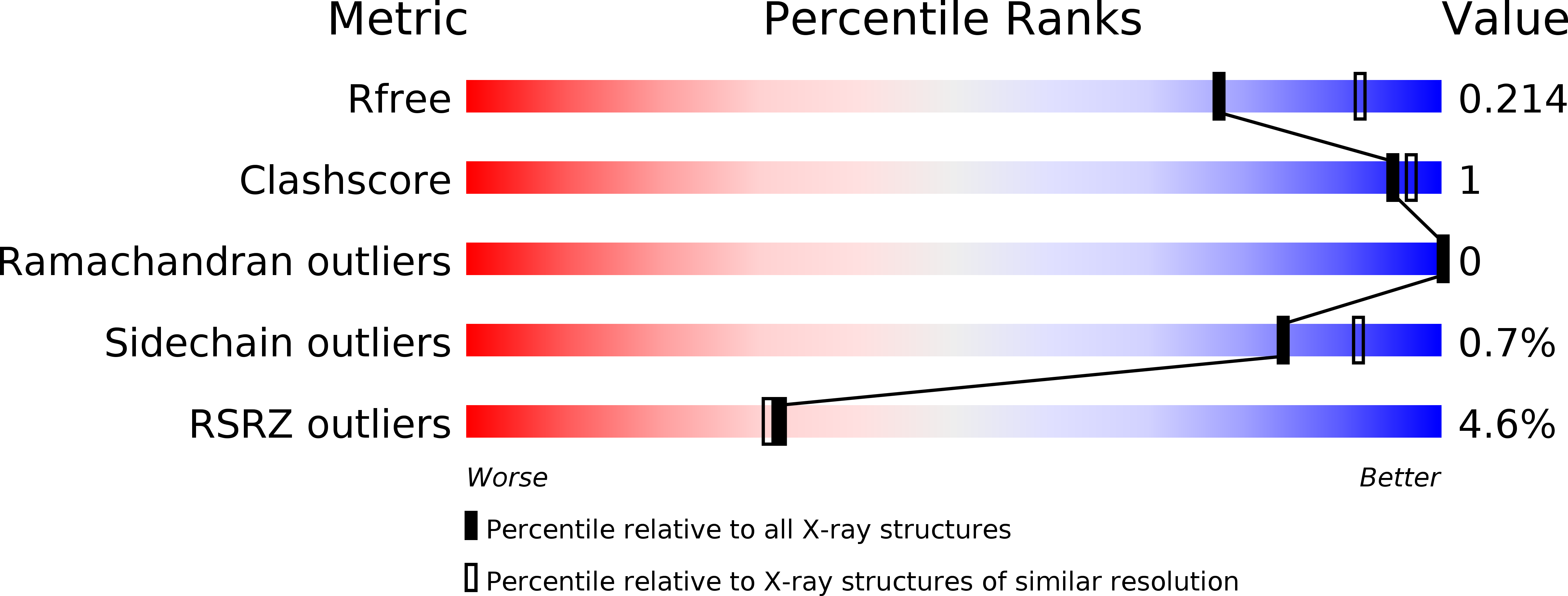
2.20 Å
R-Value Free:
0.21
R-Value Work:
0.18
R-Value Observed:
0.18
Space Group:
I 2 2 2
Macromolecular Entities
Structures with similar UniProt ID
Protein Blast
Polymer Type:polypeptide(L)
Molecule:Nucleoside diphosphate kinase
Mutagens:R80A
Chain IDs:A, B, C, D, E, F
Chain Length:136
Number of Molecules:6
Biological Source:Mycobacterium tuberculosis (strain ATCC 25177 / H37Ra)
Primary Citation
Remodeling of the Binding Site of Nucleoside Diphosphate Kinase Revealed by X-ray Structure and H/D Exchange.
Biochemistry 58 1440 1449 (2019)
PMID: 30785730 DOI: 10.1021/acs.biochem.8b01308

Abstact

To be fully active and participate in the metabolism of phosphorylated nucleotides, most nucleoside diphosphate kinases (NDPKs) have to assemble into stable hexamers. Here we studied the role played by six intersubunit salt bridges R80-D93 in the stability of NDPK from the pathogen Mycobacterium tuberculosis (Mt). Mutating R80 into Ala or Asn abolished the salt bridges. Unexpectedly, compensatory stabilizing mechanisms appeared for R80A and R80N mutants and we studied them by biochemical and structural methods. The R80A mutant crystallized into space group I222 that is unusual for NDPK, and its hexameric structure revealed the occurrence at the trimer interface of a stabilizing hydrophobic patch around the mutation. Functionally relevant, a trimer of the R80A hexamer showed a remodeling of the binding site. In this conformation, the cleft of the active site is more open, and then active His117 is more accessible to substrates. H/D exchange mass spectrometry analysis of the wild type and the R80A and R80N mutants showed that the remodeled region of the protein is highly solvent accessible, indicating that equilibrium between open and closed conformations is possible. We propose that such equilibrium occurs in vivo and explains how bulky substrates access the catalytic His117.

Legend

Protein

Chemical

Disease

Primary Citation of related structures
Feedback Form
Name
Email
Institute
Feedback