6PXX image
Deposition Date 2019-07-28
Release Date 2019-10-09
Last Version Date 2024-11-20
Entry Detail
PDB ID:
6PXX
Title:
Class D beta-lactamase in complex with beta-lactam antibiotic
Biological Source:
Source Organism:
Host Organism:
Method Details:
Experimental Method:
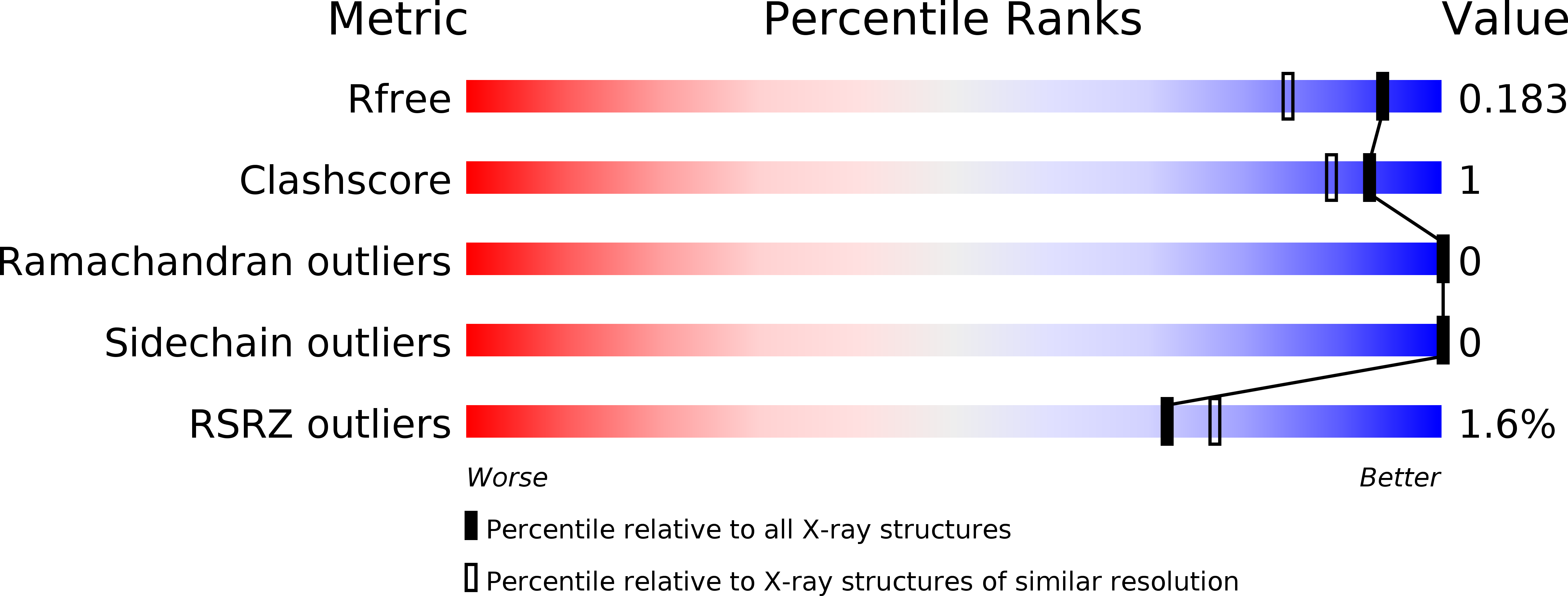
Resolution:
1.50 Å
R-Value Free:
0.17
R-Value Work:
0.15
R-Value Observed:
0.15
Space Group:
P 21 21 2
Macromolecular Entities
Structures with similar UniProt ID
Protein Blast
Polymer Type:polypeptide(L)
Molecule:Beta-lactamase
Gene (Uniprot):OXA-48
Mutagens:K73A
Chain IDs:A, B
Chain Length:265
Number of Molecules:2
Biological Source:Klebsiella pneumoniae
Primary Citation
Structural Analysis of The OXA-48 Carbapenemase Bound to A "Poor" Carbapenem Substrate, Doripenem.
Antibiotics 8 ? ? (2019)
PMID: 31514291 DOI: 10.3390/antibiotics8030145

Abstact

Carbapenem-resistant Enterobacteriaceae are a significant threat to public health, and a major resistance determinant that promotes this phenotype is the production of the OXA-48 carbapenemase. The activity of OXA-48 towards carbapenems is a puzzling phenotype as its hydrolytic activity against doripenem is non-detectable. To probe the mechanistic basis for this observation, we determined the 1.5 Å resolution crystal structure of the deacylation deficient K73A variant of OXA-48 in complex with doripenem. Doripenem is observed in the Δ1R and Δ1S tautomeric states covalently attached to the catalytic S70 residue. Likely due to positioning of residue Y211, the carboxylate moiety of doripenem is making fewer hydrogen bonding/salt-bridge interactions with R250 compared to previously determined carbapenem OXA structures. Moreover, the hydroxyethyl side chain of doripenem is making van der Waals interactions with a key V120 residue, which likely affects the deacylation rate of doripenem. We hypothesize that positions V120 and Y211 play important roles in the carbapenemase profile of OXA-48. Herein, we provide insights for the further development of the carbapenem class of antibiotics that could render them less effective to hydrolysis by or even inhibit OXA carbapenemases.

Legend

Protein

Chemical

Disease

Primary Citation of related structures
Feedback Form
Name
Email
Institute
Feedback