6PKD image
Deposition Date 2019-06-29
Release Date 2019-09-11
Last Version Date 2024-11-06
Entry Detail
PDB ID:
6PKD
Keywords:
Title:
Myocilin OLF mutant N428D/D478H
Biological Source:
Source Organism:
Homo sapiens (Taxon ID: 9606)
Method Details:
Experimental Method:
Resolution:
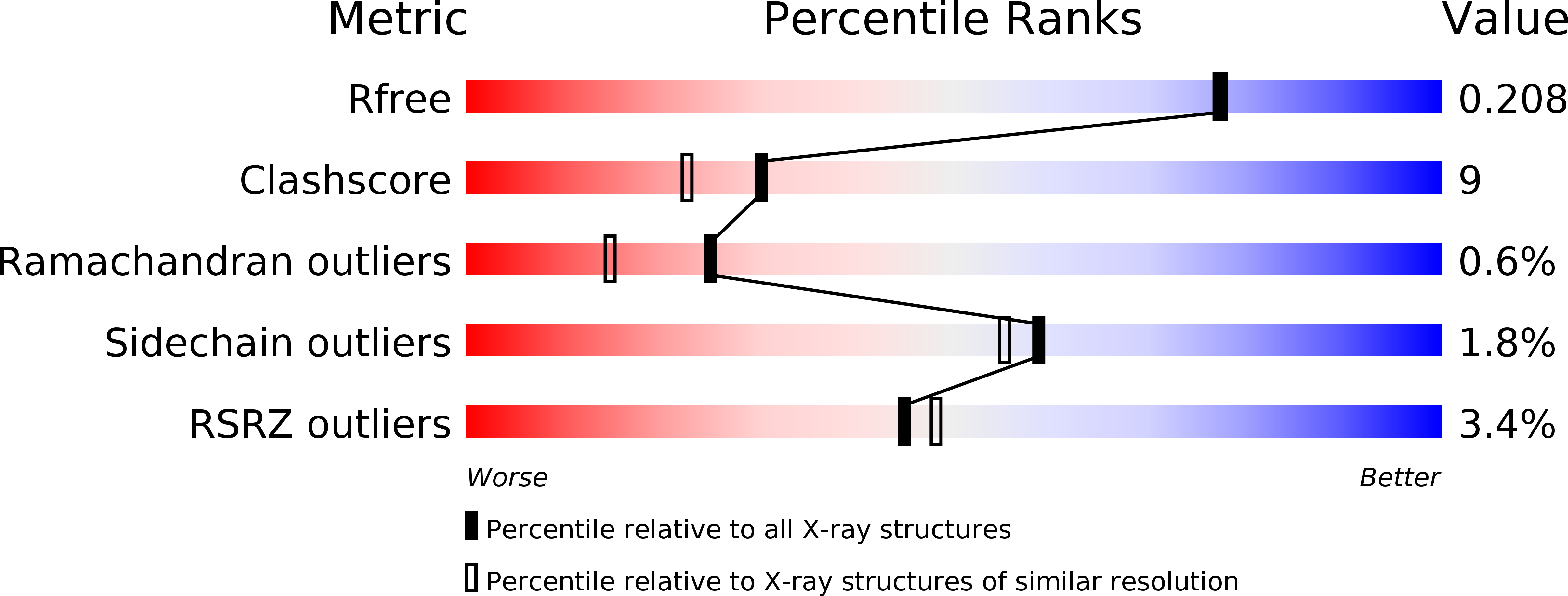
1.90 Å
R-Value Free:
0.20
R-Value Work:
0.18
R-Value Observed:
0.18
Space Group:
P 1 21 1
Macromolecular Entities
Structures with similar UniProt ID
Protein Blast
Polymer Type:polypeptide(L)
Molecule:Myocilin
Gene (Uniprot):MYOC
Mutagens:N428D, D478H
Chain IDs:A, B
Chain Length:277
Number of Molecules:2
Biological Source:Homo sapiens
Ligand Molecules
Primary Citation
Calcium-ligand variants of the myocilin olfactomedin propeller selected from invertebrate phyla reveal cross-talk with N-terminal blade and surface helices.
Acta Crystallogr D Struct Biol 75 817 824 (2019)
PMID: 31478904 DOI: 10.1107/S205979831901074X

Abstact

Olfactomedins are a family of modular proteins found in multicellular organisms that all contain five-bladed β-propeller olfactomedin (OLF) domains. In support of differential functions for the OLF propeller, the available crystal structures reveal that only some OLF domains harbor an internal calcium-binding site with ligands derived from a triad of residues. For the myocilin OLF domain (myoc-OLF), ablation of the ion-binding site (triad Asp, Asn, Asp) by altering the coordinating residues affects the stability and overall structure, in one case leading to misfolding and glaucoma. Bioinformatics analysis reveals a variety of triads with possible ion-binding characteristics lurking in OLF domains in invertebrate chordates such as Arthropoda (Asp-Glu-Ser), Nematoda (Asp-Asp-His) and Echinodermata (Asp-Glu-Lys). To test ion binding and to extend the observed connection between ion binding and distal structural rearrangements, consensus triads from these phyla were installed in the myoc-OLF. All three protein variants exhibit wild-type-like or better stability, but their calcium-binding properties differ, concomitant with new structural deviations from wild-type myoc-OLF. Taken together, the results indicate that calcium binding is not intrinsically destabilizing to myoc-OLF or required to observe a well ordered side helix, and that ion binding is a differential feature that may underlie the largely elusive biological function of OLF propellers.

Legend

Protein

Chemical

Disease

Primary Citation of related structures
Feedback Form
Name
Email
Institute
Feedback