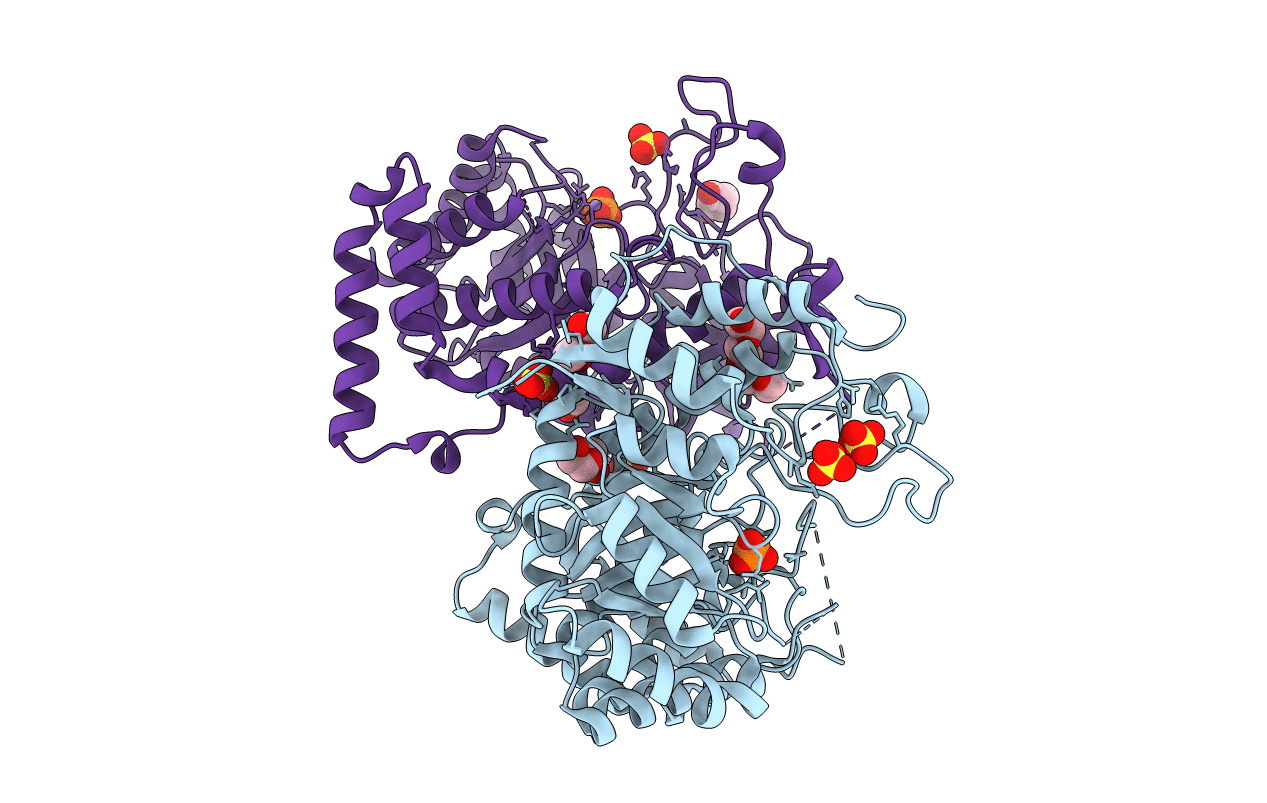
6PBJ image
Deposition Date 2019-06-13
Release Date 2020-04-08
Last Version Date 2023-10-11
Entry Detail
PDB ID:
6PBJ
Keywords:
Title:
The structure of 3-deoxy-d-arabino-heptulosonate 7-phosphate synthase with Gly190Pro mutation
Biological Source:
Source Organism:
Host Organism:
Method Details:
Experimental Method:
Resolution:
1.90 Å
R-Value Free:
0.17
R-Value Work:
0.15
R-Value Observed:
0.15
Space Group:
P 32 2 1
Macromolecular Entities
Structures with similar UniProt ID
Protein Blast
Polymer Type:polypeptide(L)
Molecule:Phospho-2-dehydro-3-deoxyheptonate aldolase
Mutagens:G190P
Chain IDs:A, B
Chain Length:464
Number of Molecules:2
Biological Source:Mycobacterium tuberculosis
Primary Citation
A single amino acid substitution uncouples catalysis and allostery in an essential biosynthetic enzyme in Mycobacterium tuberculosis .
J.Biol.Chem. 295 6252 6262 (2020)
PMID: 32217694 DOI: 10.1074/jbc.RA120.012605

Abstact

Allostery exploits the conformational dynamics of enzymes by triggering a shift in population ensembles toward functionally distinct conformational or dynamic states. Allostery extensively regulates the activities of key enzymes within biosynthetic pathways to meet metabolic demand for their end products. Here, we have examined a critical enzyme, 3-deoxy-d-arabino-heptulosonate 7-phosphate synthase (DAH7PS), at the gateway to aromatic amino acid biosynthesis in Mycobacterium tuberculosis, which shows extremely complex dynamic allostery: three distinct aromatic amino acids jointly communicate occupancy to the active site via subtle changes in dynamics, enabling exquisite fine-tuning of delivery of these essential metabolites. Furthermore, this allosteric mechanism is co-opted by pathway branchpoint enzyme chorismate mutase upon complex formation. In this study, using statistical coupling analysis, site-directed mutagenesis, isothermal calorimetry, small-angle X-ray scattering, and X-ray crystallography analyses, we have pinpointed a critical node within the complex dynamic communication network responsible for this sophisticated allosteric machinery. Through a facile Gly to Pro substitution, we have altered backbone dynamics, completely severing the allosteric signal yet remarkably, generating a nonallosteric enzyme that retains full catalytic activity. We also identified a second residue of prime importance to the inter-enzyme communication with chorismate mutase. Our results reveal that highly complex dynamic allostery is surprisingly vulnerable and provide further insights into the intimate link between catalysis and allostery.

Legend

Protein

Chemical

Disease

Primary Citation of related structures
Feedback Form
Name
Email
Institute
Feedback