6OWW image
Deposition Date 2019-05-12
Release Date 2020-07-08
Last Version Date 2023-10-11
Entry Detail
PDB ID:
6OWW
Title:
Crystal structure of a Human Cardiac Calsequestrin Filament Complexed with Ytterbium
Biological Source:
Source Organism:
Homo sapiens (Taxon ID: 9606)
Method Details:
Experimental Method:
Resolution:
3.84 Å
R-Value Free:
0.34
R-Value Work:
0.28
R-Value Observed:
0.29
Space Group:
P 1 21 1
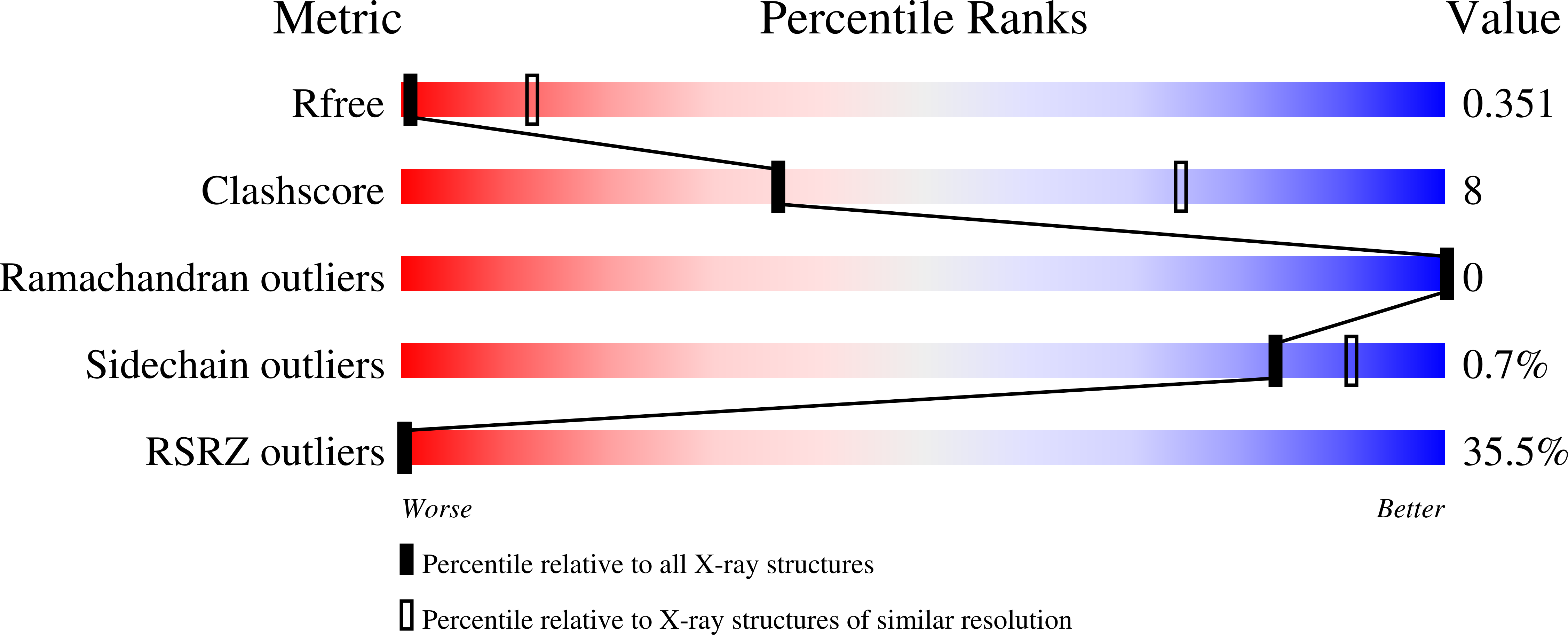
Macromolecular Entities
Structures with similar UniProt ID
Protein Blast
Polymer Type:polypeptide(L)
Molecule:Calsequestrin-2
Gene (Uniprot):CASQ2
Chain IDs:A, B, C, D, E, F, G, H
Chain Length:387
Number of Molecules:8
Biological Source:Homo sapiens
Primary Citation
The structure of a calsequestrin filament reveals mechanisms of familial arrhythmia.
Nat.Struct.Mol.Biol. 27 1142 1151 (2020)
PMID: 33046906 DOI: 10.1038/s41594-020-0510-9

Abstact

Mutations in the calcium-binding protein calsequestrin cause the highly lethal familial arrhythmia catecholaminergic polymorphic ventricular tachycardia (CPVT). In vivo, calsequestrin multimerizes into filaments, but there is not yet an atomic-resolution structure of a calsequestrin filament. We report a crystal structure of a human cardiac calsequestrin filament with supporting mutational analysis and in vitro filamentation assays. We identify and characterize a new disease-associated calsequestrin mutation, S173I, that is located at the filament-forming interface, and further show that a previously reported dominant disease mutation, K180R, maps to the same surface. Both mutations disrupt filamentation, suggesting that disease pathology is due to defects in multimer formation. An ytterbium-derivatized structure pinpoints multiple credible calcium sites at filament-forming interfaces, explaining the atomic basis of calsequestrin filamentation in the presence of calcium. Our study thus provides a unifying molecular mechanism through which dominant-acting calsequestrin mutations provoke lethal arrhythmias.

Legend

Protein

Chemical

Disease

Primary Citation of related structures
Feedback Form
Name
Email
Institute
Feedback