6OHL image
Deposition Date 2019-04-05
Release Date 2019-06-05
Last Version Date 2024-03-13
Entry Detail
PDB ID:
6OHL
Title:
Crystal structure of Fusobacterium nucleatum flavodoxin bound to flavin mononucleotide
Biological Source:
Source Organism:
Host Organism:
Method Details:
Experimental Method:
Resolution:
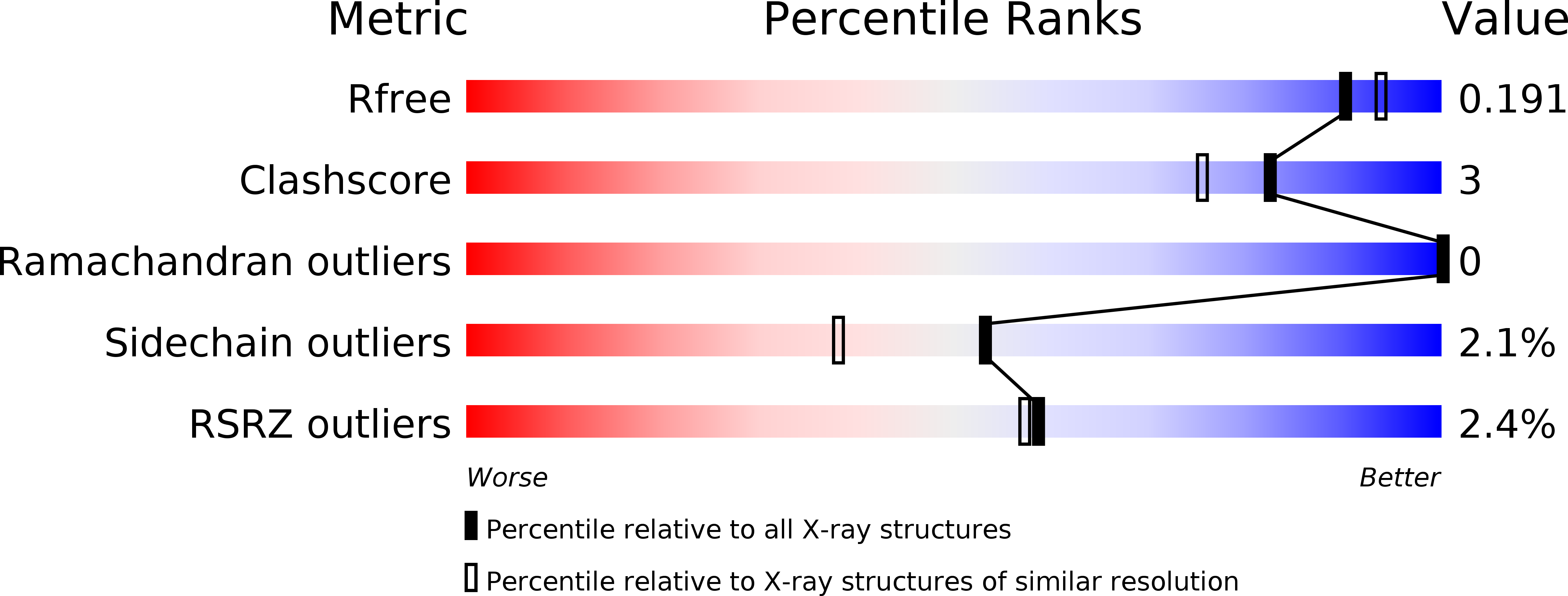
1.85 Å
R-Value Free:
0.19
R-Value Work:
0.16
R-Value Observed:
0.16
Space Group:
H 3 2
Macromolecular Entities
Structures with similar UniProt ID
Protein Blast
Polymer Type:polypeptide(L)
Molecule:Flavodoxin
Gene (Uniprot):C7Y58_06665
Chain IDs:A
Chain Length:170
Number of Molecules:1
Biological Source:Fusobacterium nucleatum
Primary Citation
Structural insight into the high reduction potentials observed for Fusobacterium nucleatum flavodoxin.
Protein Sci. 28 1460 1472 (2019)
PMID: 31116469 DOI: 10.1002/pro.3661

Abstact

Flavodoxins are small flavin mononucleotide (FMN)-containing proteins that mediate a variety of electron transfer processes. The primary sequence of flavodoxin from Fusobacterium nucleatum, a pathogenic oral bacterium, is marked with a number of distinct features including a glycine to lysine (K13) substitution in the highly conserved phosphate-binding loop (T/S-X-T-G-X-T), variation in the aromatic residues that sandwich the FMN cofactor, and a more even distribution of acidic and basic residues. The Eox/sq (oxidized/semiquinone; -43 mV) and Esq/hq (semiquinone/hydroquinone; -256 mV) are the highest recorded reduction potentials of known long-chain flavodoxins. These more electropositive values are a consequence of the apoprotein binding to the FMN hydroquinone anion with ~70-fold greater affinity compared to the oxidized form of the cofactor. Inspection of the FnFld crystal structure revealed the absence of a hydrogen bond between the protein and the oxidized FMN N5 atom, which likely accounts for the more electropositive Eox/sq . The more electropositive Esq/hq is likely attributed to only one negatively charged group positioned within 12 Å of the FMN N1. We show that natural substitutions of highly conserved residues partially account for these more electropositive reduction potentials.

Legend

Protein

Chemical

Disease

Primary Citation of related structures
Feedback Form
Name
Email
Institute
Feedback