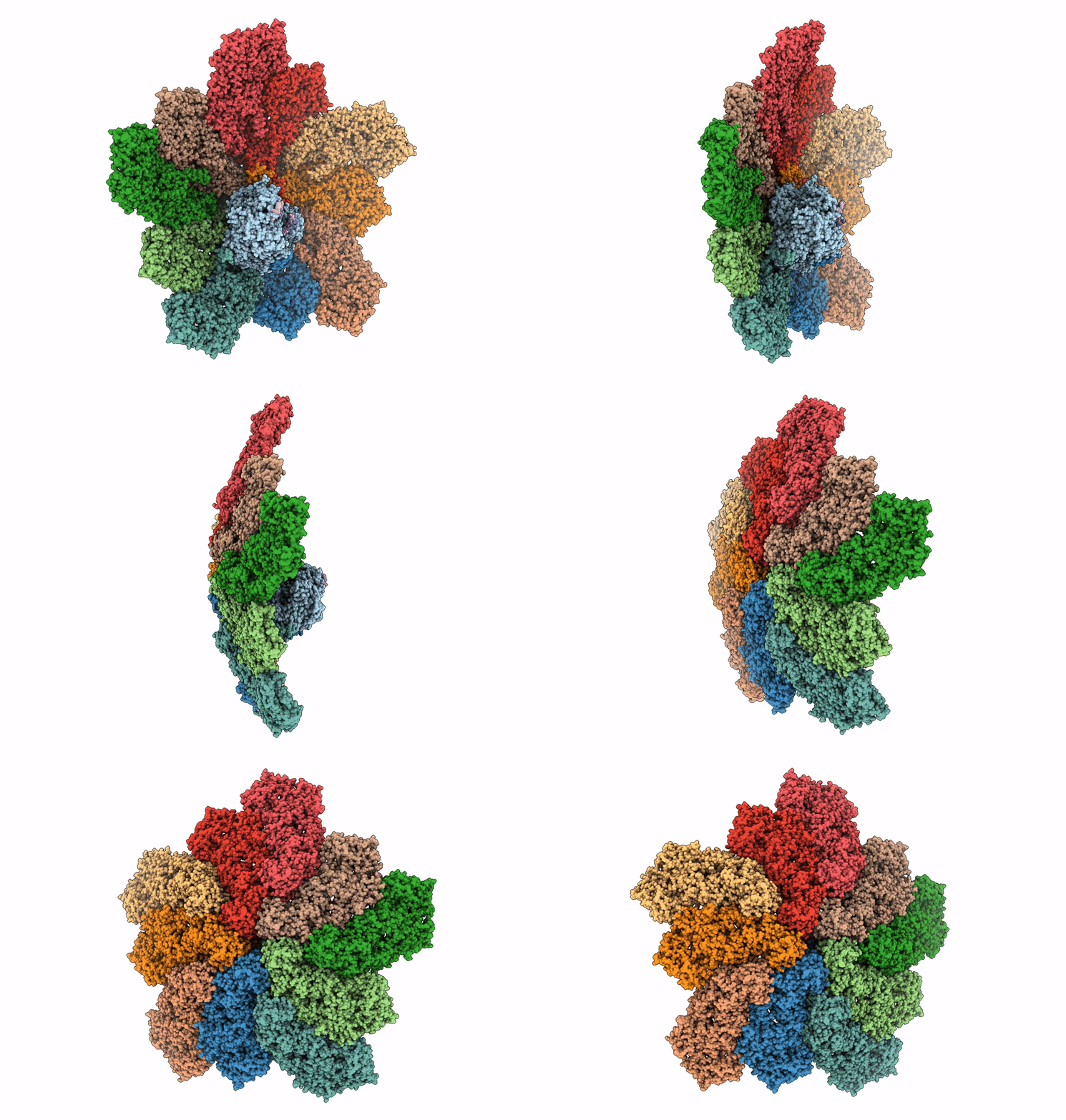
6OGY image
Deposition Date 2019-04-03
Release Date 2019-05-22
Last Version Date 2025-05-21
Entry Detail
PDB ID:
6OGY
Title:
In situ structure of Rotavirus RNA-dependent RNA polymerase at duplex-open state
Biological Source:
Source Organism:
Rotavirus A (Taxon ID: 28875)
Method Details:
Experimental Method:
Resolution:
3.40 Å
Aggregation State:
PARTICLE
Reconstruction Method:
SINGLE PARTICLE
Macromolecular Entities
Structures with similar UniProt ID
Protein Blast
Polymer Type:polypeptide(L)
Molecule:RNA-dependent RNA polymerase of rotavirus A
Gene (Uniprot):VP1
Chain IDs:A
Chain Length:1088
Number of Molecules:1
Biological Source:Rotavirus A
Structures with similar UniProt ID
Protein Blast
Polymer Type:polypeptide(L)
Molecule:Inner capsid protein VP2
Gene (Uniprot):VP2
Chain IDs:B (auth: C), C (auth: D), D (auth: E), E (auth: F), F (auth: G), G (auth: H), H (auth: I), I (auth: J), J (auth: K), K (auth: L)
Chain Length:887
Number of Molecules:10
Biological Source:Rotavirus A
Polymer Type:polydeoxyribonucleotide/polyribonucleotide hybrid
Molecule:DNA/RNA (5'-D(*(GTG))-R(P*GP*C)-3')
Chain IDs:L (auth: M)
Chain Length:3
Number of Molecules:1
Biological Source:Rotavirus A
Polymer Type:polyribonucleotide
Molecule:RNA (5'-R(P*AP*GP*CP*C)-3')
Chain IDs:M (auth: N)
Chain Length:4
Number of Molecules:1
Biological Source:Rotavirus A
Ligand Molecules
Primary Citation
In situ structures of rotavirus polymerase in action and mechanism of mRNA transcription and release.
Nat Commun 10 2216 2216 (2019)
PMID: 31101900 DOI: 10.1038/s41467-019-10236-7

Abstact

Transcribing and replicating a double-stranded genome require protein modules to unwind, transcribe/replicate nucleic acid substrates, and release products. Here we present in situ cryo-electron microscopy structures of rotavirus dsRNA-dependent RNA polymerase (RdRp) in two states pertaining to transcription. In addition to the previously discovered universal "hand-shaped" polymerase core domain shared by DNA polymerases and telomerases, our results show the function of N- and C-terminal domains of RdRp: the former opens the genome duplex to isolate the template strand; the latter splits the emerging template-transcript hybrid, guides genome reannealing to form a transcription bubble, and opens a capsid shell protein (CSP) to release the transcript. These two "helicase" domains also extensively interact with CSP, which has a switchable N-terminal helix that, like cellular transcriptional factors, either inhibits or promotes RdRp activity. The in situ structures of RdRp, CSP, and RNA in action inform mechanisms of not only transcription, but also replication.

Legend

Protein

Chemical

Disease

Primary Citation of related structures
Feedback Form
Name
Email
Institute
Feedback