6OES image
Deposition Date 2019-03-27
Release Date 2020-01-22
Last Version Date 2025-05-14
Entry Detail
PDB ID:
6OES
Title:
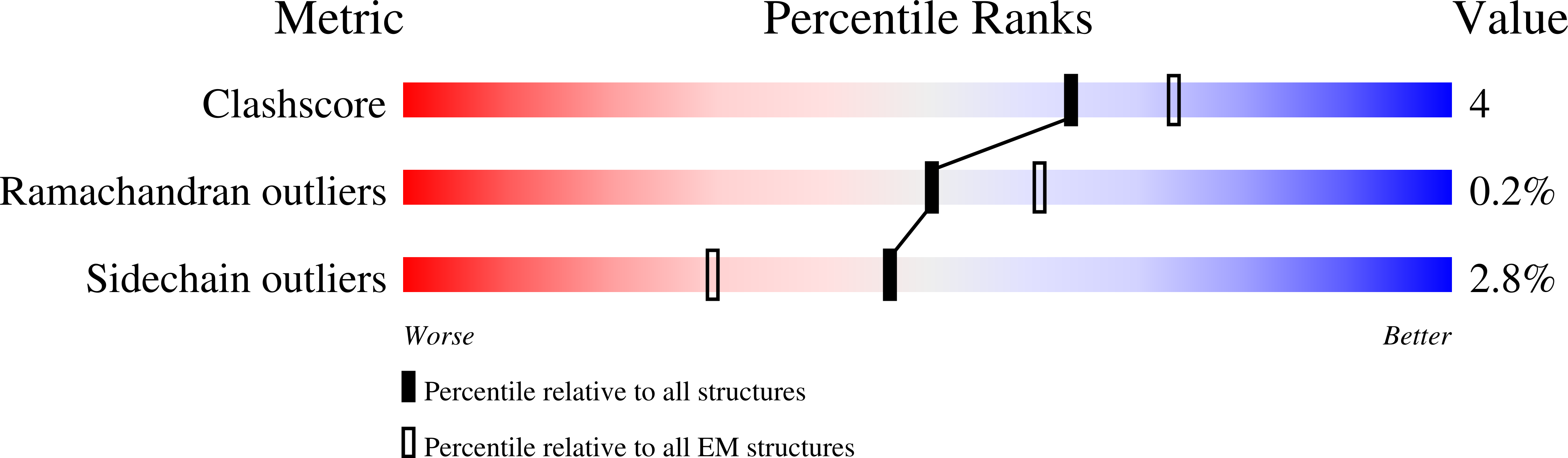
Cryo-EM structure of mouse RAG1/2 STC complex (without NBD domain)
Biological Source:
Source Organism:
Host Organism:
Method Details:
Experimental Method:
Resolution:
3.06 Å
Aggregation State:
PARTICLE
Reconstruction Method:
SINGLE PARTICLE
Macromolecular Entities
Structures with similar UniProt ID
Protein Blast
Polymer Type:polypeptide(L)
Molecule:V(D)J recombination-activating protein 1
Gene (Uniprot):Rag1
Chain IDs:A, C
Chain Length:1040
Number of Molecules:2
Biological Source:Mus musculus
Structures with similar UniProt ID
Protein Blast
Polymer Type:polypeptide(L)
Molecule:V(D)J recombination-activating protein 2
Gene (Uniprot):Rag2
Chain IDs:B, D
Chain Length:527
Number of Molecules:2
Biological Source:Mus musculus
Polymer Type:polydeoxyribonucleotide
Molecule:DNA (35-MER)
Chain IDs:E (auth: F)
Chain Length:50
Number of Molecules:1
Biological Source:Escherichia coli K-12
Polymer Type:polydeoxyribonucleotide
Molecule:DNA (34-MER)
Chain IDs:H (auth: G)
Chain Length:61
Number of Molecules:1
Biological Source:Escherichia coli K-12
Polymer Type:polydeoxyribonucleotide
Molecule:DNA (5'-D(*CP*CP*TP*GP*GP*AP*TP*CP*TP*GP*GP*CP*CP*TP*G)-3')
Chain IDs:F (auth: J), G (auth: I)
Chain Length:15
Number of Molecules:2
Biological Source:Escherichia coli K-12
Polymer Type:polydeoxyribonucleotide
Molecule:DNA (5'-D(P*CP*AP*CP*AP*GP*TP*GP*AP*TP*AP*CP*AP*GP*CP*C)-3')
Chain IDs:I (auth: L)
Chain Length:30
Number of Molecules:1
Biological Source:Escherichia coli K-12
Polymer Type:polydeoxyribonucleotide
Molecule:DNA (5'-D(P*CP*AP*CP*AP*GP*TP*GP*AP*TP*GP*CP*AP*AP*A)-3')
Chain IDs:J (auth: M)
Chain Length:41
Number of Molecules:1
Biological Source:Escherichia coli K-12
Primary Citation
How mouse RAG recombinase avoids DNA transposition.
Nat.Struct.Mol.Biol. 27 127 133 (2020)
PMID: 32015553 DOI: 10.1038/s41594-019-0366-z

Abstact

The RAG1-RAG2 recombinase (RAG) cleaves DNA to initiate V(D)J recombination, but RAG also belongs to the RNH-type transposase family. To learn how RAG-catalyzed transposition is inhibited in developing lymphocytes, we determined the structure of a DNA-strand transfer complex of mouse RAG at 3.1-Å resolution. The target DNA is a T form (T for transpositional target), which contains two >80° kinks towards the minor groove, only 3 bp apart. RAG2, a late evolutionary addition in V(D)J recombination, appears to enforce the sharp kinks and additional inter-segment twisting in target DNA and thus attenuates unwanted transposition. In contrast to strand transfer complexes of genuine transposases, where severe kinks occur at the integration sites of target DNA and thus prevent the reverse reaction, the sharp kink with RAG is 1 bp away from the integration site. As a result, RAG efficiently catalyzes the disintegration reaction that restores the RSS (donor) and target DNA.

Legend

Protein

Chemical

Disease

Primary Citation of related structures
Feedback Form
Name
Email
Institute
Feedback