6O8A image
Deposition Date 2019-03-09
Release Date 2019-05-08
Last Version Date 2024-10-16
Entry Detail
PDB ID:
6O8A
Keywords:
Title:
Thaumatin native-SAD structure determined at 5 keV from microcrystals
Biological Source:
Source Organism:
Method Details:
Experimental Method:
Resolution:
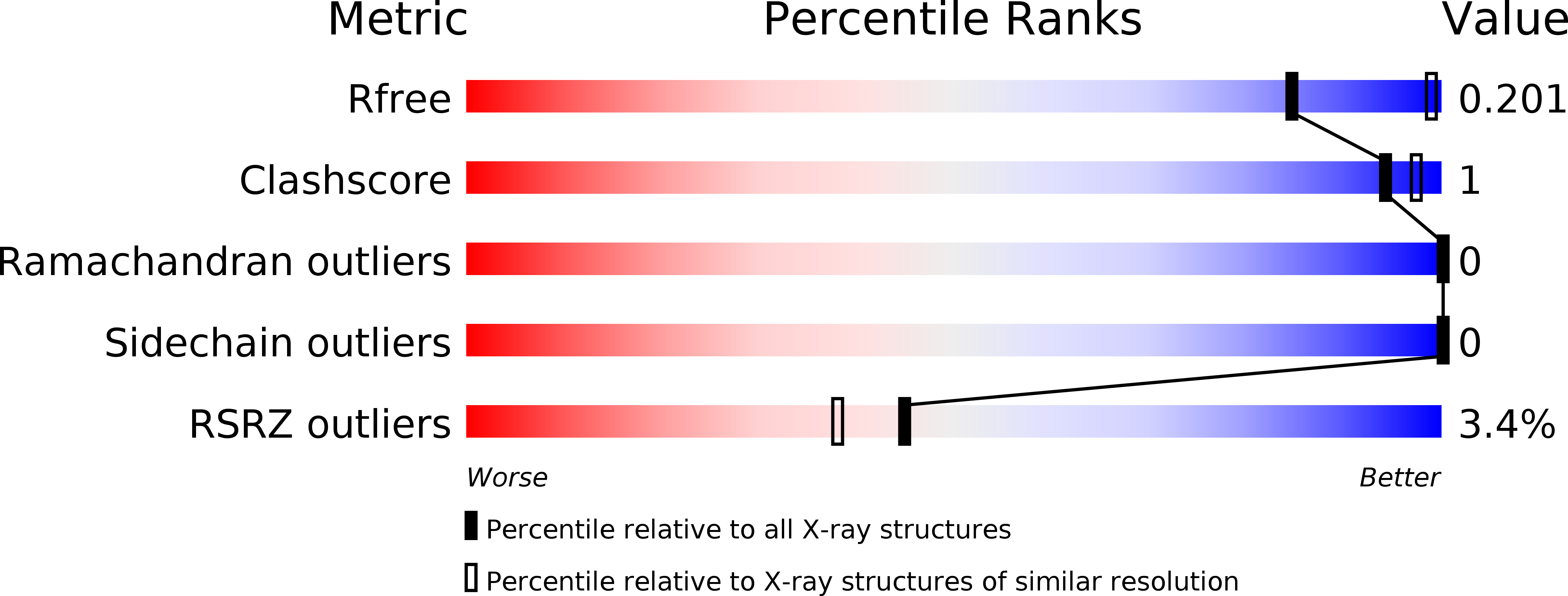
2.60 Å
R-Value Free:
0.21
R-Value Work:
0.18
R-Value Observed:
0.18
Space Group:
P 41 21 2
Macromolecular Entities
Structures with similar UniProt ID
Protein Blast
Polymer Type:polypeptide(L)
Molecule:Thaumatin-1
Chain IDs:A
Chain Length:207
Number of Molecules:1
Biological Source:Thaumatococcus daniellii
Ligand Molecules
Primary Citation
Synchrotron microcrystal native-SAD phasing at a low energy.
Iucrj 6 532 542 (2019)
PMID: 31316798 DOI: 10.1107/S2052252519004536

Abstact

De novo structural evaluation of native biomolecules from single-wavelength anomalous diffraction (SAD) is a challenge because of the weakness of the anomalous scattering. The anomalous scattering from relevant native elements - primarily sulfur in proteins and phospho-rus in nucleic acids - increases as the X-ray energy decreases toward their K-edge transitions. Thus, measurements at a lowered X-ray energy are promising for making native SAD routine and robust. For microcrystals with sizes less than 10 µm, native-SAD phasing at synchrotron microdiffraction beamlines is even more challenging because of difficulties in sample manipulation, diffraction data collection and data analysis. Native-SAD analysis from microcrystals by using X-ray free-electron lasers has been demonstrated but has required use of thousands of thousands of microcrystals to achieve the necessary accuracy. Here it is shown that by exploitation of anomalous microdiffraction signals obtained at 5 keV, by the use of polyimide wellmounts, and by an iterative crystal and frame-rejection method, microcrystal native-SAD phasing is possible from as few as about 1 200 crystals. Our results show the utility of low-energy native-SAD phasing with microcrystals at synchrotron microdiffraction beamlines.

Legend

Protein

Chemical

Disease

Primary Citation of related structures
Feedback Form
Name
Email
Institute
Feedback