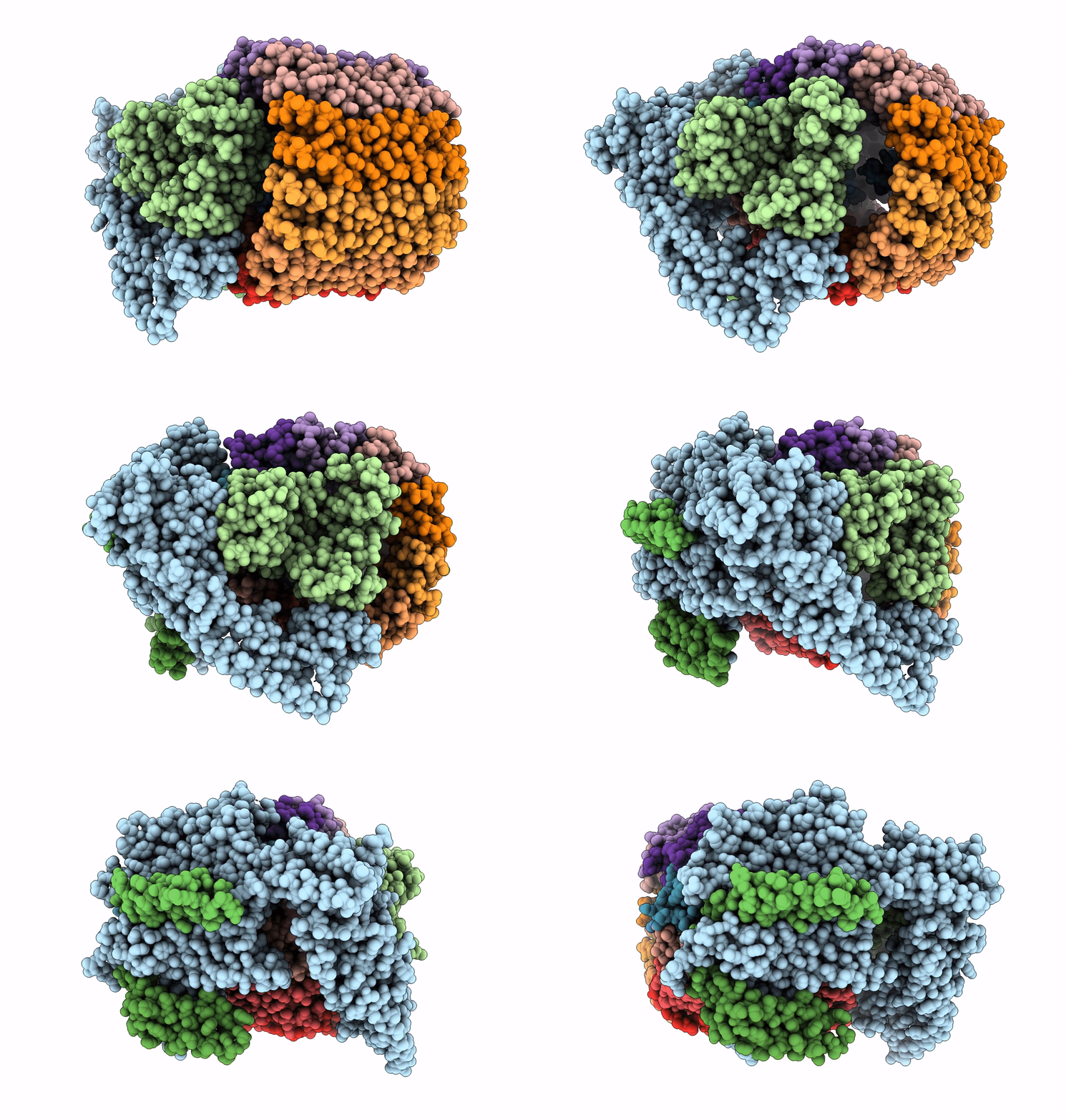
6O7T image
Deposition Date 2019-03-08
Release Date 2019-04-03
Last Version Date 2024-03-20
Entry Detail
PDB ID:
6O7T
Title:
Saccharomyces cerevisiae V-ATPase Vph1-VO
Biological Source:
Source Organism:
Method Details:
Experimental Method:
Resolution:
3.20 Å
Aggregation State:
PARTICLE
Reconstruction Method:
SINGLE PARTICLE

Macromolecular Entities
Structures with similar UniProt ID
Protein Blast
Polymer Type:polypeptide(L)
Molecule:V-type proton ATPase subunit a, vacuolar isoform
Gene (Uniprot):VPH1
Chain IDs:A (auth: a)
Chain Length:862
Number of Molecules:1
Biological Source:Saccharomyces cerevisiae
Structures with similar UniProt ID
Protein Blast
Polymer Type:polypeptide(L)
Molecule:V0 assembly protein 1
Gene (Uniprot):VOA1
Chain IDs:B (auth: b)
Chain Length:265
Number of Molecules:1
Biological Source:Saccharomyces cerevisiae
Structures with similar UniProt ID
Protein Blast
Polymer Type:polypeptide(L)
Molecule:V-type proton ATPase subunit c''
Gene (Uniprot):VMA16
Chain IDs:C (auth: c)
Chain Length:213
Number of Molecules:1
Biological Source:Saccharomyces cerevisiae
Structures with similar UniProt ID
Protein Blast
Polymer Type:polypeptide(L)
Molecule:V-type proton ATPase subunit d
Gene (Uniprot):VMA6
Chain IDs:D (auth: d)
Chain Length:345
Number of Molecules:1
Biological Source:Saccharomyces cerevisiae
Structures with similar UniProt ID
Protein Blast
Polymer Type:polypeptide(L)
Molecule:V-type proton ATPase subunit e
Gene (Uniprot):VMA9
Chain IDs:O (auth: e)
Chain Length:73
Number of Molecules:1
Biological Source:Saccharomyces cerevisiae
Structures with similar UniProt ID
Protein Blast
Polymer Type:polypeptide(L)
Molecule:Putative protein YPR170W-B
Gene (Uniprot):YPR170W-B
Chain IDs:E (auth: f)
Chain Length:85
Number of Molecules:1
Biological Source:Saccharomyces cerevisiae
Structures with similar UniProt ID
Protein Blast
Polymer Type:polypeptide(L)
Molecule:V-type proton ATPase subunit c
Gene (Uniprot):VMA3
Chain IDs:F (auth: g), G (auth: h), H (auth: i), I (auth: j), J (auth: k), K (auth: l), L (auth: m), M (auth: n)
Chain Length:160
Number of Molecules:8
Biological Source:Saccharomyces cerevisiae
Structures with similar UniProt ID
Protein Blast
Polymer Type:polypeptide(L)
Molecule:V-type proton ATPase subunit c'
Gene (Uniprot):VMA11
Chain IDs:N (auth: o)
Chain Length:164
Number of Molecules:1
Biological Source:Saccharomyces cerevisiae
Ligand Molecules
Primary Citation
Structural comparison of the vacuolar and Golgi V-ATPases fromSaccharomyces cerevisiae.
Proc. Natl. Acad. Sci. U.S.A. 116 7272 7277 (2019)
PMID: 30910982 DOI: 10.1073/pnas.1814818116

Abstact

Proton-translocating vacuolar-type ATPases (V-ATPases) are necessary for numerous processes in eukaryotic cells, including receptor-mediated endocytosis, protein maturation, and lysosomal acidification. In mammals, V-ATPase subunit isoforms are differentially targeted to various intracellular compartments or tissues, but how these subunit isoforms influence enzyme activity is not clear. In the yeast Saccharomyces cerevisiae, isoform diversity is limited to two different versions of the proton-translocating subunit a: Vph1p, which is targeted to the vacuole, and Stv1p, which is targeted to the Golgi apparatus and endosomes. We show that purified V-ATPase complexes containing Vph1p have higher ATPase activity than complexes containing Stv1p and that the relative difference in activity depends on the presence of lipids. We also show that VO complexes containing Stv1p could be readily purified without attached V1 regions. We used this effect to determine structures of the membrane-embedded VO region with Stv1p at 3.1-Å resolution, which we compare with a structure of the VO region with Vph1p that we determine to 3.2-Å resolution. These maps reveal differences in the surface charge near the cytoplasmic proton half-channel. Both maps also show the presence of bound lipids, as well as regularly spaced densities that may correspond to ergosterol or bound detergent, around the c-ring.

Legend

Protein

Chemical

Disease

Primary Citation of related structures
Feedback Form
Name
Email
Institute
Feedback