6O7A image
Deposition Date 2019-03-07
Release Date 2019-09-11
Last Version Date 2024-03-13
Entry Detail
PDB ID:
6O7A
Title:
Crystal structure of the LjCASTOR gating ring in the Ca2+-free state
Biological Source:
Source Organism:
Host Organism:
Method Details:
Experimental Method:
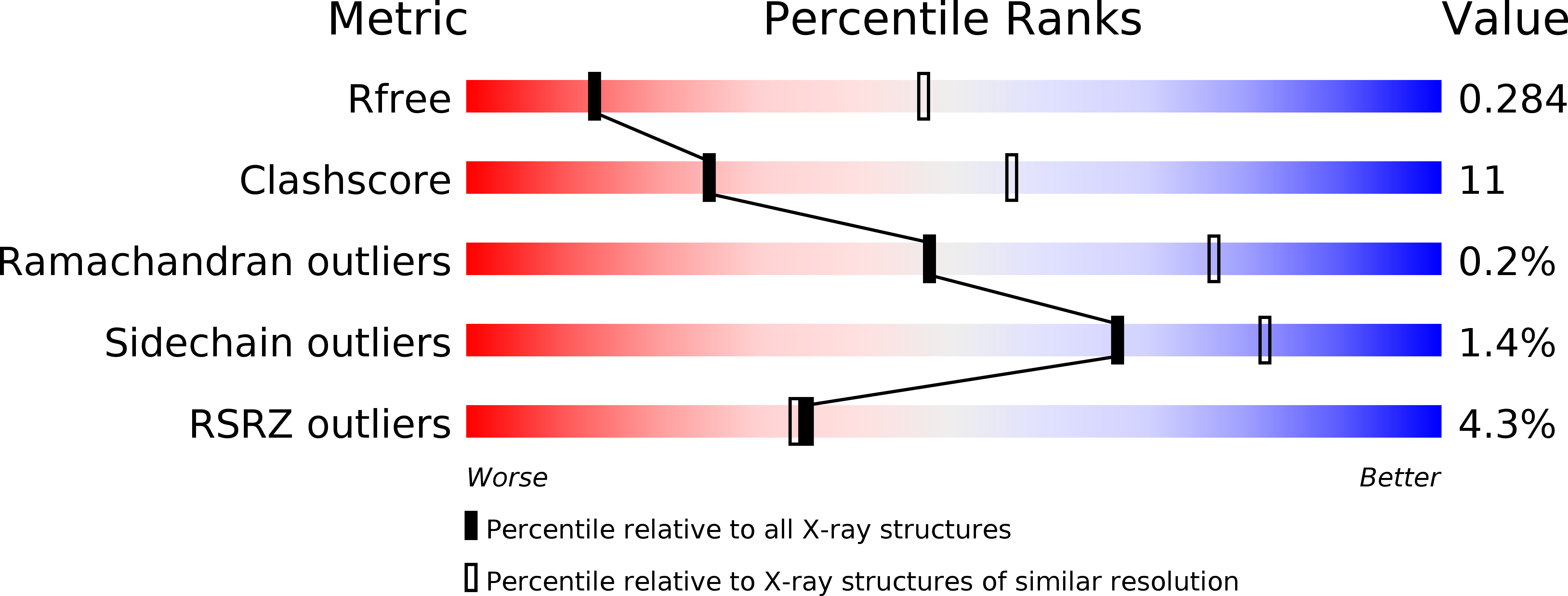
Resolution:
3.30 Å
R-Value Free:
0.28
R-Value Work:
0.22
R-Value Observed:
0.23
Space Group:
P 1 21 1
Macromolecular Entities
Structures with similar UniProt ID
Protein Blast
Polymer Type:polypeptide(L)
Molecule:Ion channel CASTOR
Gene (Uniprot):CASTOR
Chain IDs:A, B (auth: C), C (auth: B), D
Chain Length:554
Number of Molecules:4
Biological Source:Lotus japonicus
Ligand Molecules
Primary Citation
Ca2+-regulated Ca2+channels with an RCK gating ring control plant symbiotic associations.
Nat Commun 10 3703 3703 (2019)
PMID: 31420535 DOI: 10.1038/s41467-019-11698-5

Abstact

A family of plant nuclear ion channels, including DMI1 (Does not Make Infections 1) and its homologs CASTOR and POLLUX, are required for the establishment of legume-microbe symbioses by generating nuclear and perinuclear Ca2+ spiking. Here we show that CASTOR from Lotus japonicus is a highly selective Ca2+ channel whose activation requires cytosolic/nucleosolic Ca2+, contrary to the previous suggestion of it being a K+ channel. Structurally, the cytosolic/nucleosolic ligand-binding soluble region of CASTOR contains two tandem RCK (Regulator of Conductance for K+) domains, and four subunits assemble into the gating ring architecture, similar to that of large conductance, Ca2+-gated K+ (BK) channels despite the lack of sequence similarity. Multiple ion binding sites are clustered at two locations within each subunit, and three of them are identified to be Ca2+ sites. Our in vitro and in vivo assays also demonstrate the importance of these gating-ring Ca2+ binding sites to the physiological function of CASTOR as well as DMI1.

Legend

Protein

Chemical

Disease

Primary Citation of related structures
Feedback Form
Name
Email
Institute
Feedback