6O47 image
Deposition Date 2019-02-28
Release Date 2019-05-29
Last Version Date 2023-10-11
Entry Detail
PDB ID:
6O47
Keywords:
Title:
human cGAS core domain (K427E/K428E) bound with RU-521
Biological Source:
Source Organism(s):
Homo sapiens (Taxon ID: 9606)
Expression System(s):
Method Details:
Experimental Method:
Resolution:
2.20 Å
R-Value Free:
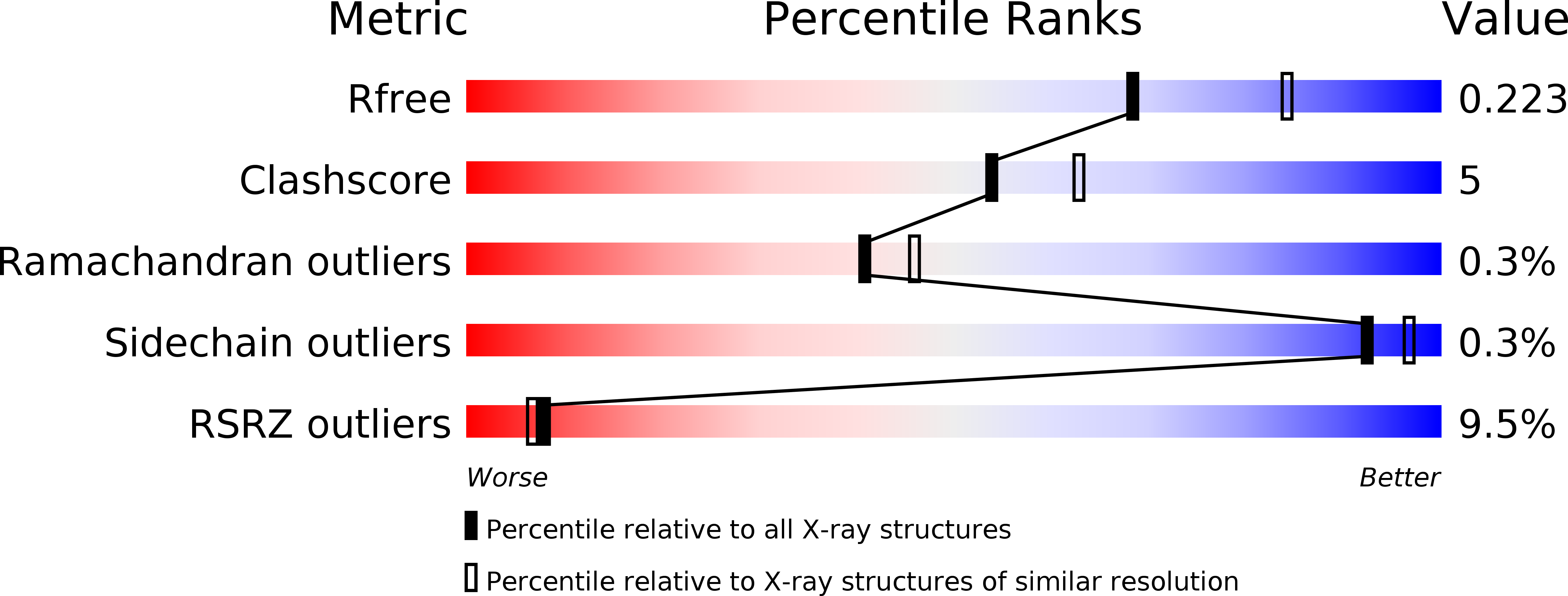
0.22
R-Value Work:
0.18
R-Value Observed:
0.18
Space Group:
P 64
Macromolecular Entities
Structures with similar UniProt ID
Protein Blast
Polymer Type:polypeptide(L)
Molecule:Cyclic GMP-AMP synthase
Gene (Uniprot):CGAS
Mutagens:K427E, K428E
Chain IDs:A
Chain Length:372
Number of Molecules:1
Biological Source:Homo sapiens
Primary Citation
Human cGAS catalytic domain has an additional DNA-binding interface that enhances enzymatic activity and liquid-phase condensation.
Proc.Natl.Acad.Sci.USA 116 11946 11955 (2019)
PMID: 31142647 DOI: 10.1073/pnas.1905013116

Abstact

The cyclic GMP-AMP synthase (cGAS)-cGAMP-STING pathway plays a key role in innate immunity, with cGAS sensing both pathogenic and mislocalized DNA in the cytoplasm. Human cGAS (h-cGAS) constitutes an important drug target for control of antiinflammatory responses that can contribute to the onset of autoimmune diseases. Recent studies have established that the positively charged N-terminal segment of cGAS contributes to enhancement of cGAS enzymatic activity as a result of DNA-induced liquid-phase condensation. We have identified an additional cGASCD-DNA interface (labeled site-C; CD, catalytic domain) in the crystal structure of a human SRY.cGASCD-DNA complex, with mutations along this basic site-C cGAS interface disrupting liquid-phase condensation, as monitored by cGAMP formation, gel shift, spin-down, and turbidity assays, as well as time-lapse imaging of liquid droplet formation. We expand on an earlier ladder model of cGAS dimers bound to a pair of parallel-aligned DNAs to propose a multivalent interaction-mediated cluster model to account for DNA-mediated condensation involving both the N-terminal domain of cGAS and the site-C cGAS-DNA interface. We also report the crystal structure of the h-cGASCD-DNA complex containing a triple mutant that disrupts the site-C interface, with this complex serving as a future platform for guiding cGAS inhibitor development at the DNA-bound h-cGAS level. Finally, we solved the structure of RU.521 bound in two alternate alignments to apo h-cGASCD, thereby occupying more of the catalytic pocket and providing insights into further optimization of active-site-binding inhibitors.

Legend

Protein

Chemical

Disease

Primary Citation of related structures
Feedback Form
Name
Email
Institute
Feedback