6O3C image
Deposition Date 2019-02-26
Release Date 2019-07-03
Last Version Date 2024-10-23
Entry Detail
PDB ID:
6O3C
Title:
Crystal structure of active Smoothened bound to SAG21k, cholesterol, and NbSmo8
Biological Source:
Source Organism:
Mus musculus (Taxon ID: 10090)
Lama glama (Taxon ID: 9844)
Host Organism:
Method Details:
Experimental Method:
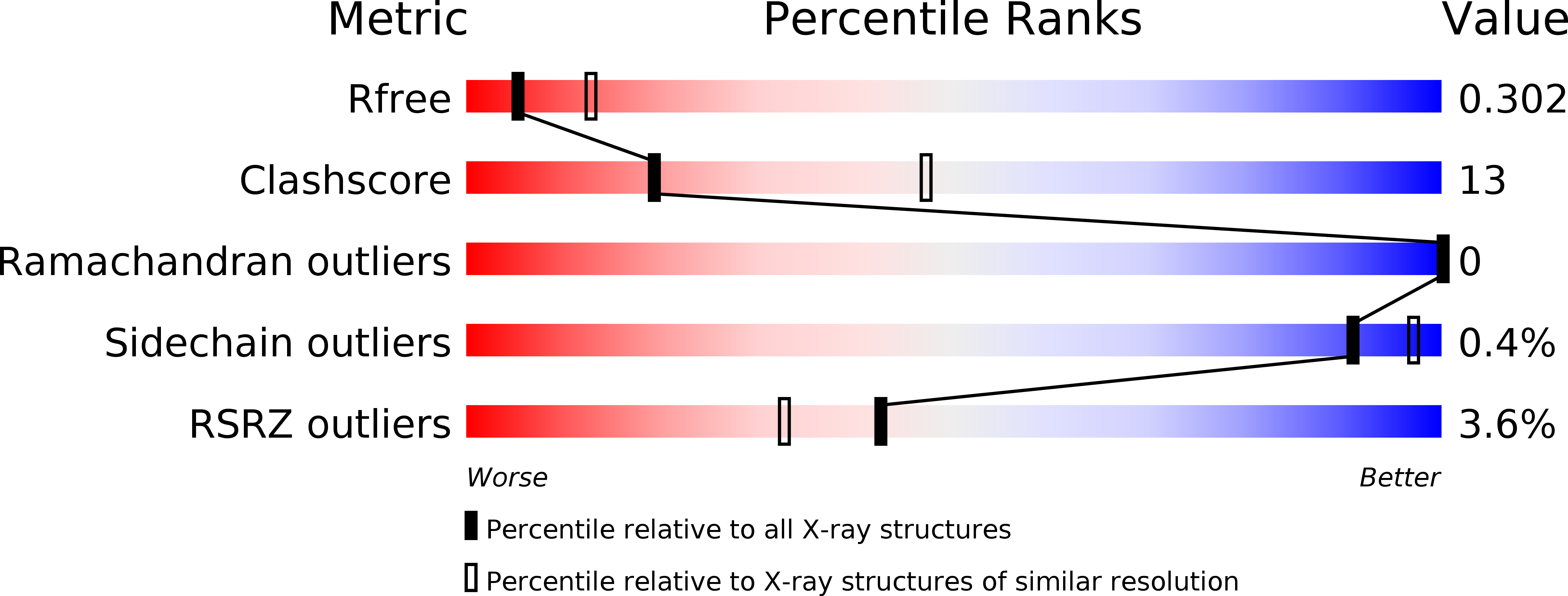
Resolution:
2.80 Å
R-Value Free:
0.29
R-Value Work:
0.24
R-Value Observed:
0.24
Space Group:
P 2 2 21
Macromolecular Entities
Structures with similar UniProt ID
Protein Blast
Polymer Type:polypeptide(L)
Molecule:Smoothened homolog
Gene (Uniprot):Smo
Chain IDs:A
Chain Length:525
Number of Molecules:1
Biological Source:Mus musculus
Polymer Type:polypeptide(L)
Molecule:NbSmo8
Chain IDs:B
Chain Length:128
Number of Molecules:1
Biological Source:Lama glama
Primary Citation
Smoothened stimulation by membrane sterols drives Hedgehog pathway activity.
Nature 571 284 288 (2019)
PMID: 31263273 DOI: 10.1038/s41586-019-1355-4

Abstact

Hedgehog signalling is fundamental to embryonic development and postnatal tissue regeneration1. Aberrant postnatal Hedgehog signalling leads to several malignancies, including basal cell carcinoma and paediatric medulloblastoma2. Hedgehog proteins bind to and inhibit the transmembrane cholesterol transporter Patched-1 (PTCH1), which permits activation of the seven-transmembrane transducer Smoothened (SMO) via a mechanism that is poorly understood. Here we report the crystal structure of active mouse SMO bound to both the agonist SAG21k and to an intracellular binding nanobody that stabilizes a physiologically relevant active state. Analogous to other G protein-coupled receptors, the activation of SMO is associated with subtle motions in the extracellular domain, and larger intracellular changes. In contrast to recent models3-5, a cholesterol molecule that is critical for SMO activation is bound deep within the seven-transmembrane pocket. We propose that the inactivation of PTCH1 by Hedgehog allows a transmembrane sterol to access this seven-transmembrane site (potentially through a hydrophobic tunnel), which drives the activation of SMO. These results-combined with signalling studies and molecular dynamics simulations-delineate the structural basis for PTCH1-SMO regulation, and suggest a strategy for overcoming clinical resistance to SMO inhibitors.

Legend

Protein

Chemical

Disease

Primary Citation of related structures
Feedback Form
Name
Email
Institute
Feedback