6NSQ image
Deposition Date 2019-01-25
Release Date 2019-06-19
Last Version Date 2023-10-11
Entry Detail
PDB ID:
6NSQ
Title:
Crystal structure of BRAF kinase domain bound to the inhibitor 2l
Biological Source:
Source Organism:
Homo sapiens (Taxon ID: 9606)
Host Organism:
Method Details:
Experimental Method:
Resolution:
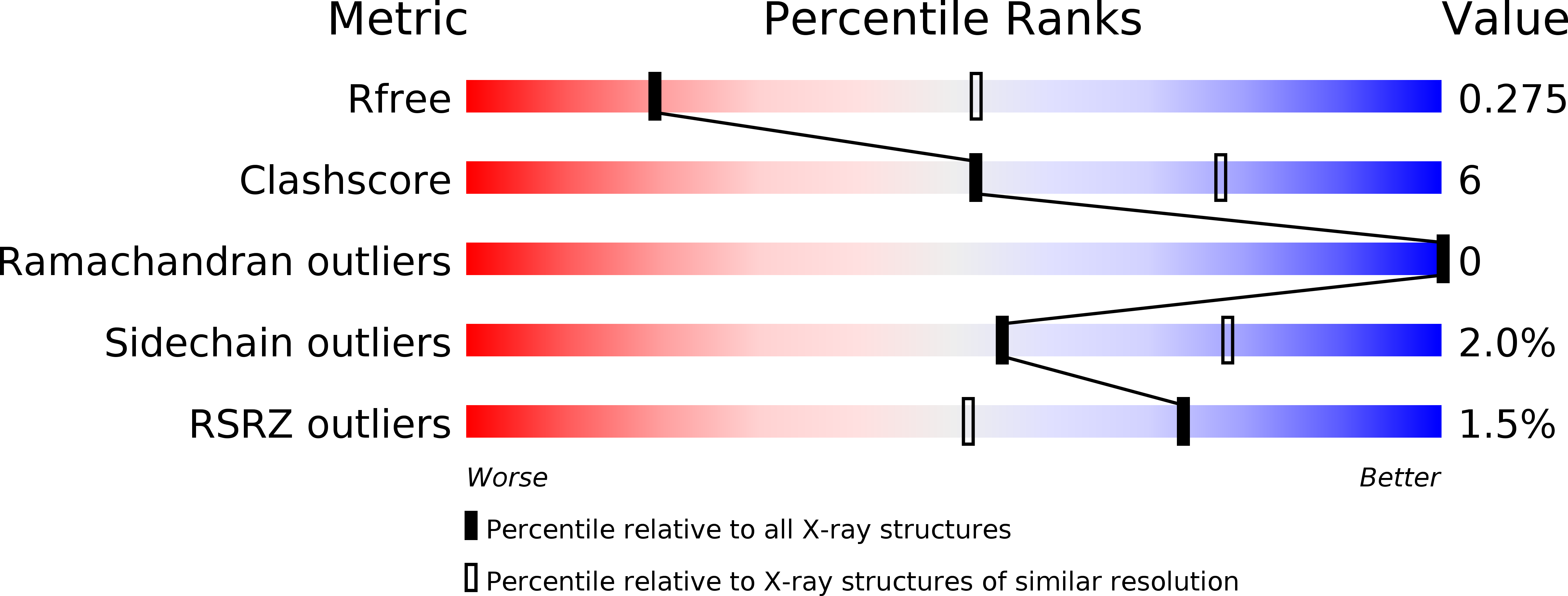
3.05 Å
R-Value Free:
0.27
R-Value Work:
0.23
R-Value Observed:
0.23
Space Group:
P 2 21 21
Macromolecular Entities
Structures with similar UniProt ID
Protein Blast
Polymer Type:polypeptide(L)
Molecule:Serine/threonine-protein kinase B-raf
Gene (Uniprot):BRAF
Mutagens:I543A, I544S, I551K, Q562R, L588N, K630S, F667E, Y673S, A688R, L706S, Q709R, S713E, L716E, S720E, P722S, K723G
Chain IDs:A (auth: B), B (auth: A)
Chain Length:284
Number of Molecules:2
Biological Source:Homo sapiens
Ligand Molecules
Primary Citation
Rigidification Dramatically Improves Inhibitor Selectivity for RAF Kinases.
Acs Med.Chem.Lett. 10 1074 1080 (2019)
PMID: 31312411 DOI: 10.1021/acsmedchemlett.9b00194

Abstact

One effective means to achieve inhibitor specificity for RAF kinases, an important family of cancer drug targets, has been to target the monomeric inactive state conformation of the kinase domain, which, unlike most other kinases, can accommodate sulfonamide-containing drugs such as vemurafenib and dabrafenib because of the presence of a unique pocket specific to inactive RAF kinases. We previously reported an alternate strategy whereby rigidification of a nonselective pyrazolo[3,4-d]pyrimidine-based inhibitor through ring closure afforded moderate but appreciable increases in selectivity for RAF kinases. Here, we show that a further application of the rigidification strategy to a different pyrazolopyrimidine-based scaffold dramatically improved selectivity for RAF kinases. Crystal structure analysis confirmed our inhibitor design hypothesis revealing that 2l engages an active-like state conformation of BRAF normally associated with poorly discriminating inhibitors. When screened against a panel of distinct cancer cell lines, the optimized inhibitor 2l primarily inhibited the proliferation of the expected BRAFV600E-harboring cell lines consistent with its kinome selectivity profile. These results suggest that rigidification could be a general and powerful strategy for enhancing inhibitor selectivity against protein kinases, which may open up therapeutic opportunities not afforded by other approaches.

Legend

Protein

Chemical

Disease

Primary Citation of related structures
Feedback Form
Name
Email
Institute
Feedback