6NQ8 image
Deposition Date 2019-01-19
Release Date 2019-04-17
Last Version Date 2023-10-11
Entry Detail
PDB ID:
6NQ8
Title:
Crystal structure of YetJ mutant from Bacillus Subtilis - D171E
Biological Source:
Method Details:
Experimental Method:
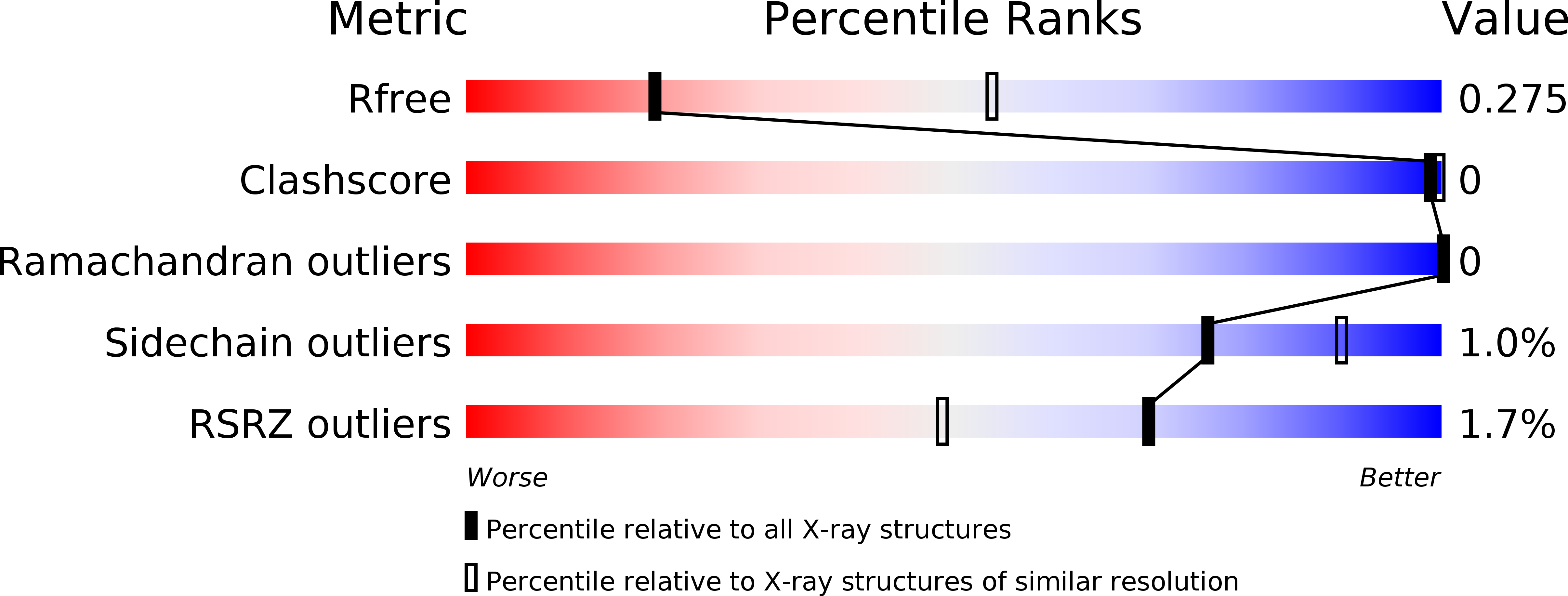
Resolution:
3.10 Å
R-Value Free:
0.27
R-Value Work:
0.24
R-Value Observed:
0.24
Space Group:
C 1 2 1
Macromolecular Entities
Structures with similar UniProt ID
Protein Blast
Polymer Type:polypeptide(L)
Molecule:Uncharacterized protein YetJ
Gene (Uniprot):calJ
Mutagens:D171E
Chain IDs:A, B, C, D
Chain Length:214
Number of Molecules:4
Biological Source:Bacillus subtilis (strain 168)
Ligand Molecules
Primary Citation
Ion and pH Sensitivity of a TMBIM Ca2+Channel.
Structure 27 1013 1021.e3 (2019)
PMID: 30930064 DOI: 10.1016/j.str.2019.03.003

Abstact

The anti-apoptotic transmembrane Bax inhibitor motif (TMBIM) containing protein family regulates Ca2+ homeostasis, cell death, and the progression of diseases including cancers. The recent crystal structures of the TMBIM homolog BsYetJ reveal a conserved Asp171-Asp195 dyad that is proposed in regulating a pH-dependent Ca2+ translocation. Here we show that BsYetJ mediates Ca2+ fluxes in permeabilized mammalian cells, and its interaction with Ca2+ is sensitive to protons and other cations. We report crystal structures of BsYetJ in additional states, revealing the flexibility of the dyad in a closed state and a pore-opening mechanism. Functional studies show that the dyad is responsible for both Ca2+ affinity and pH dependence. Computational simulations suggest that protonation of Asp171 weakens its interaction with Arg60, leading to an open state. Our integrated analysis provides insights into the regulation of the BsYetJ Ca2+ channel that may inform understanding of human TMBIM proteins regarding their roles in cell death and diseases.

Legend

Protein

Chemical

Disease

Primary Citation of related structures
Feedback Form
Name
Email
Institute
Feedback