6NJG image
Deposition Date 2019-01-03
Release Date 2019-03-06
Last Version Date 2023-10-11
Entry Detail
PDB ID:
6NJG
Keywords:
Title:
Ubiquitin Variant in Complex with Ubiquitin Interacting Motif
Biological Source:
Host Organism:
Method Details:
Experimental Method:
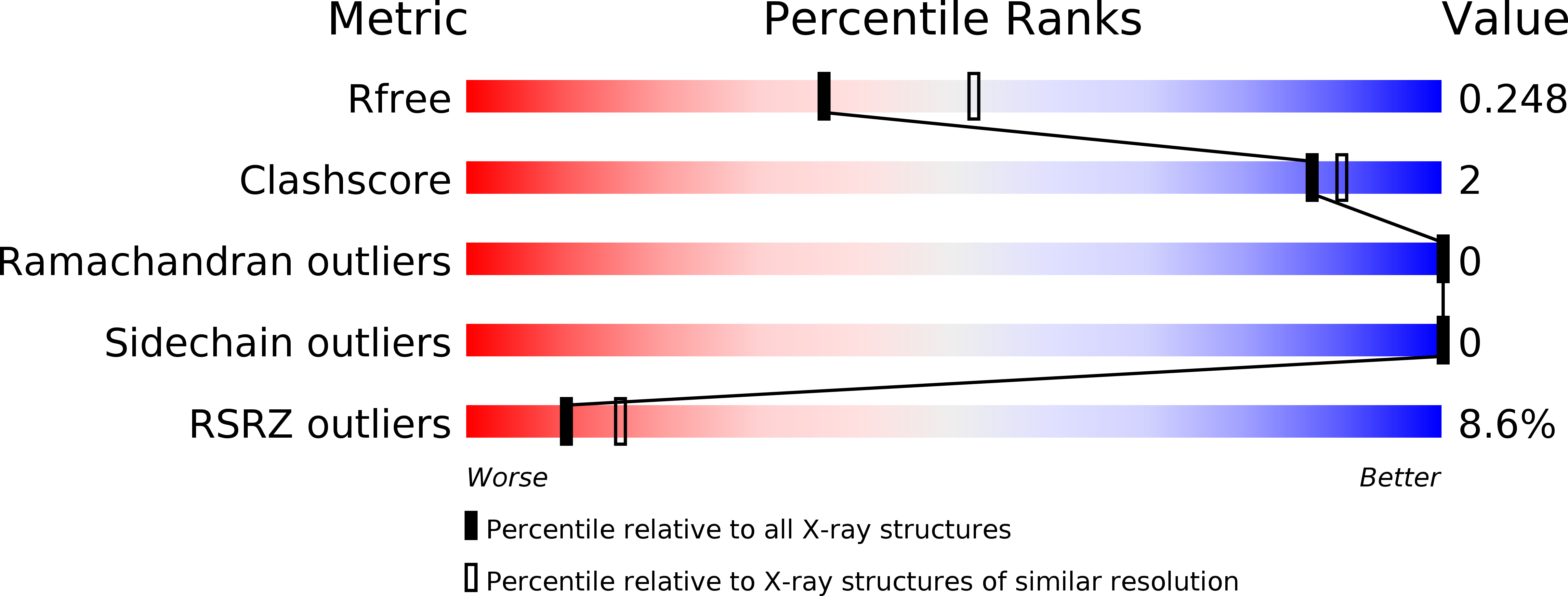
Resolution:
2.35 Å
R-Value Free:
0.24
R-Value Work:
0.20
R-Value Observed:
0.20
Space Group:
P 43 21 2
Macromolecular Entities
Structures with similar UniProt ID
Protein Blast
Polymer Type:polypeptide(L)
Molecule:Vacuolar protein sorting-associated protein 27
Gene (Uniprot):VPS27
Chain IDs:A (auth: B)
Chain Length:24
Number of Molecules:1
Biological Source:Saccharomyces cerevisiae (strain ATCC 204508 / S288c)
Structures with similar UniProt ID
Protein Blast
Polymer Type:polypeptide(L)
Molecule:Polyubiquitin-B
Gene (Uniprot):UBB
Mutagens:K6Q, L8I, G10V, K11M, T12R, T14A, K48M, Q62K, K63R, E64D, T66N, H68Y, L71S, R72S, G75S, G76L, M77R, Q78A
Chain IDs:B (auth: C)
Chain Length:89
Number of Molecules:1
Biological Source:Homo sapiens
Primary Citation
Dimerization of a ubiquitin variant leads to high affinity interactions with a ubiquitin interacting motif.
Protein Sci. 28 848 856 (2019)
PMID: 30793400 DOI: 10.1002/pro.3593

Abstact

We previously described structural and functional characterization of the first ubiquitin variant (UbV), UbV.v27.1, engineered by phage display to bind with high affinity to a specific ubiquitin interacting motif (UIM). We identified two substitutions relative to ubiquitin (Gly10Val/His68Tyr) that were critical for enhancing binding affinity but could only rationalize the mechanism of action of the Tyr68 substitution. Here, we extend our characterization and uncover the mechanism by which the Val10 substitution enhances binding affinity. We show that Val10 in UbV.v27.1 drives UbV dimerization through an intermolecular β-strand exchange. Dimerization serves to increase the contact surface between the UIM and UbV and also affords direct contacts between two UIMs through an overall 2:2 binding stoichiometry. Our identification of the role of Val10 in UbV dimerization suggests a general means for the development of dimeric UbVs with improved affinity and specificity relative to their monomeric UbV counterparts. Statement: Previously, we used phage display to engineer a UbV that bound tightly and specifically to a UIM. Here, we discovered that tight binding is partly due to the dimerization of the UbV, which increases the contact surface between the UbV and UIM. We show that UbV dimerization is dependent on the Gly10Val substitution, and posit that dimerization may provide a general means for engineering UbVs with improved binding properties.

Legend

Protein

Chemical

Disease

Primary Citation of related structures
Feedback Form
Name
Email
Institute
Feedback