6N9L image
Deposition Date 2018-12-03
Release Date 2019-05-01
Last Version Date 2023-10-11
Entry Detail
PDB ID:
6N9L
Title:
Crystal structure of T. maritima UvrA d117-399 with ADP
Biological Source:
Source Organism:
Host Organism:
Method Details:
Experimental Method:
Resolution:
2.01 Å
R-Value Free:
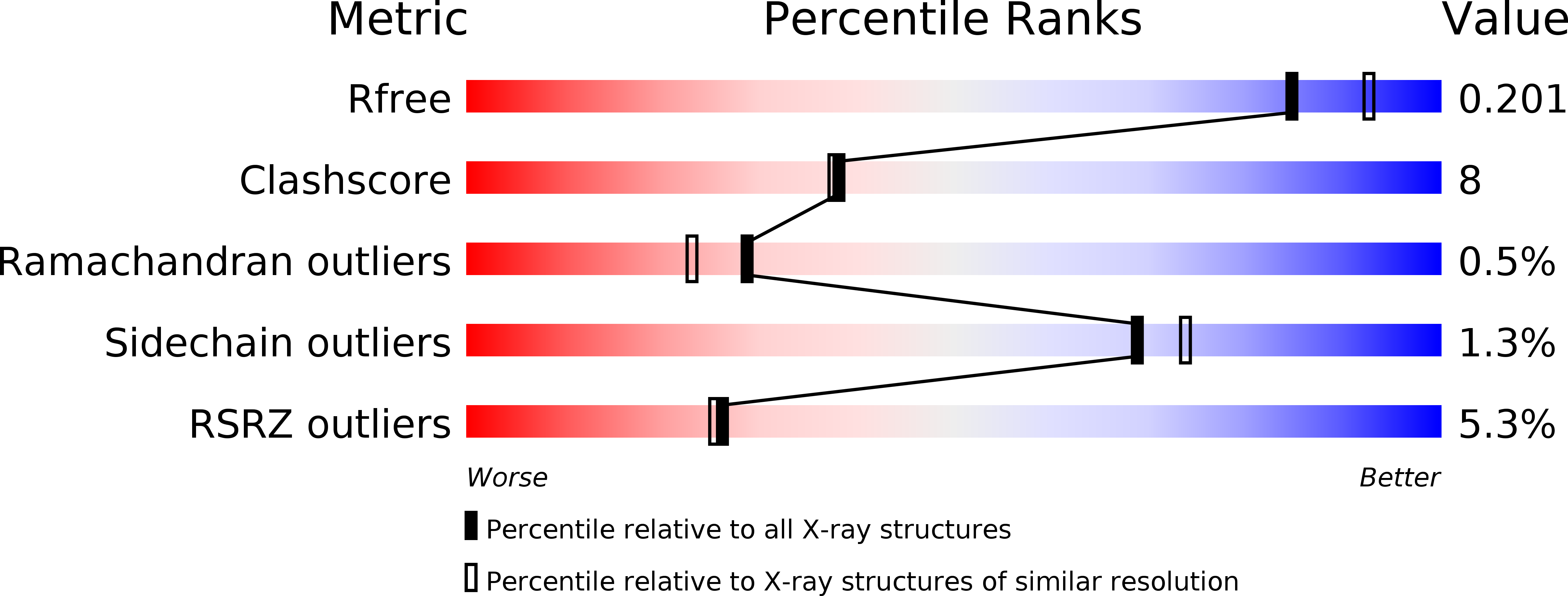
0.20
R-Value Work:
0.16
R-Value Observed:
0.17
Space Group:
C 1 2 1
Macromolecular Entities
Structures with similar UniProt ID
Protein Blast
Polymer Type:polypeptide(L)
Molecule:UvrABC system protein A
Gene (Uniprot):uvrA
Mutagens:d117-399
Chain IDs:A
Chain Length:640
Number of Molecules:1
Biological Source:Thermotoga maritima
Primary Citation
The ATPase mechanism of UvrA2 reveals the distinct roles of proximal and distal ATPase sites in nucleotide excision repair.
Nucleic Acids Res. 47 4136 4152 (2019)
PMID: 30892613 DOI: 10.1093/nar/gkz180

Abstact

The UvrA2 dimer finds lesions in DNA and initiates nucleotide excision repair. Each UvrA monomer contains two essential ATPase sites: proximal (P) and distal (D). The manner whereby their activities enable UvrA2 damage sensing and response remains to be clarified. We report three key findings from the first pre-steady state kinetic analysis of each site. Absent DNA, a P2ATP-D2ADP species accumulates when the low-affinity proximal sites bind ATP and enable rapid ATP hydrolysis and phosphate release by the high-affinity distal sites, and ADP release limits catalytic turnover. Native DNA stimulates ATP hydrolysis by all four sites, causing UvrA2 to transition through a different species, P2ADP-D2ADP. Lesion-containing DNA changes the mechanism again, suppressing ATP hydrolysis by the proximal sites while distal sites cycle through hydrolysis and ADP release, to populate proximal ATP-bound species, P2ATP-Dempty and P2ATP-D2ATP. Thus, damaged and native DNA trigger distinct ATPase site activities, which could explain why UvrA2 forms stable complexes with UvrB on damaged DNA compared with weaker, more dynamic complexes on native DNA. Such specific coupling between the DNA substrate and the ATPase mechanism of each site provides new insights into how UvrA2 utilizes ATP for lesion search, recognition and repair.

Legend

Protein

Chemical

Disease

Primary Citation of related structures
Feedback Form
Name
Email
Institute
Feedback