6MZO image
Deposition Date 2018-11-05
Release Date 2019-04-17
Last Version Date 2023-10-11
Entry Detail
PDB ID:
6MZO
Keywords:
Title:
X-ray Structure of an Inactive Zymogen C11 Protease from Parabacteroides distasonis
Biological Source:
Method Details:
Experimental Method:
Resolution:
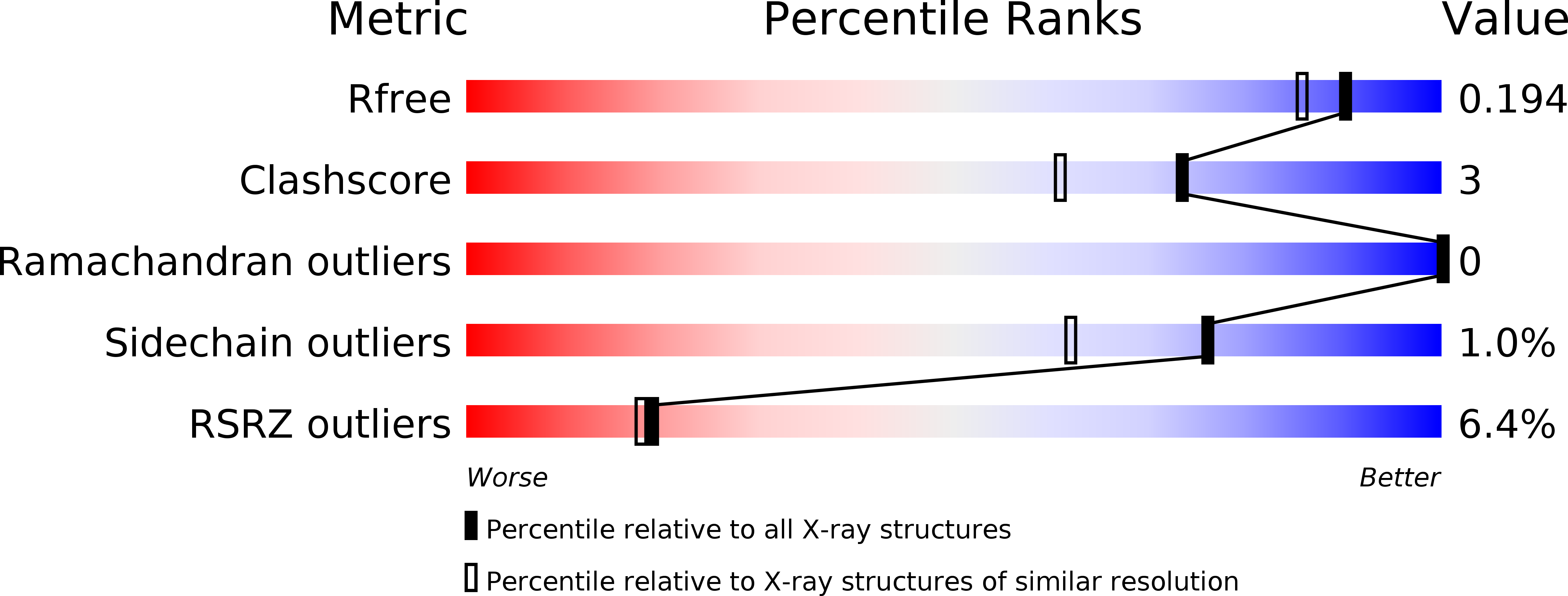
1.65 Å
R-Value Free:
0.19
R-Value Work:
0.15
R-Value Observed:
0.16
Space Group:
C 2 2 21
Macromolecular Entities
Structures with similar UniProt ID
Protein Blast
Polymer Type:polypeptide(L)
Molecule:Inactive Zymogen C11 Protease
Gene (Uniprot):BDI_3271
Chain IDs:A
Chain Length:369
Number of Molecules:1
Biological Source:Parabacteroides distasonis (strain ATCC 8503 / DSM 20701 / CIP 104284 / JCM 5825 / NCTC 11152)
Ligand Molecules
Primary Citation
X-ray structure of an inactive zymogen clostripain-like protease from Parabacteroides distasonis.
Acta Crystallogr D Struct Biol 75 325 332 (2019)
PMID: 30950403 DOI: 10.1107/S2059798319000809

Abstact

The clostripain-like (C11) family of cysteine proteases are ubiquitously produced by the vast majority of the bacterial strains that make up the human distal gut microbiome. Recent reports show that some C11 proteases promote host immune responses and bacterial pathogenesis, including the induction of neutrophil phagocytosis and the activation of bacterial pathogenic toxins, respectively. The crystal structure of distapain, the only C11 protease predicted within the genome of the commensal bacterium Parabacteroides distasonis, was determined in the inactive zymogen state to 1.65 Å resolution. This is the first C11 protease structure of a zymogen, and the structure helped to uncover key unique conformations among critical active-site residues that are likely to assist in preserving the inactive protease. His135, a member of the catalytic dyad, is repositioned approximately 5.5 Å from the orientation found in active C11 structures and forms a hydrogen bond to Asp180 and a π-stacking interaction with Trp133. The structure sheds light on the potential importance of Asp180 and Trp133, as these residues are highly conserved across C11 proteases. Structure elucidation of C11 proteases will ultimately help to identify new ways to chemically and/or biologically regulate this family of enzymes, which represent potential drug-discovery targets in microbiome-related gastrointestinal diseases.

Legend

Protein

Chemical

Disease

Primary Citation of related structures
Feedback Form
Name
Email
Institute
Feedback