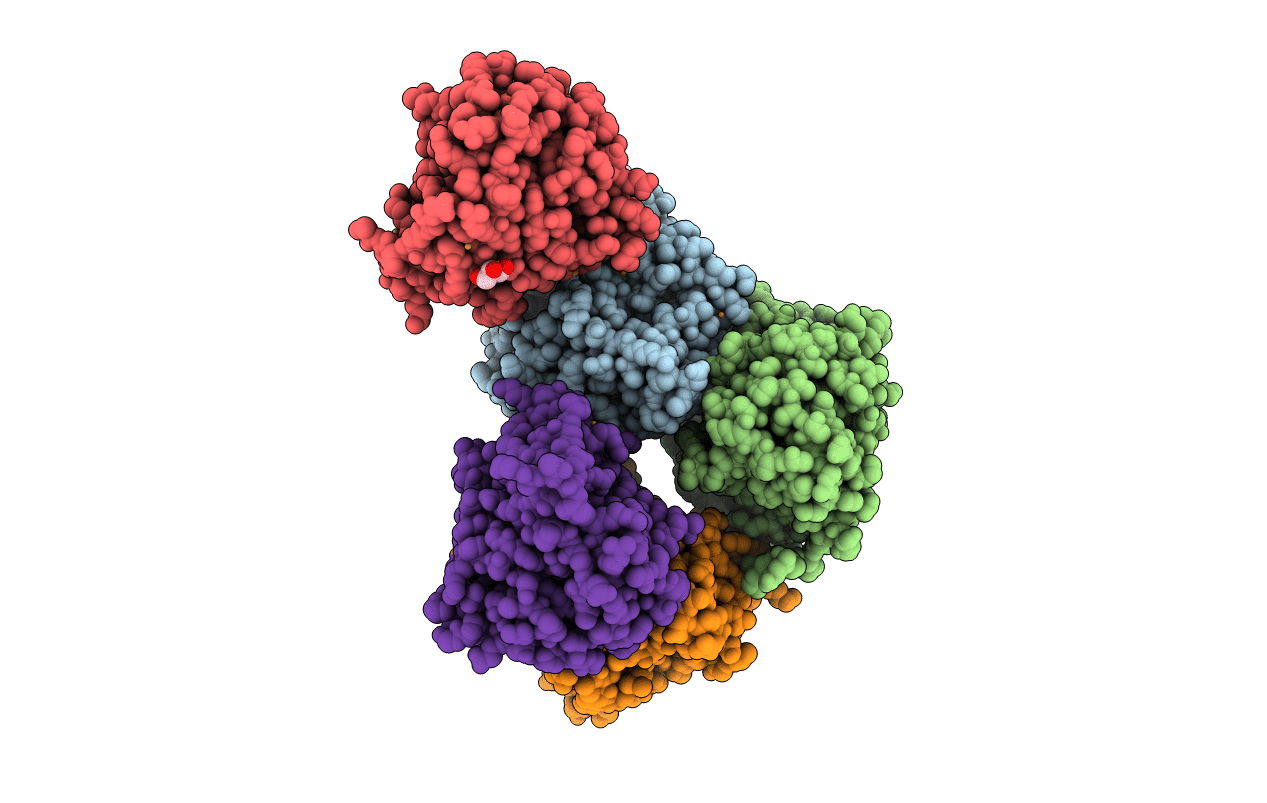
6MUJ image
Deposition Date 2018-10-23
Release Date 2019-02-27
Last Version Date 2023-10-11
Entry Detail
PDB ID:
6MUJ
Title:
Formylglycine generating enzyme bound to copper
Biological Source:
Source Organism:
Host Organism:
Method Details:
Experimental Method:
Resolution:
2.25 Å
R-Value Free:
0.24
R-Value Work:
0.20
R-Value Observed:
0.20
Space Group:
P 31 2 1
Macromolecular Entities
Structures with similar UniProt ID
Protein Blast
Polymer Type:polypeptide(L)
Molecule:Formylglycine-generating enzyme
Gene (Uniprot):SCO7548
Chain IDs:A, B, C, D, E
Chain Length:319
Number of Molecules:5
Biological Source:Streptomyces coelicolor
Primary Citation
Formylglycine-generating enzyme binds substrate directly at a mononuclear Cu(I) center to initiate O2activation.
Proc. Natl. Acad. Sci. U.S.A. 116 5370 5375 (2019)
PMID: 30824597 DOI: 10.1073/pnas.1818274116

Abstact

The formylglycine-generating enzyme (FGE) is required for the posttranslational activation of type I sulfatases by oxidation of an active-site cysteine to Cα-formylglycine. FGE has emerged as an enabling biotechnology tool due to the robust utility of the aldehyde product as a bioconjugation handle in recombinant proteins. Here, we show that Cu(I)-FGE is functional in O2 activation and reveal a high-resolution X-ray crystal structure of FGE in complex with its catalytic copper cofactor. We establish that the copper atom is coordinated by two active-site cysteine residues in a nearly linear geometry, supporting and extending prior biochemical and structural data. The active cuprous FGE complex was interrogated directly by X-ray absorption spectroscopy. These data unambiguously establish the configuration of the resting enzyme metal center and, importantly, reveal the formation of a three-coordinate tris(thiolate) trigonal planar complex upon substrate binding as furthermore supported by density functional theory (DFT) calculations. Critically, inner-sphere substrate coordination turns on O2 activation at the copper center. These collective results provide a detailed mechanistic framework for understanding why nature chose this structurally unique monocopper active site to catalyze oxidase chemistry for sulfatase activation.

Legend

Protein

Chemical

Disease

Primary Citation of related structures
Feedback Form
Name
Email
Institute
Feedback