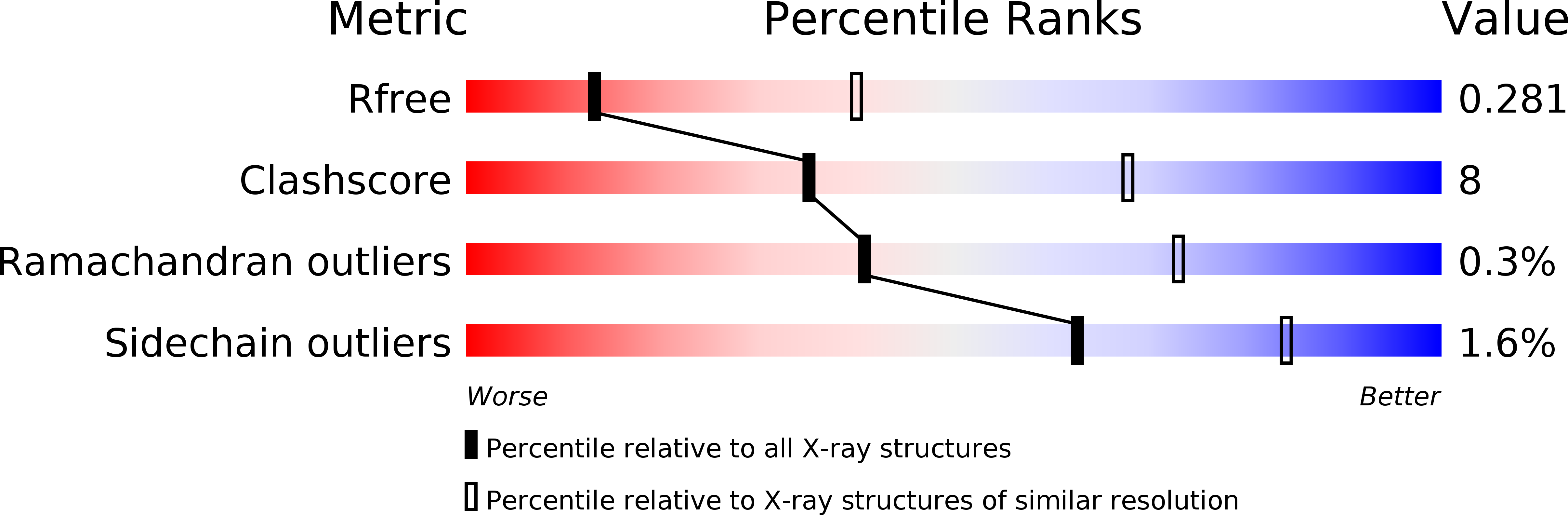
6MSU image
Deposition Date 2018-10-18
Release Date 2019-10-23
Last Version Date 2024-11-06
Entry Detail
PDB ID:
6MSU
Keywords:
Title:
Integrin alphaVBeta3 in complex with EETI-II 2.5F
Biological Source:
Source Organism:
Homo sapiens (Taxon ID: 9606)
Ecballium elaterium (Taxon ID: 3679)
Method Details:
Experimental Method:
Resolution:
3.11 Å
Space Group:
P 32 2 1
Macromolecular Entities
Structures with similar UniProt ID
Protein Blast
Polymer Type:polypeptide(L)
Molecule:Integrin alpha-V
Gene (Uniprot):ITGAV
Chain IDs:A
Chain Length:967
Number of Molecules:1
Biological Source:Homo sapiens
Structures with similar UniProt ID
Protein Blast
Polymer Type:polypeptide(L)
Molecule:Integrin beta-3
Gene (Uniprot):ITGB3
Chain IDs:B
Chain Length:695
Number of Molecules:1
Biological Source:Homo sapiens
Structures with similar UniProt ID
Protein Blast
Polymer Type:polypeptide(L)
Molecule:Engineered EETI-II 2.5F
Chain IDs:C
Chain Length:32
Number of Molecules:1
Biological Source:Ecballium elaterium
Primary Citation
Structural Basis of the Differential Binding of Engineered Knottins to Integrins alpha V beta 3 and alpha 5 beta 1.
Structure 27 1443 1451.e6 (2019)
PMID: 31353240 DOI: 10.1016/j.str.2019.06.011

Abstact

Targeting both integrins αVβ3 and α5β1 simultaneously appears to be more effective in cancer therapy than targeting each one alone. The structural requirements for bispecific binding of ligand to integrins have not been fully elucidated. RGD-containing knottin 2.5F binds selectively to αVβ3 and α5β1, whereas knottin 2.5D is αVβ3 specific. To elucidate the structural basis of this selectivity, we determined the structures of 2.5F and 2.5D as apo proteins and in complex with αVβ3, and compared their interactions with integrins using molecular dynamics simulations. These studies show that 2.5D engages αVβ3 by an induced fit, but conformational selection of a flexible RGD loop accounts for high-affinity selective binding of 2.5F to both integrins. The contrasting binding of the highly flexible low-affinity linear RGD peptides to multiple integrins suggests that a "Goldilocks zone" of conformational flexibility of the RGD loop in 2.5F underlies its selective binding promiscuity to integrins.

Legend

Protein

Chemical

Disease

Primary Citation of related structures
Feedback Form
Name
Email
Institute
Feedback