6MKQ image
Deposition Date 2018-09-26
Release Date 2019-01-30
Last Version Date 2024-11-13
Entry Detail
PDB ID:
6MKQ
Title:
Carbapenemase VCC-1 bound to avibactam
Biological Source:
Source Organism:
Vibrio cholerae (Taxon ID: 666)
Host Organism:
Method Details:
Experimental Method:
Resolution:
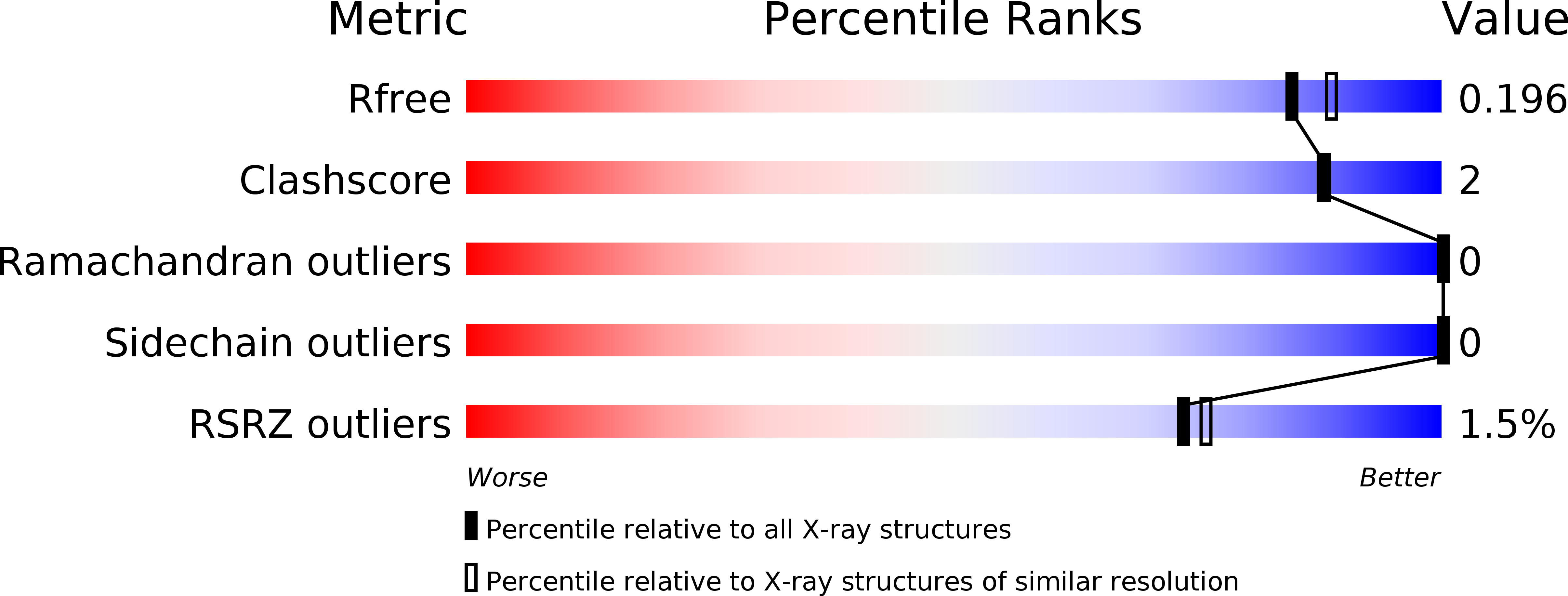
1.90 Å
R-Value Free:
0.19
R-Value Work:
0.15
R-Value Observed:
0.16
Space Group:
P 43 21 2
Macromolecular Entities
Structures with similar UniProt ID
Protein Blast
Polymer Type:polypeptide(L)
Molecule:Beta-lactamase
Gene (Uniprot):BC353_18910
Chain IDs:A
Chain Length:265
Number of Molecules:1
Biological Source:Vibrio cholerae
Ligand Molecules
Primary Citation
Molecular Basis for the Potent Inhibition of the Emerging Carbapenemase VCC-1 by Avibactam.
Antimicrob. Agents Chemother. 63 ? ? (2019)
PMID: 30782990 DOI: 10.1128/AAC.02112-18

Abstact

In 2016, we identified a new class A carbapenemase, VCC-1, in a nontoxigenic Vibrio cholerae strain that had been isolated from retail shrimp imported into Canada for human consumption. Shortly thereafter, seven additional VCC-1-producing V. cholerae isolates were recovered along the German coastline. These isolates appear to have acquired the VCC-1 gene (blaVCC-1) independently from the Canadian isolate, suggesting that blaVCC-1 is mobile and widely distributed. VCC-1 hydrolyzes penicillins, cephalothin, aztreonam, and carbapenems and, like the broadly disseminated class A carbapenemase KPC-2, is only weakly inhibited by clavulanic acid or tazobactam. Although VCC-1 has yet to be observed in the clinic, its encroachment into aquaculture and other areas with human activity suggests that the enzyme may be emerging as a public health threat. To preemptively address this threat, we examined the structural and functional biology of VCC-1 against the FDA-approved non-β-lactam-based inhibitor avibactam. We found that avibactam restored the in vitro sensitivity of V. cholerae to meropenem, imipenem, and ertapenem. The acylation efficiency was lower for VCC-1 than for KPC-2 and akin to that of Pseudomonas aeruginosa PAO1 AmpC (k2/Ki  = 3.0 × 103 M-1 s-1). The tertiary structure of VCC-1 is similar to that of KPC-2, and they bind avibactam similarly; however, our analyses suggest that VCC-1 may be unable to degrade avibactam, as has been found for KPC-2. Based on our prior genomics-based surveillance, we were able to target VCC-1 for detailed molecular studies to gain early insights that could be used to combat this carbapenemase in the future.

Legend

Protein

Chemical

Disease

Primary Citation of related structures
Feedback Form
Name
Email
Institute
Feedback